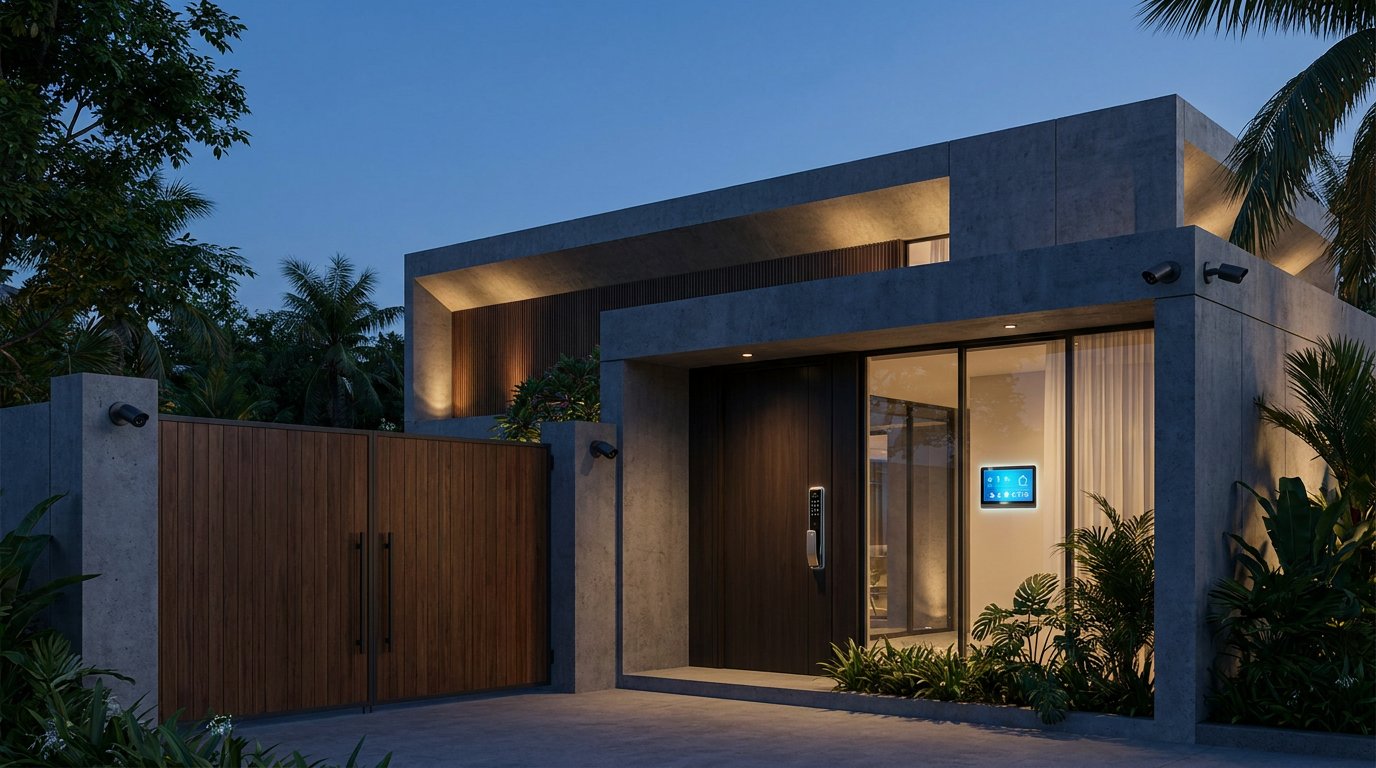
Integrating security & smart home for high-end villas is an inevitable trend in 2026, but many homeowners make mistakes that cause the system to operate inefficiently and incur costly repairs. From choosing incompatible devices to neglecting network security, this article highlights 7 common errors and solutions from experts at An Ninh Số.
Mistake 1: Choosing devices with incompatible protocols (Zigbee vs Z-Wave vs Matter)
Many homeowners buy smart home devices from different brands without checking the connection protocol, leading to a non-synchronized system. For example, a Zigbee door sensor cannot communicate directly with a Z-Wave controller without a multi-protocol hub.
Solution: Prioritize devices supporting the Matter standard (the newest protocol for 2025-2026, compatible with Apple HomeKit, Google Home, Amazon Alexa) or use a multi-protocol hub like the Aqara Hub M3 (supports Zigbee 3.0, Matter, Thread). The investment cost for a hub is around 3-5 million VND, saving tens of millions when replacing incompatible devices.
Mistake 2: Installing AI cameras in the wrong position, creating security blind spots
AI cameras for villas are often installed with a narrow field of view, overlooking sensitive areas like ground-floor windows, back garden paths, or garages. As a result, intruders can easily approach without detection.
A survey from An Ninh Số shows that 65% of high-end villas have at least 2-3 security blind spots after installation. Outdoor AI cameras like Hikvision AcuSense or Avigilon H6A should be arranged according to the principle: every 45° corner, covering the entire perimeter, combined with indoor cameras in hallways and staircases. The cost of adding 2-3 cameras to fix this is about 8-15 million VND.
Mistake 3: Neglecting network security for the smart home system
Many homeowners focus only on automation features, forgetting that an Internet-connected smart home system is a target for hackers. A weak Wi-Fi router, default passwords, or lack of a dedicated VLAN for IoT devices can compromise the entire villa.
Solution: Use a router supporting VLAN (like Ubiquiti UniFi or TP-Link Omada), separate the network for cameras and smart home devices. Regularly update firmware, enable two-factor authentication (2FA) for admin accounts. The cost of upgrading the router is about 5-10 million VND, much less than the damage from hacked cameras or smart locks. See more: Can villa smart homes be unhackable? 7 enterprise security layers for 2026.
Mistake 4: Not considering future expandability
Security and smart home systems for villas are often designed statically, without room for adding more devices (sensors, cameras, motorized blinds) after 1-2 years. This forces homeowners to replace the entire hub or controller when they want to upgrade.
Solution: Choose a scalable platform like Crestron CP3 (supports up to 100 devices) or Genetec Security Center (allows adding unlimited cameras). Design a central rack with 30-40% spare slots for future modules. The initial investment is 15-25% higher but saves 50-70% when expanding after 3 years.
Mistake 5: Choosing the wrong type of smart lock for the main gate and doors
Smart locks for villas are often chosen based on design (aesthetics) without considering durability, water/dust resistance (IP rating), and compatibility with the access control system. This results in locks failing quickly or not integrating with AI cameras.
Solution: Use fingerprint + RFID card locks with IP65 rating (like Suprema FaceLite) for the main gate, and smart locks supporting Apple HomeKey or Matter for interior doors. Avoid locks with only Bluetooth (short range, prone to disconnection). High-quality locks cost from 8-20 million VND each.
Mistake 6: Installing sensors in the wrong direction, reducing accuracy
PIR motion sensors, door sensors, or smoke detectors are often installed at the wrong angle, blocked by furniture, or placed near heat sources (air conditioners, stoves), causing constant false alarms.
Solution: Motion sensors should be installed at a height of 2-2.5m, at a 90° angle to the main movement direction. Door sensors should be installed on the top edge, at least 5mm away from the magnet. Smoke detectors should be placed 30cm from the ceiling, away from air conditioner vents. Checking and calibrating after installation reduces false alarms by 80%.
Mistake 7: Lack of synchronized automation scenarios between security and smart home
The security system (cameras, alarms) and smart home (lights, blinds, AC) operate independently without coordinated scenarios. For example, when a camera detects an intrusion, lights don't turn on automatically, blinds don't close, making it easy for intruders to operate.
Solution: Build scenes on a central platform: "Away Mode" — AI cameras activate, lights turn on randomly by schedule, blinds close at 10 PM. "Sleep Mode" — window sensors activate alarms, hallway lights turn off, AC lowers temperature. The cost of programming scenes is typically 5-10 million VND, depending on complexity.
Cost comparison table for fixing mistakes
| Mistake | Fix cost (million VND) | Cost-saving alternative solution |
|---|---|---|
| Incompatible devices | 15-30 | Use multi-protocol hub (3-5 million) |
| Camera wrong position | 8-15 | Thorough site survey before installation (free) |
| Weak network security | 5-10 | VLAN router + 2FA (3-7 million) |
| Not expandable | 20-50 | Design with spare slots (add 15-25% initially) |
| Wrong smart lock | 8-20 | Choose IP65 + Matter lock (10-15 million) |
| Sensor wrong direction | 3-8 | Recalibrate (free if DIY) |
| Lack of synchronized scenarios | 5-10 | Program basic scenes (2-5 million) |
Frequently asked questions about integrating security & smart home for villas
Should AI cameras and smart home be integrated on the same platform?
Yes, they should be integrated on a single platform like Crestron, Control4, or Genetec Security Center to synchronize security and automation scenarios. However, ensure the platform supports open protocols (ONVIF, RTSP, Matter) to avoid ecosystem lock-in. The comprehensive integration cost for a 300-500m² villa is about 150-300 million VND.
What is the average cost to fix integration mistakes?
Depending on the severity, the fix cost ranges from 15-50 million VND for basic errors (replacing hub, adding cameras, upgrading router). If the entire system must be replaced due to incompatibility, costs can reach 100-200 million VND. Investing correctly from the start saves 40-60% of the total cost of ownership.
How to check if a villa smart home system is secure?
Request the installer to provide a security test report (penetration test) for the network and IoT devices. Check if the router supports VLAN, WPA3, and firewall. Update the latest firmware for all devices. If you lack expertise, hire a network security audit service (cost 5-15 million VND per session).
Is it necessary to install smoke and fire detectors for a villa smart home?
Very necessary. A smart home system should integrate smoke detectors, CO detectors, and gas leak sensors to automatically turn off the stove, open emergency exits, and send alerts to your phone. These sensors should connect via Zigbee or Matter to function even without Internet. The additional cost is about 3-8 million VND for a 200-400m² villa.
Which protocol should I choose for a villa smart home: Zigbee, Z-Wave, or Matter?
Prioritize Matter (version 1.3 or later) for multi-platform compatibility, easy expansion, and better security. Zigbee 3.0 is still a good choice for sensors and lights (low cost, stable). Z-Wave is suitable for security systems due to low latency, but has fewer devices. Use a multi-protocol hub to utilize all three if needed.
Are you making mistakes integrating security & smart home for your villa? The technical team at An Ninh Số with over 10 years of experience will conduct a free site survey and advise on optimal solutions. Call the hotline 0796 700 777 or email [email protected] for support within 24 hours.