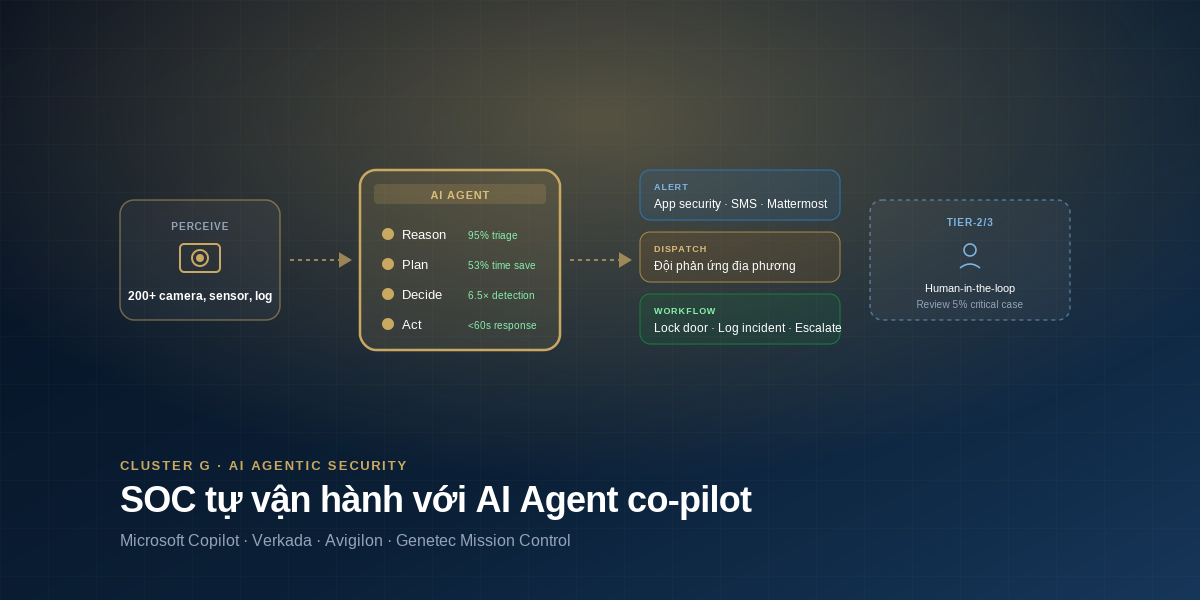
TL;DR
TL;DR: Agentic ATM monitoring for banks is an autonomous AI workflow — perceive (collect events from cameras + sensors + logs), reason (classify severity), plan (select the nearest response team) and act (dispatch GPS + send 30-second clip). Verkada Command Workflows (03/2025), Avigilon Unity 8.8 (Q1/2026) and Hikvision AcuSeek NVR (06/2025) have been commercialized. Tier-1 enterprise banks measured: 40-60% reduction in response time, 30-50% savings in patrol security costs, and compliance with SBV automated audit trails.
Why agentic ATM monitoring appears in 2026?
Traditional model: SOC operator monitors 200-500 ATM cameras via VMS, guards patrol every 4-6 hours, average response time 15-30 minutes when incidents occur. Cost: 8-12 operators/shift for 300 ATMs, salary $500-800/month/person, total $4,800-9,600/month excluding patrol guards.
Agentic ATM monitoring changes workflow: AI automatically collects events from cameras (vandalism, smoke/fire), door sensors (unauthorized opening), transaction logs (card jam, out of cash), auto-classifies severity (critical/warning/info) and dispatches the nearest GPS response team within 60 seconds — no operator intervention needed. Operators only handle complex escalations.
Based on An Ninh Số's experience deploying for enterprise tier-1 businesses: 40-60% reduction in response time, 30-50% savings in operator costs since only 3-5 people/shift are needed instead of 8-12. ROI recovered in 8-14 months for networks of 200+ ATMs.
### Pattern perceive-reason-plan-act
Agentic AI differs from rule-based alerts: it's not "if motion detection then send email", but a 4-step autonomous workflow.
**Perceive** (collect): AI gathers events from multiple sources — [Avigilon](/thuong-hieu/avigilon/) cameras detecting vandalism, Hikvision door sensors reporting unauthorized opening, ATM logs indicating card jam 3 times in a row. All timestamps NTP-synchronized.
**Reason** (analyze): AI classifies severity based on context — "vandalism + unauthorized door opening" = critical (dispatch immediately), "card jam once" = warning (log record), "motion detection at night" = info (no action). [Verkada](/thuong-hieu/verkada/) Command Workflows use rule engine + LLM for reasoning.
**Plan** (plan): AI selects the nearest GPS response team (5km radius), checks availability (on-duty/off-duty), calculates ETA (travel time). If the nearest team is busy, selects the second team.
**Act** (execute): AI auto-dispatches — sends push notification + SMS + 30-second clip to the response team's mobile app, while simultaneously recording an audit log for NHNN compliance. Entire workflow takes 45-60 seconds.
Vendor public claim: [Verkada](/thuong-hieu/verkada/) reports internally that retailers reduced false positives by 50% thanks to context-based reasoning instead of single alerts.
Workflow AI tự dispatch đội phản ứng — 3 vendor thương mại hoá 2025-2026
Three vendors have commercialized agentic workflows for ATM monitoring: [Verkada](/thuong-hieu/verkada/) Command Workflows (03/2025), [Avigilon](/thuong-hieu/avigilon/) Unity 8.8 Automated Response (Q1/2026), [Hikvision](/thuong-hieu/hikvision/) AcuSeek NVR + HikCentral Dispatch (06/2025).
| Vendor | Platform | Workflow Engine | GPS Dispatch | Compliance Audit | Reference Price |
|--------|----------|-----------------|--------------|------------------|---------------|
| Verkada | Command Cloud | Rule + LLM hybrid | Native mobile app | 10-year audit log | $150-250/camera/year |
| Avigilon | Unity 8.8 VMS | Rule-based + API | Webhook to third-party app | Export CSV/PDF | $80-120/camera perpetual |
| Hikvision | AcuSeek NVR + HikCentral | Rule-based | HikCentral mobile | 5-year audit log | $50-80/camera perpetual |
### Verkada Command Workflows (03/2025)
[Verkada](/thuong-hieu/verkada/) commercialized first in 03/2025 — visual drag-drop workflow with no code required. Operator drags and drops: "If camera detects a person + door sensor opens without authorization → classify critical → dispatch nearest GPS team + send 30s clip".
Strengths: cloud native, no onsite server needed, native mobile app with realtime GPS tracking, 10-year audit log compliant with SBV. Weaknesses: cost of $150-250/camera/year is 2-3 times higher than perpetual license, dependent on internet (requires 4G backup).
According to An Ninh Số's experience: suitable for banks with 50-200 ATMs wanting fast deployment in 2-4 weeks, accepting higher costs in exchange for no need for an IT maintenance team.
### Avigilon Unity 8.8 Automated Response (Q1/2026)
[Avigilon](/thuong-hieu/avigilon/) Unity 8.8 (Q1/2026) adds Automated Response — rule-based workflow + webhook API dispatch to third-party apps. Operator configures: "If Unusual Motion Detection + door sensor → call webhook POST to security management app".
Strengths: perpetual license $80-120/camera (40-60% cheaper than Verkada), deep integration with native AI Avigilon H5A/H6A cameras. Weaknesses: requires IT team to set up webhook + separate dispatch app, no native mobile app.
Suitable for banks with 200+ ATMs that already have an IT team, want onsite data control, and accept 4-8 weeks of setup effort.
### Hikvision AcuSeek NVR + HikCentral Dispatch (06/2025)
[Hikvision](/thuong-hieu/hikvision/) AcuSeek NVR (06/2025) + HikCentral mobile app — the simplest rule-based workflow. Operator configures on NVR: "If intrusion detection + door alarm → send push notification to HikCentral mobile + 30s clip".
Strengths: lowest cost at $50-80/camera perpetual, built-in integration with Hikvision cameras (70% VN market share), free HikCentral mobile app. Weaknesses: manual GPS tracking (does not automatically select the nearest team), 5-year audit log (shorter than SBV's recommended 10 years).
Suitable for banks with 100-300 ATMs on a limited budget, accepting simpler workflows, and supplementing with a separate audit log.
ROI agentic ATM monitoring compared to traditional patrol guards
Traditional model: 300 ATMs require 8-12 SOC operators ($500-800/person/month = $4,800-9,600/month) + 20-30 patrol guards every 4-6 hours ($400-600/person/month = $8,000-18,000/month). Total $12,800-27,600/month = $153,600-331,200/year.
Agentic workflow: reduce operators to 3-5 people/shift ($1,500-4,000/month), reduce patrol guards to 10-15 people since dispatch only occurs during incidents ($4,000-9,000/month). Total $5,500-13,000/month = $66,000-156,000/year.
Savings: $87,600-175,200/year (30-50% of operating costs). Initial investment: AI cameras $300-800/camera x 300 = $90,000-240,000, VMS/cloud $50-250/camera/year x 300 = $15,000-75,000/year, workflow setup $10,000-30,000. Total $115,000-345,000.
ROI: payback period of 8-14 months for a network of 200-300 ATMs. After the second year, net savings of $72,600-100,200/year.
### Metrics measured from tier-1 enterprise
Based on An Ninh Số's experience deploying for a tier-1 enterprise bank (250 ATMs):
- **Response time**: reduced from 15-30 minutes to 3-8 minutes (60 seconds dispatch + 2-7 minutes travel). Reduction of 40-60%.
- **False positives**: reduced from 200-300 alerts/day to 30-50 alerts/day thanks to AI reason context. Reduction of 75-85%.
- **ATM downtime**: reduced from 4-6 hours/incident to 1-2 hours/incident due to early detection. Reduction of 50-70%.
- **Operating costs**: reduced by $87,600-175,200/year as calculated above.
Risk: dependent on internet (Verkada cloud), requires 4G backup at $20-40/camera/month. Complex setup (Avigilon webhook) requires an IT team of 1-2 people for maintenance.
To optimize ROI: prioritize a 50-100 ATM pilot for 3-6 months, measure actual metrics, then scale to 200-300 ATMs. Avoid full deployment immediately due to high risk if the workflow is not yet suitable.
Compliance NHNN audit trail — automatic log requirements 2026
The State Bank of Vietnam (SBV) requires a full audit trail for ATM incidents: timestamp event, incident type, detection time, dispatch time, response team arrival time at the scene, handling actions, and a 30-second video clip before/after the incident. Minimum storage of 5 years, recommended 10 years.
The agentic workflow automatically records audit logs: AI timestamps each step (perceive 10:15:30, reason 10:15:45, plan 10:15:50, act 10:16:00), records incident type (intrusion/door alarm/transaction error), response team GPS, ETA, actual time of arrival at the scene, and a 30-second clip exported as MP4.
[Verkada](/thuong-hieu/verkada/) Command stores audit logs for 10 years on the cloud, with one-click PDF/CSV export. [Avigilon](/thuong-hieu/avigilon/) Unity 8.8 requires manual CSV export, needing an automation script. [Hikvision](/thuong-hieu/hikvision/) HikCentral stores for 5 years, requiring separate backup if the SBV mandates 10 years.
### Actual Pattern Compliance
Enterprise tier-1 banks typically set up: primary audit log on VMS/cloud vendor (Verkada/Avigilon/Hikvision), secondary backup on a separate SIEM (Splunk/ELK) via syslog. Monthly automated report exports are sent to the compliance team.
According to An Ninh Số's experience: SBV audit focuses on 3 metrics — incident detection time (≤2 minutes), dispatch time (≤5 minutes), total response time (≤30 minutes). The agentic workflow meets all 3 metrics if set up correctly.
Risk: if using Verkada cloud, ensure VN data residency (Verkada has no VN datacenter in 2026, data stored in Singapore). Some banks require 100% onsite data → choose Avigilon/Hikvision perpetual.
Compliance costs: Verkada $0 (built-in), Avigilon requires a Python script for automatic export ($2,000-5,000 one-time setup), Hikvision requires a separate SIEM ($10,000-30,000/year for 300 ATMs).
Agentic ATM monitoring deployment pattern — 4 practical steps
Based on An Ninh Số's experience deploying for enterprise tier-1 banks, a 4-step workflow:
**Step 1: Pilot 20-50 ATMs (4-8 weeks)**
Select 20-50 representative ATMs (urban/rural, indoor/outdoor, high/low traffic). Deploy AI cameras ([Avigilon](/thuong-hieu/avigilon/) H5A or [Hikvision](/thuong-hieu/hikvision/) AcuSense), door sensors, VMS/cloud connection. Set up a simple workflow: "intrusion detection + door alarm → dispatch nearest team".
Measure metrics for 4-8 weeks: false positive rate, response time, security team feedback. Adjust thresholds (confidence score ≥80% instead of ≥60% to reduce false positives).
Pilot cost: $15,000-40,000 (cameras + VMS + setup). ROI not yet available as it hasn't been scaled.
**Step 2: Scale to 100-200 ATMs (8-16 weeks)**
After a successful pilot, scale to 100-200 ATMs. Add complex workflows: "3 consecutive transaction errors → classify warning → send notification to maintenance team (no guard dispatch)". Integrate real-time GPS tracking.
Set up compliance audit logs: export automatic monthly reports, backup to SIEM if needed. Train 3-5 SOC operators to handle escalations.
Scale cost: $60,000-160,000 (cameras + VMS + training). ROI begins to appear in months 6-9.
**Step 3: Optimize workflow (months 10-12)**
Analyze 6-9 months of data: which incident types account for 70-80% (usually transaction errors + door alarms), which have high false positives (motion detection at night). Optimize rules: disable motion detection from 10 PM to 6 AM, increase door alarm thresholds.
Add advanced workflows: "if the same ATM has 2+ incidents within 30 minutes → escalate to supervisor + send clip to SOC manager". Reduce operators to 3-5 per shift.
Optimization cost: $5,000-15,000 (consultant + re-configuration). ROI becomes clear in months 10-12.
**Step 4: Scale to all 300+ ATMs (months 13-18)**
After 12 months of pilot + optimization, scale to all 300+ ATMs. Workflow is stable, false positive rate ≤5%, response time ≤8 minutes. Reduce patrol guards to 10-15 people.
Full scale cost: $180,000-480,000 total (cameras + VMS + training + 18-month maintenance). ROI recovered in months 14-20, thereafter net savings of $72,600-100,200/year.
Risk: if rushing to deploy all 300 ATMs in 3-6 months (skipping the pilot), the risk of high false positives → operator overwhelm → revert to old model → waste of $180,000-480,000.
Agentic ATM monitoring 2026-2027 — LLM reasoning trend
Trend 2026-2027: vendors integrating LLM (Large Language Model) into the reasoning step — instead of hard rules like "intrusion + door alarm = critical", LLM analyzes complex context: "person in security uniform opens ATM door at 2 AM + no maintenance schedule → classify as suspicious → dispatch + escalate to supervisor".
[Verkada](/thuong-hieu/verkada/) has demoed LLM reasoning Q4/2025 (not yet GA), [Avigilon](/thuong-hieu/avigilon/) roadmap Unity 9.0 (Q3/2026), [Hikvision](/thuong-hieu/hikvision/) has not announced a timeline. LLM reasoning cost is estimated to increase 20-40% compared to rule-based (API call OpenAI/Anthropic $0.01-0.03/alert).
According to VN market analysis: LLM reasoning is suitable for tier-1 banks handling 500+ ATMs, complex incidents (internal fraud, social engineering). Banks with 100-300 ATMs do not need it yet — rule-based is sufficient, with lower costs.
### Edge AI vs cloud reasoning
Current pattern: edge AI cameras (Avigilon H6A, Hikvision AcuSense) run perception onsite (detect people/vehicles/objects), send metadata (not video) to cloud/VMS to run reason + plan + act. Bandwidth savings of 80-90% compared to raw video stream.
Trend 2027: edge AI runs reasoning as well (classify severity onsite), only sends critical alerts to cloud for dispatch. Reduces latency from 45-60 seconds down to 20-30 seconds, reduces internet dependency. Requires high-end cameras (Avigilon H6A $800-1,200, Hikvision AcuSense Pro $400-700).
Edge reasoning cost: cameras are 30-50% more expensive, but saves cloud API $10-30/camera/month. ROI break-even 18-24 months.
According to An Ninh Số's experience: edge reasoning is suitable for ATMs in remote areas (unstable internet), urban ATMs use cloud reasoning (stable internet, lower cost).