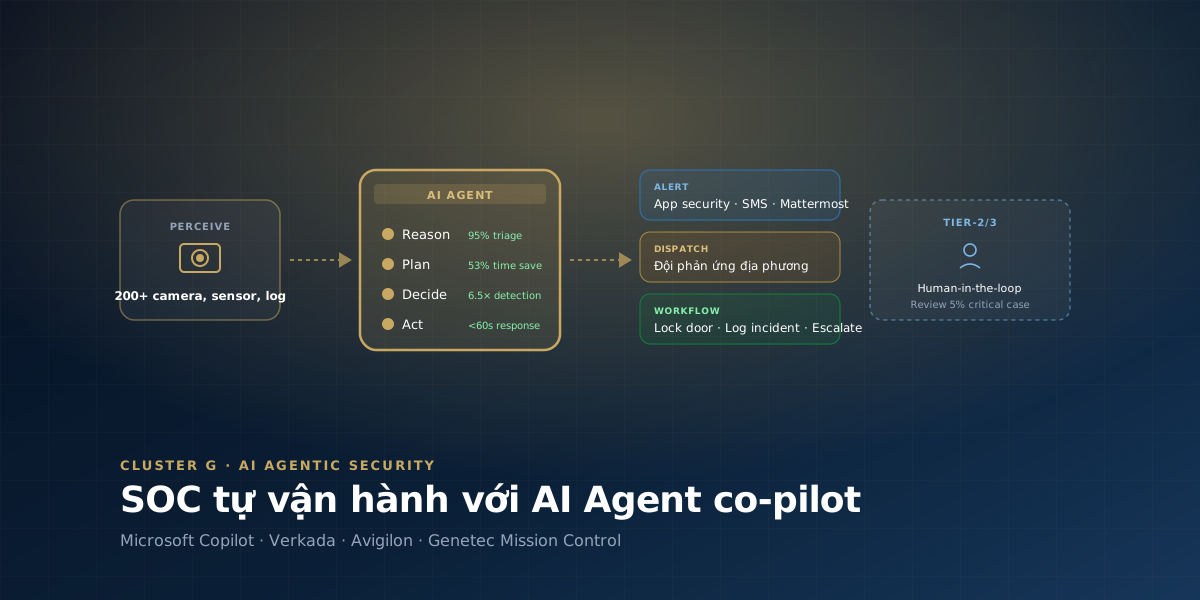
AI Agent in security is an AI architecture with 4 capabilities — perceive (view cameras), reason (analyze situations), plan (develop action plans), and act (execute workflows). Unlike traditional AI tag-and-alert systems that only detect and notify, AI Agent autonomously synthesizes multi-system events and escalates to the right person. Microsoft Security Copilot Agents (03/2025) pioneered in cyber-security: Phishing Triage Agent detects malicious alerts 6.5x more, with 77% accuracy, freeing up 53% of analyst time. In physical security, Verkada AI-Powered Alerts (09/2024), Avigilon Visual Alerts (09/2025), and Genetec Mission Control are deploying Agentic capabilities. The lesson from Amazon Just Walk Out (4/2024 shutdown at Fresh stores, still requiring ~1,000 Indian reviewers) confirms: human-in-the-loop is a default requirement for any serious autonomous SOC deployment.
AI Agent for Security Surveillance: From Recording Cameras to Self-Operating SOC 2026
AI Agent in security is an AI architecture capable of perceiving, reasoning, planning, and acting — not just tag-and-alert like older-generation AI cameras. Microsoft Security Copilot Agents (3/2025) is the first benchmark in cyber-security with 6.5x detection and 53% time saving. In physical security, Avigilon, Verkada, and Genetec are pushing Agentic capabilities — but a full autonomous SOC still requires human-in-the-loop after the Amazon Just Walk Out lesson.
TL;DR
The concept of "AI Agent" has gone viral across all forums since ChatGPT and Claude became popular in late 2023. In the security context, the definition is more specific: **An AI Agent is a system with 4 capabilities connected into an autonomous workflow — perceive, reason, plan, act**.
- **Perceive**: view multiple cameras, read multiple sensors, collect logs from multi-systems simultaneously
- **Reason**: reason about the situation — is this an emergency or normal, is it related to a previous event, should it be cross-referenced with KSRV data
- **Plan**: plan the action — who to call, which level to notify, what workflow to trigger
- **Act**: execute — send notification, dispatch response team, lock doors, log incident, call security
The difference from previous-generation AI lies in the reason and plan steps. [Hikvision DeepinMind NVR](/thuong-hieu/hikvision/) and [Dahua](/thuong-hieu/dahua/) WizMind Video Metadata 2.0 are **AI tag-and-alert** — detecting objects ("a person wearing a mask") and alerting via fixed rules. An AI Agent understands context: "a person wearing a mask has been standing too long in front of an ATM at 11 PM, at the same time a car is blocking the emergency exit — escalate with high priority to the local response team".
In cyber-security, **Microsoft Security Copilot Agents** (announced 03/2025) is the first commercial benchmark — 6 Microsoft agents + 5 partner agents (Tanium, OneTrust, ...) autonomously handle phishing triage, vulnerability assessment, identity threat. The Phishing Triage Agent claims to detect malicious alerts **6.5x more** than traditional approaches, with **77% accuracy**, freeing up **53% of Tier-1 analyst time**.
In physical security, Agentic capabilities are at an earlier stage — primarily natural-language search and auto-alert generation. Verkada, Avigilon, Genetec are pushing hard in 2024-2025 but no vendor yet claims "full autonomous".
A traditional Security Operation Center (SOC) has a 3-tier staffing structure:
- **Tier-1 analyst** on duty 24/7, triage alerts, collect events, assess false positives
- **Tier-2 investigator** investigates root cause, synthesizes threat intelligence
- **Tier-3 incident responder + manager** coordinates response, makes escalation decisions
A typical enterprise SOC requires **5-7 staff × 3 shifts = 15-21 people just for Tier-1**, not including high burnout costs due to alarm fatigue (Tier-1 sifts through thousands of alerts per shift, 95-98% are false positives).
**Autonomous SOC** inverts this structure. AI Agent handles the majority of Tier-1 — triages 95% of alerts, correlates events, filters false positives based on historical patterns. Humans focus only on Tier-2 and Tier-3, where judgment and experience are needed.
Real economic math for Vietnamese enterprises deploying an in-house SOC:
- **Traditional SOC** 3 shifts × 5 Tier-1 analysts × 25 million VND/person/month = **~375 million/month for Tier-1 staffing**
- **Autonomous SOC** AI Agent + 1-2 Tier-1 supervisors per shift (monitoring AI) ≈ **120-150 million/month** + $30-50K/year license platform = **~250-300 million/month total**
- **Save 25-35% in costs** + **increase 24/7 coverage without burnout**, **reduce 30-50% alarm fatigue** (Milestone reports in traffic context), accelerate investigation speed
Important note: the above figures only apply when volume is large enough — minimum 100+ cameras × 30+ KSRV doors × 5+ branches or 1 grade-A building. Enterprises below that scale are typically more effectively served by managed SOC service or Tier-1 outsourcing.
[An Ninh Số offers the GP6 Total Management package](/giai-phap/quan-ly-tong-the/) integrating these Agentic capabilities for enterprise customers — from SOC design to deployment and operation.
### Microsoft Security Copilot Agents — cyber-security benchmark
Announced in March 2025 with the first Phishing Triage Agent, expanded in April 2025 to 6 Microsoft agents + 5 partner agents (Tanium, OneTrust, ...) in preview stage. Available for Microsoft 365 E5 customers. Published metrics:
- Phishing Triage Agent: detects malicious alerts **6.5x more** than the old approach
- Accuracy: **77%** on internal Microsoft benchmark
- Frees up **53% of Tier-1 analyst time**
Uses GPT-4 and Microsoft proprietary LLM. This is a reference for all physical security vendors — indicating that the Agentic pattern is already working at enterprise scale.
### Verkada AI-Powered Search + Alerts — cloud physical security
[Verkada](/thuong-hieu/verkada/) launched **AI Search** in May 2024, expanded with **AI-Powered Alerts** in September 2024. Uses VLM CLIP-based (multi-billion parameter), cloud processing with pre-computed embeddings for fast real-time queries.
Agentic Workflow: AI automatically generates alerts based on natural-language rules (e.g., "alert me if someone stands in front of the ATM for more than 5 minutes after 10 PM") — no hard-coded rules required. Cloud-native, suitable for multi-branch chains that don't want to maintain on-site servers.
### Avigilon Unity Video 8.7 Visual Alerts — on-premise GenAI
[Avigilon](/thuong-hieu/avigilon/) released Visual Alerts in Unity Video 8.7 on **September 18, 2025**, the first on-premise GenAI feature allowing alert creation via natural-language prompts. Deployed through Avigilon AI Appliance 2X — server-side analytics + GenAI processing.
Unlike Verkada, Avigilon runs on-premise, suitable for banks and FDI with data sovereignty requirements in Vietnam.
### Genetec Mission Control — workflow automation cross-system
[Genetec](/thuong-hieu/genetec/) Mission Control differs in segment: it is an **incident management + decision support system** running on Genetec Security Center. Aggregates events via access control + video + alarm + intrusion + BMS + IoT into a single workflow.
Mission Control's Agentic capability lies in workflow automation: arm zone, change incident state, dispatch response teams, send email/SMS, trigger alarm — all without human intervention across individual software. 2024-2025 updates include performance enhancements and mobile incident procedures.
**Note for differentiation**: Mission Control is not a VLM — it does not understand free-text video queries. This is rule-based workflow automation. Avigilon and Verkada are stronger in VLM search, Genetec is stronger in cross-system orchestration. Large enterprise customers typically need both capabilities, not a choice between them.
### Use case 1: Ngân hàng giám sát ATM 24/7 autonomous
A Vietnamese bank with 200-500 ATMs distributed nationwide. Traditional pattern: ATM guards or patrol teams respond to calls. Agentic pattern 2026:
- AI Agent monitors each ATM 24/7, detecting 30+ patterns: loitering too long, face covering, people in fake protective gear, vehicles blocking emergency exits, physical ATM incidents
- Upon detection — agent automatically gathers events (camera + tamper sensors + ATM transaction logs), classifies severity, escalates to local response team within 60 seconds
- Tier-2 investigator only reviews pre-classified alerts, decides whether to call authorities or wait for internal response
### Use case 2: Toà nhà hạng A unified incident response
A 30+ floor building with 60+ tenants, 4,000 people entering/exiting daily — security operations must synchronize cameras + KSRV + fire alarms + elevators + parking lot. Typical Genetec Mission Control: when a fire incident is detected, agent automatically locks doors according to evacuation routes, overrides elevators to ground floor, alerts tenants via multi-channel (SMS + email + audio PA), dispatches response team — all within under 90 seconds.
### Use case 3: Nhà máy FDI tích hợp với SAP/HRM
A factory with 1,500+ workers, 3 shifts, 22 access control doors, integration with SAP and HRM. Agentic pattern: AI Agent cross-references KSRV logs + cameras + ERP to detect anomalies — workers entering R&D area not on shift, exiting with large assets without approval, shift records not matching timekeeping. Agent automatically creates cases in HRM platform for HR review instead of detecting issues at month-end via audit.
### Use case 4: Chuỗi bán lẻ multi-CN [BriefCam](/thuong-hieu/briefcam/) integration
A chain of 50-100 branches faces scaling challenges: cannot have 100 Tier-1 security teams. Agent processes via BriefCam Review + Respond — detects sweethearting, walk-around theft, abnormal patterns at checkout counters — aggregates events through central VMS, escalates to district manager overseeing 5-10 branches. Saves 70-80% security personnel compared to traditional pattern of 2-3 guards per branch.
**Should deploy** if the business has 1 of 3 characteristics:
- Enterprise scale: 100+ cameras × 50+ KSRV doors × 5+ branches or 1 Grade A building
- Requires fast compliance forensic: banks (SBV Circular), US-EU FDI (SOX, GDPR audit)
- Already has an internal SOC with 5+ Tier-1 analysts and is facing burnout / high personnel cost issues
**Should not deploy** if:
- SMB or standalone enterprise — AI Agent platform cost has no ROI
- No existing VMS/KSRV enterprise infrastructure — Agentic requires deep data integration, not a bolt-on
- Current security team lacks technical personnel to monitor AI Agent (still needs human-in-the-loop)
- Strong data sovereignty requirements — most vendors are cloud-based (Verkada, Microsoft Copilot) storing data abroad
**Practical approach steps**:
1. **60-90 day Pilot** with 16-32 cameras at 1 centralized branch — specifically measure false positive rate, time from alert to response, reliability of agent decision
2. **Year 1**: Deploy Agentic capability for 1-2 most important use cases (24/7 ATM or unified incident response) — don't try to do everything
3. **Year 2-3**: Gradually expand when ROI is measured and the operations team becomes familiar with the human-in-the-loop pattern
An Ninh Số recommends **not forcing "full autonomous" in the first 12 months**. The realistic pattern is **co-pilot** — AI handles 80% of repetitive work, humans focus on 20% of cases requiring judgment. This is also Microsoft's conclusion after 1 year of deploying Security Copilot Agents.
**1. Hallucination from VLM-based agents.** Any AI Agent processing video via VLM (Verkada, Avigilon Visual Alerts) inherits the hallucination problem of the underlying VLM — the agent may "guess" the wrong action context and escalate false positive alerts. Verkada itself recommends human review for critical alerts — this is not a vendor flaw but a technological limitation as of 2026.
**2. Privacy + compliance.** Agents process video frames through large models — if hosted on foreign clouds (Verkada US, Microsoft global), passing GDPR / Vietnam Decree 13/2023 / China PIPL audits becomes difficult. Data-sensitive enterprises should prioritize on-premise solutions (Avigilon, Genetec, [Milestone](/thuong-hieu/milestone-systems/) Hafnia self-host).
**3. Weak multilingual support for Vietnamese.** Microsoft Security Copilot Agents support Vietnamese for input, but response insights remain heavily English-oriented. Verkada AI Search has not been benchmarked for Vietnamese. Vietnamese enterprises need internal workflows to translate queries VN→EN before feeding them into the agent — increasing deployment complexity.
**4. Cost — VLM-grade GPUs are expensive.** Avigilon AI Appliance 2X ~$15,000-25,000/server per site. Verkada cloud subscription $300-500/camera/year, scaling to 100 cameras = $30,000-50,000/year ongoing. Vietnamese system integrators are still hesitant to invest in this hardware when customers are not yet familiar with the SaaS hardware model.
**5. Lesson from Amazon Just Walk Out (04/2024).** Amazon shut down Just Walk Out for Amazon Fresh full-size stores (retaining it only in small Amazon Go stores) after discovering that the "autonomous" AI system still required approximately **1,000 reviewers in India** as a human-in-the-loop to ensure transaction accuracy. The general lesson for any autonomous SOC deployment: **do not set a "100% automation" KPI for year 1**. The realistic pattern is 70-80% AI self-processing + 20-30% human review — and this pattern is NOT problematic, as long as the overall ROI remains positive.
This co-pilot pattern was also confirmed by Microsoft in its 1-year Security Copilot report: 53% analyst time saved — not 100% replacement. AI Agents are tools to augment human capabilities, not replace them.