Autonomous SOC is a Security Operation Center architecture where AI Agents handle the majority of Tier-1 tasks — triage alerts, assess false positives, correlate events — freeing up personnel to focus on Tier-2 and Tier-3 tasks that require judgment. Microsoft Security Copilot Agents (3/2025) is the first benchmark in cyber-security, with the Phishing Triage Agent achieving 6.5x detection and 53% time savings for analysts. In physical security, vendors such as Genetec Mission Control, Avigilon Visual Alerts, and Verkada AI-Powered Alerts are advancing Agentic capabilities. The economic math: a traditional SOC costs ~375 million VND/month for 5 Tier-1 analysts × 3 shifts; an Autonomous SOC reduces this to ~250-300 million/month (saving 25-35%) with 24/7 coverage and no burnout. The lesson from Amazon Just Walk Out (4/2024 shutdown of ~1,000 Indian reviewers) confirms: human-in-the-loop is the default requirement.
Autonomous SOC: When AI operates the Security Operation Center instead of humans in 2026
A traditional SOC requires 5-7 personnel × 3 shifts = 15-21 people just for Tier-1. Autonomous SOC reduces Tier-1 staffing by 60% with AI Agent handling 95% of triage + alarm fatigue reduced by 30%. Microsoft Security Copilot Agents (3/2025) is the cyber-security benchmark with 6.5x detection and 53% time saving. In physical security, Genetec Mission Control + Avigilon Visual Alerts + Verkada AI-Powered Alerts are being deployed. Vietnam adoption: large enterprises pilot in 2025-2026, expected scale in 2027.
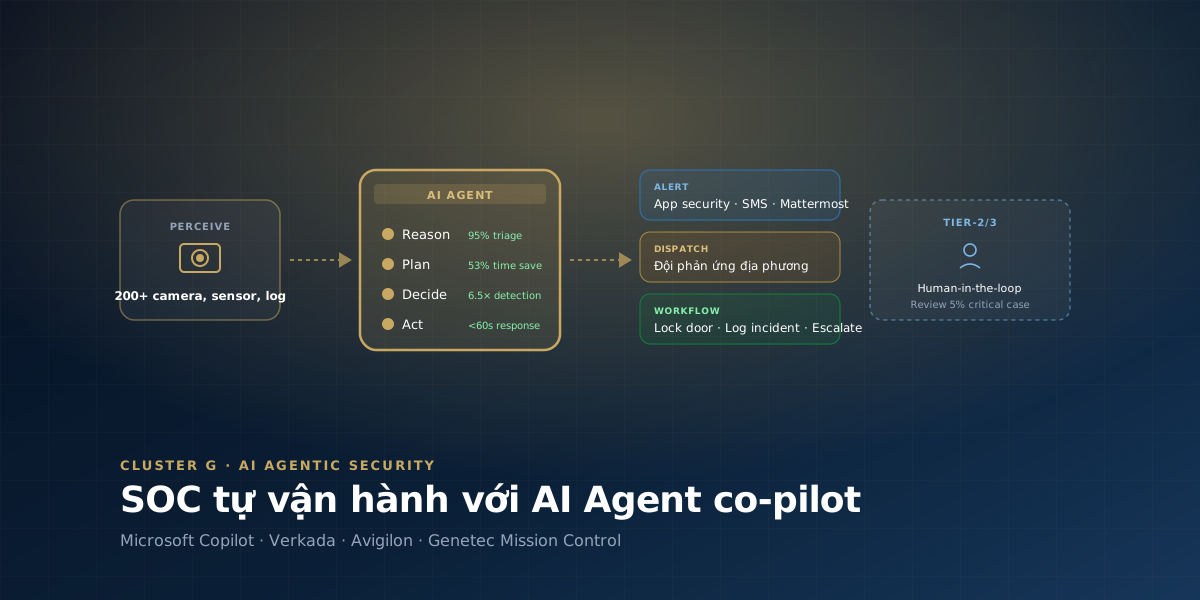
TL;DR
The Security Operation Center (SOC) of a large enterprise has a 3-tier personnel structure:
- **Tier-1 analyst** on duty 24/7, triage alerts, collect events, assess false positives — repetitive, exhausting work
- **Tier-2 investigator** investigates root causes, synthesizes threat intelligence
- **Tier-3 incident responder + manager** coordinates response, makes escalation decisions
A typical enterprise SOC requires **5-7 personnel × 3 shifts = 15-21 people just for Tier-1**. This is the largest cost and the weakest link:
- Tier-1 analysts face **alarm fatigue** — sifting through thousands of alerts per shift, 95-98% are false positives. After 3-6 months, the rate of missing critical alerts spikes.
- Tier-1 turnover rate is high at 30-50%/year — continuous recruitment and training
- The "3 rotating shifts" pattern on the same personnel pool leads to burnout, especially during night shifts
### Traditional SOC cost math for Vietnamese enterprises
In-house SOC for an enterprise with 100+ cameras × 50+ KSRV doors × 5+ branches:
- **Tier-1 analyst**: 5 people × 3 shifts × 25 million VND/person/month = **375 million VND/month** (4.5 billion VND/year)
- **Tier-2 investigator**: 2-3 people × 35 million VND = 70-105 million VND/month
- **Tier-3 manager**: 1-2 people × 50 million VND = 50-100 million VND/month
- **Software platform** (VMS + KSRV + SIEM): 100-200 million VND/month
- **Total in-house SOC**: ~600-800 million VND/month = 7-10 billion VND/year
This is why many Vietnamese enterprises outsource SOC — but outsourcing also has issues: slow response time, lack of specific business context.
### The core problem of Autonomous SOC
Inverting the Tier-1 structure: **AI Agent handles 95% of repetitive work**, humans only focus on the 5% of cases requiring judgment. This is not "AI replacing humans" — it is "AI augmenting human capability" following the co-pilot pattern.
Microsoft announced **Security Copilot Agents** in March 2025 — this is the first commercial benchmark for Autonomous SOC in the cyber-security industry:
- **Phishing Triage Agent** (first launched 03/2025): automatically processes phishing reports
- **6.5x malicious alert detection** compared to traditional approaches
- **77% accuracy** on internal benchmark
- **53% time savings** for Tier-1 analysts
- **Expansion in April 2025**: 6 Microsoft agents + 5 partner agents (Tanium, OneTrust, ...) in preview stage
- **Available for Microsoft 365 E5** customers
### Microsoft Security Copilot Architecture
Uses GPT-4 and Microsoft proprietary LLM. Agents are trained on data from Microsoft Defender, Sentinel, Entra ID. Each agent specializes in one use case: phishing, vulnerability assessment, identity threat, conditional access, alert triage.
Typical workflow:
1. Alert arrives from Sentinel/Defender
2. Agent classifies alert (severity, type, related events)
3. Agent automatically gathers context (user history, recent activity, related alerts)
4. Agent generates hypothesis about root cause
5. Agent recommends response action — analyst only approves/rejects
Result: Tier-1 analyst shifts from "manual alert hunting" to "reviewing and approving agent recommendations" — workflow is less exhausting, decision quality is higher.
### Lessons for physical security
Microsoft Security Copilot specializes in cyber, not integrated with cameras/physical KSRV. But the Agentic pattern has proven viable at enterprise scale — physical security vendors are following this pattern. Avigilon Visual Alerts and Genetec Mission Control are the equivalents in physical security.
### [Genetec](/thuong-hieu/genetec/) Mission Control — incident management workflow automation
Mission Control is a decision support system on Genetec Security Center. It differs from Verkada/Avigilon in that:
- **Aggregate multi-system events**: access control + video + alarm + intrusion + BMS + IoT
- **Workflow automation**: arm zone, change incident state, dispatch response team, send email/SMS, trigger alarm
- **Decision support**: provides standard playbooks for operators based on incident type
The 2024-2025 update adds performance enhancements and mobile incident procedure refinement. It is the most mature product in the physical security workflow automation segment.
### [Avigilon](/thuong-hieu/avigilon/) Visual Alerts — natural-language alert generation
Unity Video 8.7 (09/2025) allows alert creation via natural-language prompt: "alert me if someone leaves a backpack in the lobby for more than 10 minutes". Runs on AI Appliance 2X server-side. Unlike Genetec's workflow automation, it focuses on **AI detection + alert generation** rather than orchestrating responses.
### [Verkada](/thuong-hieu/verkada/) AI-Powered Search + Alerts — cloud-native
- **AI Search** (05/2024): VLM CLIP-based, freeform query
- **AI-Powered Alerts** (09/2024): proactive monitoring via VLM rules
Verkada is cloud-native, so data flows to US/EU servers — suitable for businesses without Vietnam data sovereignty requirements.
### [BriefCam](/thuong-hieu/briefcam/) REVIEW + RESPOND — analytics integration
BriefCam (Canon → integrated with [Milestone](/thuong-hieu/milestone-systems/) 2024) provides:
- **REVIEW**: search hours of video in minutes, filter by facial recognition, appearance filter
- **RESPOND**: real-time rule-based alerts for face match, line crossing, object count
- **RESEARCH**: trend analysis, count, dwell time
It is not a full Autonomous SOC — it is an analytics layer added to existing VMS. Enterprises with large VMS (Genetec, Milestone, Avigilon) often add BriefCam to gain Agentic capabilities without replacing the entire stack.
### Capability Differentiation
| Vendor | Core Capability | Best Suited For |
|---|---|---|
| Genetec Mission Control | Workflow automation + incident management | Grade A multi-system buildings |
| Avigilon Visual Alerts | AI alert generation via natural-language | Enterprises with Avigilon ecosystem |
| Verkada AI-Powered | Cloud VLM search + alerts | Multi-branch chains without onsite IT |
| BriefCam REVIEW + RESPOND | Analytics overlay on existing VMS | Enterprises with large VMS unwilling to replace |
Large enterprise customers often combine 2-3 capabilities — it is not a matter of choosing just one.
### Pattern hybrid co-pilot — not full autonomous
From the Amazon Just Walk Out lesson, no vendor pushes "100% autonomous" in the first 12-18 months. The actual pattern is **co-pilot**: AI handles 70-80% of repetitive work, humans review 20-30% of critical cases.
In the SOC context, the hybrid pattern:
- **Tier-1 reduced**: 1-2 people per shift instead of 5 — only supervising AI Agent
- **AI Agent platform**: subscription or on-premise license
- **Tier-2 + Tier-3**: kept as is
### Specific math — Vietnamese enterprise with 200+ cameras × 100+ doors
**Traditional SOC** (5 Tier-1 × 3 shifts):
- Tier-1 personnel: 5 × 3 × 25 million = **375 million/month**
- Tier-2 + Tier-3: ~150 million/month
- Software platform: ~150 million/month
- **Total**: ~675 million/month = 8.1 billion/year
**Autonomous SOC** (1-2 supervisors × 3 shifts + AI Agent):
- Tier-1 supervisor personnel: 2 × 3 × 30 million = **180 million/month** (fewer people but higher level)
- Tier-2 + Tier-3: ~150 million/month
- AI Agent platform license: $30K-50K/year = ~80 million/month amortized
- Software VMS + KSRV: ~100 million/month
- **Total**: ~510 million/month = 6.1 billion/year
**Savings**: ~165 million/month = **2 billion/year**, equivalent to 25%. ROI typically 18-24 months including migration + training costs.
### Non-financial benefits
- **24/7 coverage without burnout**: AI doesn't get tired, doesn't skip night shifts
- **Reduce alarm fatigue by 30%** ([Milestone](/thuong-hieu/milestone-systems/) reported in traffic command center context) — remaining operators are more alert for 5% critical cases
- **Forensic investigation speed** increases 5-10x with AI search
- **Easier compliance audit** — AI has full logs, not dependent on analyst memory
### When there is no ROI
- Enterprises with under 100 cameras × 30 doors — AI platform costs cannot be amortized yet
- SOC outsourcing costs less than 300 million/month — outsourcing is already cheaper than building in-house
- No technical team to supervise AI Agent — expert oversight is still required
### Mandatory Pre-conditions
Do not start Autonomous SOC if any of the following 4 are missing:
1. **Stable VMS enterprise**: Genetec, Milestone, Avigilon, Hikvision HikCentral Pro — do not start with DSS Pro or simple NVR
2. **KSRV enterprise**: HID/Suprema/Honeywell with open API to integrate multi-system events
3. **Network LAN/cloud reliability**: Latency under 100ms, uptime >99.5% — Autonomous SOC depends on real-time data
4. **In-house technical team** of at least 2-3 people: 1 SOC manager + 1-2 platform admins
### 12-18 Month Roadmap
**Months 1-3 — Audit + design**:
- Audit current VMS, KSRV, SIEM systems
- Identify 3-5 most important use cases (ATM monitoring, lobby access, factory perimeter, ...)
- Design workflow: what AI does, what humans do, escalation rules
**Months 4-6 — Pilot 1 site**:
- Deploy AI platform (Genetec Mission Control or Verkada AI Alerts or Avigilon Visual Alerts) at 1 site
- Keep traditional SOC running in parallel — do not switch entirely immediately
- Measure metrics: false positive rate, time-to-response, analyst satisfaction
**Months 7-12 — Optimize + scale**:
- Fine-tune AI prompts/rules based on 6-month pilot feedback
- Expand to 2-3 other sites
- Begin gradually reducing Tier-1 staff (through natural attrition + reassignment, no layoffs)
**Months 13-18 — Full autonomous co-pilot**:
- AI handles 70-80% of Tier-1 workload
- 1-2 Tier-1 supervisors per shift instead of 5
- Tier-2 and Tier-3 receive better quality alerts — higher-level judgment
### Risks and mitigation
- **AI hallucination**: mandatory human-in-the-loop — AI must never close critical incidents autonomously
- **Privacy compliance**: choose on-premise vendors (Genetec, Avigilon) for Vietnam data sovereignty
- **Vendor lock-in**: design loose-coupling architecture — VMS, KSRV, AI platform can be swapped if needed
- **Team resistance**: clearly communicate AI is a co-pilot, not a replacement — provide reskill roadmap for Tier-1 to Tier-2
[An Ninh Số offers Autonomous SOC consulting packages](/giai-phap/quan-ly-tong-the/) for enterprise businesses — including current state audit, roadmap design, AI platform deployment, team training, and 12-24 month initial support.
**1. Amazon Just Walk Out shutdown 04/2024.** Amazon shut down Just Walk Out for Amazon Fresh full-size stores after discovering the "autonomous" AI system still required approximately **1,000 reviewers in India** as human-in-the-loop to ensure transaction accuracy. General lesson: **do not set a KPI of "100% automation" for year 1**. The practical pattern is 70-80% AI self-processing + 20-30% human review.
**2. AI hallucination from VLM-based agent.** All AI Agents processing video via VLM inherit the hallucination problem — the agent may "guess" the wrong action context and escalate false positive alerts. Verkada itself recommends human review for critical alerts. This is especially dangerous when the AI Agent has the authority to trigger automated workflows (lock doors, dispatch police).
**3. Privacy + compliance for cloud-based agent.** Verkada AI-Powered Alerts process video frames on US/EU cloud — difficult to pass GDPR/PIPL/Vietnam Decree 13/2023 audits. Avigilon Visual Alerts on-premise is better for Vietnam compliance. Microsoft Security Copilot stores data at Microsoft global — region settings for Vietnam need to be checked.
**4. Cost — VLM-grade GPU at edge/on-prem is expensive.** Avigilon AI Appliance 2X ~$15K-25K/server. Genetec Mission Control enterprise license. Verkada long-term subscription $300-500/camera/year. Vietnamese SI firms are still hesitant to invest in this hardware/license — adoption is slower than expected.
**5. Multilingual weak — Vietnamese agent not yet benchmarked.** Most AI Agents are trained on English. Microsoft Security Copilot supports Vietnamese input but response insights are heavily in English. Verkada AI Search has not been benchmarked for Vietnamese. Vietnamese operators must think of queries in English or use internal translation workflows — increasing deployment complexity by 12-18 months in the initial phase.
Conclusion: Autonomous SOC is a practical and feasible pattern for Vietnamese enterprises in 2026-2027, but requires a cautious approach with a co-pilot pattern, mandatory human-in-the-loop, and a minimum 12-18 month roadmap. Do not rush to scale — pilot quality is more important than speed.