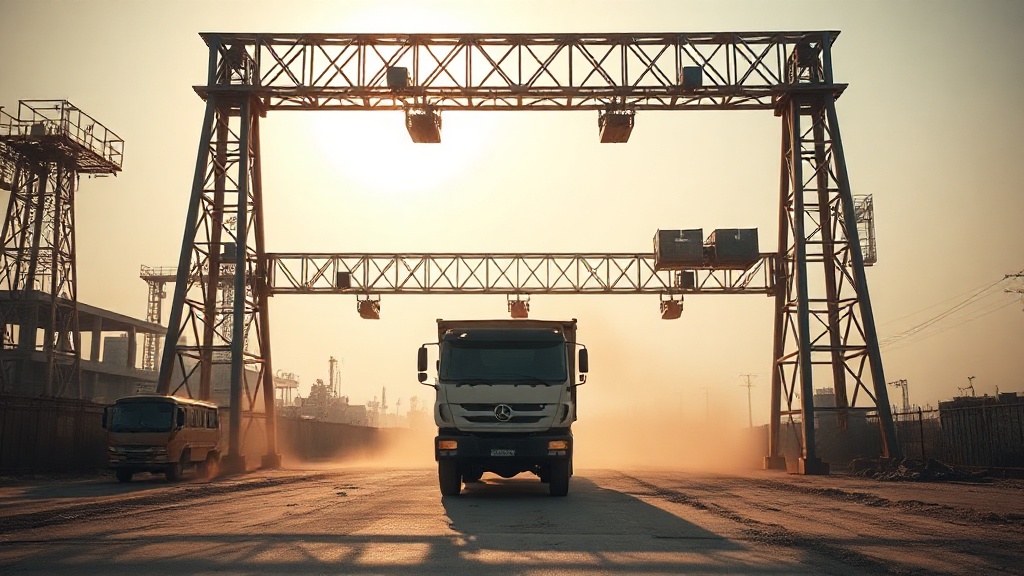
The LiDAR truck volume measurement system is a solution that uses 3D laser sensors to automatically measure the cargo volume on trucks in real-time, replacing manual weighing or visual estimation methods. In Vietnam, this technology is being deployed at quarries, cement plants, logistics centers, and seaports, with investment costs ranging from 150 million to 850 million VND depending on the configuration.
What is the LiDAR truck volume measurement system and how does it work?
The LiDAR truck volume measurement system uses a 360-degree laser beam to create a 3D point cloud map of the truck bed and cargo. AI software processes the data to calculate volume with an accuracy of ±1-3%, fully automatically as the truck passes through the measurement gate at speeds under 10 km/h.
The system includes 2-4 LiDAR sensors mounted on a gantry frame, an edge computing processing module, surveillance cameras, and management software. When a truck passes through, the sensors scan the entire cargo surface, the AI software removes the truck bed portion and calculates the actual volume. Data is stored along with the license plate number, time, and images, serving reconciliation and invoicing purposes. Compared to electronic scales, the LiDAR system does not require the vehicle to stop, increasing productivity by 3-5 times and reducing operational labor costs by 40-60%. 7 Reasons to Invest in an Automatic Vehicle Control System for Buildings in 2026 also mentions similar automation benefits.
Investment cost for LiDAR truck volume measurement system 2026: Price list for 3 solution packages
The investment cost for a LiDAR truck volume measurement system in 2026 ranges from 150 million to 850 million VND, depending on the number of sensors, required accuracy, and software features. Below is a detailed price list for 3 popular solution packages for Vietnamese enterprises.
| Solution Package | Application Scope | Number of LiDAR Sensors | Accuracy | Investment Cost (VND) | Warranty |
|---|---|---|---|---|---|
| Entry | Weigh stations, small warehouses | 2 sensors, 16 channels | ±3% | 150-250 million | 12 months |
| Standard | Medium factories, quarries | 3 sensors, 32 channels | ±1.5% | 300-500 million | 24 months |
| Premium | Large ports, logistics hubs | 4 sensors, 128 channels | ±1% | 600-850 million | 36 months |
The above costs include hardware, software, installation, and training. They do not include costs for electrical infrastructure, networking, or gantry reinforcement if needed. Enterprises can choose to lease equipment monthly at a fee of 15-25 million VND/month for the Standard package, suitable for short-term needs or trials before long-term investment.
Comparison of 5 popular LiDAR sensor models for truck volume measurement
Choosing the right LiDAR sensor determines accuracy and investment cost. Below is a comparison table of the 5 most popular models on the Vietnamese market in 2026, based on technical specifications from manufacturers.
| Model | Brand | Number of Laser Channels | Maximum Scanning Range | Accuracy | Reference Price (VND) |
|---|---|---|---|---|---|
| PandarXT32 | Hesai | 32 channels | 120m | ±2cm | 120-150 million |
| Puck VLP-16 | Velodyne | 16 channels | 100m | ±3cm | 80-100 million |
| OS-0-128 | Ouster | 128 channels | 250m | ±1.5cm | 200-250 million |
| RS-Bpearl | RoboSense | 32 channels | 150m | ±2cm | 100-130 million |
| Titan M1 | Neuvition | 480 channels (dense) | 200m | ±1cm | 180-220 million |
For truck volume measurement applications at quarries or cement plants, the Hesai PandarXT32 and RoboSense RS-Bpearl are optimal choices for performance/price. If high accuracy is required for high-value cargo, the Ouster OS-0-128 or Neuvition Titan M1 are more suitable. Office building vehicle control solution: A-Z Guide 2026 also provides insights into integrating sensors for vehicle control.
Installation process for LiDAR truck volume measurement system: 5 detailed steps
The installation process for a LiDAR truck volume measurement system takes 7-14 working days, including 5 steps from survey to acceptance. Each step has a specific checklist to ensure the system operates accurately from day one.
- Site Survey (1-2 days): Measure gate dimensions, assess lighting, dust, and vibration conditions. Determine sensor and electrical cabinet installation locations.
- Technical Design (2-3 days): Create 3D drawings of installation positions, calculate scanning angles, select appropriate sensor models. Design the gantry frame or mounting brackets.
- Hardware Installation (3-5 days): Reinforce the gate, install LiDAR sensors, cameras, edge computing module, electrical cabinet, and cabling system. Connect LAN or 4G network.
- Software Configuration (2-3 days): Install point cloud processing software, train AI to recognize truck beds, integrate with existing management systems (ERP, WMS).
- Acceptance and Training (1 day): Run 50-100 test vehicle passes, calibrate errors, sign off on acceptance report. Train 2-3 operational staff.
Benefits of investing in a LiDAR truck volume measurement system for enterprises
Investing in a LiDAR truck volume measurement system brings 4 main benefits: increasing productivity by 3-5 times, reducing measurement errors from 5-10% down to 1-3%, saving 40-60% on labor costs, and ensuring transparent delivery data. The average Return on Investment (ROI) period is 12-18 months.
In the context where logistics costs in Vietnam account for 20-25% of GDP, automating cargo measurement helps enterprises cut 5-8% of operational costs. The LiDAR system also helps detect overloaded or non-compliant cargo immediately as the vehicle enters the gate, reducing the risk of traffic violation fines. Shopping mall vehicle control system: 8 essential features for 2026 also emphasizes the importance of automation in vehicle control.
Case study: Installation of LiDAR volume measurement system at Lam Dong quarry
In August 2025, An Ninh Số deployed a Standard package LiDAR truck volume measurement system for Tan Phat quarry (Lam Dong) handling 15 trucks/day. Results after 3 months: 30% reduction in labor costs, measurement error reduced from 7% to 1.8%, 25% increase in delivery productivity.
Before installation, the quarry used manual measurement methods with tape measures and volume estimation, leading to disputes with customers 3-5 times per month. After installing the LiDAR system with 3 Hesai PandarXT32 sensors, each truck only takes 15-25 seconds to complete measurement, with data automatically synced to the management software. The investment cost of 420 million VND was recouped after 14 months thanks to labor savings and reduced cargo loss. The system continues to operate stably with a downtime rate of less than 0.5%.
Frequently asked questions about LiDAR truck volume measurement systems
Can the LiDAR truck volume measurement system operate in rainy or dusty conditions?
Yes, LiDAR sensors use 905nm or 1550nm wavelength laser beams, performing well in light rain, fog, and dust. However, heavy rain or dense dust can reduce the scanning range by 10-20%. The system is designed with an IP67 protective housing and anti-dust glass, suitable for quarry or cement plant environments.
What is the annual maintenance cost for the LiDAR volume measurement system?
Annual maintenance costs range from 15-30 million VND, including sensor cleaning, software calibration, firmware updates, and hardware checks. An extended maintenance package (including component replacement) costs 30-50 million VND/year. Most suppliers offer periodic maintenance contracts with fixed fees.
Can the system integrate with existing management software?
Yes, the system supports integration via API RESTful, Modbus TCP, or OPC UA with most ERP, WMS, and SAP software. Volume measurement data is exported in JSON, CSV, or XML formats. The average integration time is 3-5 working days, depending on the complexity of the existing system.
What is the delivery and installation lead time for the system?
The time from order placement to final acceptance is 3-5 weeks, including 1-2 weeks for sensor import (if in stock) and 2-3 weeks for installation. For urgent projects, this can be shortened to 2-3 weeks if sensors are available in local inventory. An Ninh Số commits to the schedule and includes contract penalties for delays.
Can the LiDAR volume measurement system measure trucks carrying bulk materials like sand or stone?
Absolutely. The system is optimized for measuring bulk materials such as sand, stone, coal, ore, and fertilizer. The AI software can filter out noise from uneven surfaces and calculate volume accurately. However, with highly reflective materials (glass shards, shiny metals), accuracy may decrease by 1-2%.
Are you looking for an automatic truck volume measurement solution for your business? Contact An Ninh Số immediately via hotline 0796 700 777 or email [email protected] for a free site survey and detailed quotation within 24 hours. Our technical team is ready to advise on a solution suitable for your budget and operational scale.