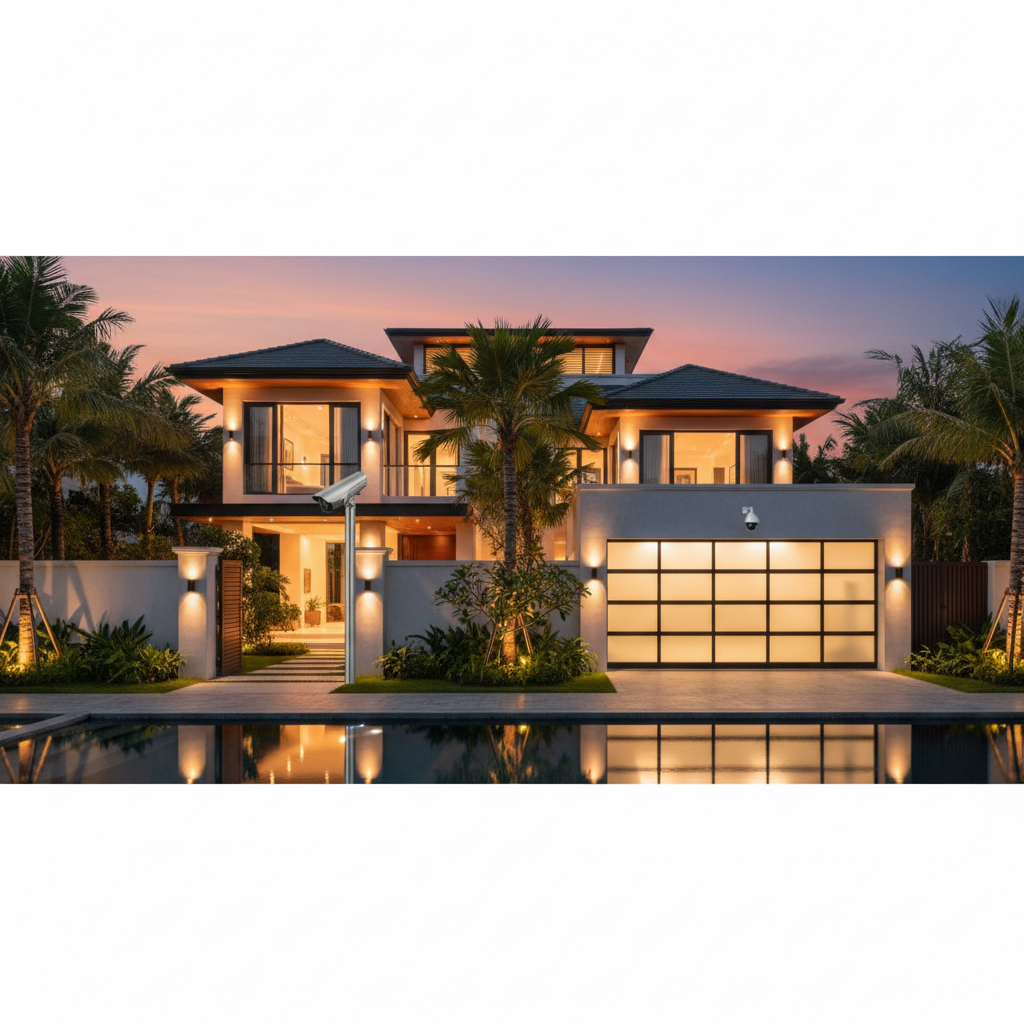
At 8 PM, in villa area X in Thu Duc, a dark figure glides over the fence. The AI camera instantly recognizes the unfamiliar face, sending a real-time alert to the homeowner's phone. Within 3-5 seconds, the garden lights turn on, and the magnetic gate locks automatically. This is not a movie script – it is the reality with smart cameras for luxury villas in 2026. This article helps you choose the right camera solution, from technical criteria to actual installation costs for a 200-500m² villa.
What is a smart villa camera? How is it different from a regular camera?
A smart villa camera is a camera system integrated with AI, capable of facial recognition, detecting unusual motion, sending alerts via an app, and automatically activating other security devices such as lights, alarms, and door locks. Unlike regular cameras that only passively record, smart cameras analyze video in real-time, reducing false alerts (from pets, leaves) by 70-80% and allowing historical queries by specific person/scene.
Quick comparison of regular cameras and smart cameras for villas
| Feature | Regular Camera | Smart AI Camera |
|---|---|---|
| Facial recognition | No | Yes (whitelist/blacklist) |
| Smart motion detection | Alerts on all motion | Filters people/vehicles/pets |
| Smart home integration | No or limited | ONVIF/RTSP, activates lights/locks/alarms |
| Cloud storage | Optional | Default + end-to-end encryption |
| Anti-hacking | Basic | TLS 1.3 encryption, two-factor authentication |
5 criteria for choosing smart cameras for luxury villas
Choosing a camera for a villa is not just about resolution. You need to consider AI facial recognition, weather resistance (IP66/IP67), smart home integration, secure storage, and aesthetic design. Below are 5 specific criteria to help you make the right decision.
1. AI facial recognition and anomaly detection technology
Modern AI cameras can recognize faces from a distance of 5-10 meters, even in low-light conditions (smart infrared). This feature allows you to create a whitelist (family members, maids) and a blacklist (unknown persons appearing multiple times). When an unidentified face is detected during sensitive hours (11 PM - 5 AM), the system automatically sends an alert and turns on the garden lights.
2. Resolution and night vision capability
Villas often have large gardens, gates, and garages. Cameras should be at least 4K (8MP) to recognize license plates from a distance. For nighttime, Smart IR technology automatically adjusts light intensity to avoid overexposure when objects are close. Some high-end models also feature white LED lights for color recording in complete darkness.
3. Smart home integration and access control
Cameras do not operate in isolation. You need a system integrated with smart locks, door/gate sensors, garden lights, and alarm systems. The ONVIF Profile G/T standard ensures compatibility with most smart home devices from brands like Aqara, Lutron, Crestron. See the comparison of smart home Aqara vs Lutron vs Crestron to choose the right solution.
4. Data storage and security
Villa image data is sensitive property. Cameras should support local storage (memory card/NVR) combined with cloud storage using AES-256 encryption. Minimize the risk of camera hacking by choosing devices with automatic firmware updates, two-factor authentication (2FA), and integrated firewalls. Read more Can smart homes for villas prevent hacking? to understand the 7 layers of enterprise security.
5. Design and aesthetics
Luxury villas do not want cameras to spoil the facade. Choose compact bullet cameras with electrostatic painting in white/black, or transparent dome cameras for ceiling mounting. Some brands offer faux stone or faux wood housing options to blend with the architecture. Installation positions need to be sheltered from rain and sun but without obstructing the view.
4-step smart villa camera installation process
Installing villa cameras is not just about drilling walls and mounting lenses. A professional process includes site survey, layout design, wiring, and software configuration. Each step affects the overall protection effectiveness.
- Site survey (1-2 days): Technicians measure the area, identify blind spots, assess existing electrical/network systems, and advise on optimal installation positions for each area (gate, garage, garden, balcony, walkway).
- Security layout design (half a day): Draw a diagram of camera positions, viewing angles, coverage areas, connections to NVR/PoE switch, and smart home integration. Ensure no dead blind spots.
- Installation (2-3 days): Run network cables in walls/conduits, mount cameras, connect PoE power, set up NVR, configure LAN/WiFi network. Test the signal of each camera.
- AI configuration and training (1-2 days): Install the app, create face lists, set up alert zones, recording schedules, and connect to the alarm system. Guide the homeowner on using the app.
Smart villa camera installation costs in 2026
Installation costs for a 200-500m² villa range from 15 to 45 million VND, depending on the number of cameras, brand, and installation complexity. The table below provides estimated reference costs for each item.
| Item | Quantity | Cost (VND) |
|---|---|---|
| Outdoor AI 4K camera (Hikvision/Dahua) | 4-6 units | 8,000,000 – 18,000,000 |
| Indoor AI 4K camera (dome) | 2-3 units | 4,000,000 – 9,000,000 |
| 8-channel PoE NVR recorder | 1 | 3,000,000 – 7,000,000 |
| 4TB hard drive | 1-2 | 2,500,000 – 5,000,000 |
| Cat6 network cable, conduits, accessories | Package | 1,500,000 – 3,000,000 |
| Installation labor + configuration | Package | 2,000,000 – 5,000,000 |
| Total (200-300m² villa) | 15,000,000 – 25,000,000 | |
| Total (300-500m² villa) | 25,000,000 – 45,000,000 |
Frequently asked questions about smart villa cameras
Do AI villa cameras violate Decree 13 on personal data protection?
No, if installed correctly. Decree 13 requires notifying people within the recording area, limiting private recording zones (bedrooms, bathrooms), and securing data. AI cameras can set up privacy masks to cover sensitive areas. See more about AI cameras and Decree 13/GDPR.
Is it necessary to install cameras for a villa that already has on-site security guards?
Yes. On-site guards cannot monitor the entire premises 24/7. AI cameras act as vigilant eyes for continuous monitoring, detecting anomalies when guards are off shift or distracted. The system also retains evidence for verification in case of incidents.
Can villa cameras integrate with an existing smart home system?
Most cameras supporting ONVIF and RTSP standards can integrate with smart home hubs like Aqara, Lutron, Crestron, Home Assistant. You can program scenarios: detect unusual motion → turn on garden lights → send app alert → lock smart door.
How to avoid villa camera hacking?
Choose cameras with automatic firmware updates, change default passwords, enable two-factor authentication, use a separate LAN for the camera system (VLAN), and avoid direct Internet connection if not needed. An Ninh Số recommends cameras with enterprise-level security certification.
What about warranty and technical support for villa cameras?
An Ninh Số provides a 12-24 month warranty for equipment, 24/7 remote technical support, and on-site technician dispatch within 24-48 hours. We are committed to fast issue resolution, minimizing security disruptions for your family.
Need advice on installing smart villa cameras? Contact An Ninh Số today for a free survey and detailed quote. Hotline: 0796 700 777 – Email: [email protected].