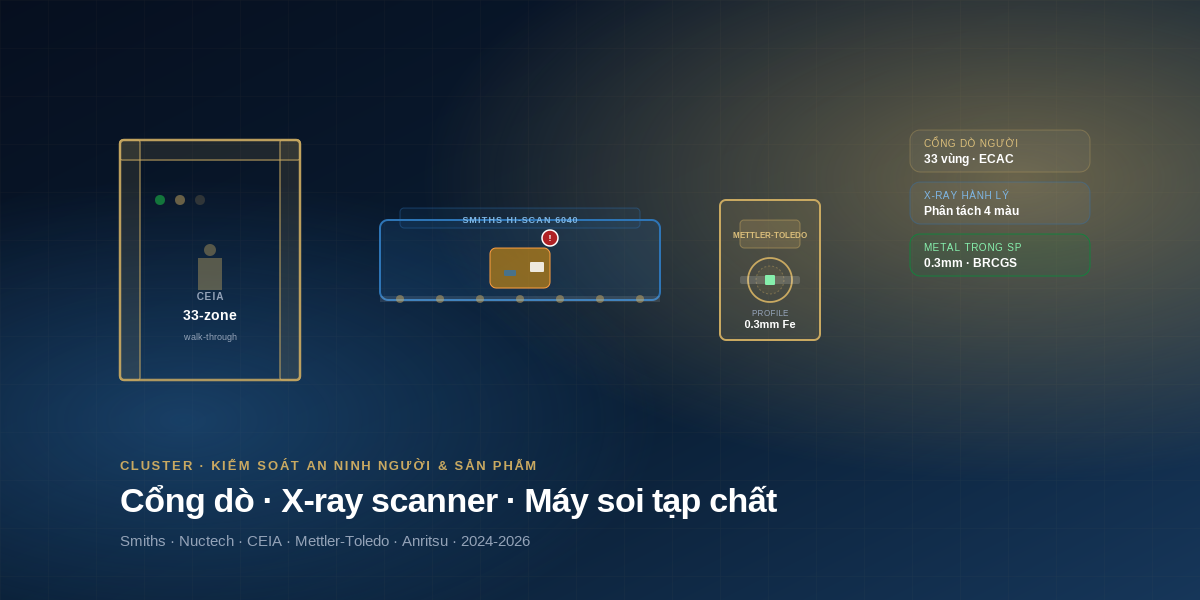
TL;DR
TL;DR: CEIA 33 zone bank ECAC is the standard for body-partition metal detection gates for central banks and tier-1 branches when needing to detect small weapons (5cm folding knives, polymer guns) without causing false alarms from coins or keys. CEIA SMD600 Plus and Garrett PD 6500i both meet ECAC C3 (EU airport standard), priced at $8,000-12,000/gate, ROI 18-24 months through 50-70% reduction in manual inspection time and 40-60% increase in lobby throughput. Deployment pattern: central banks place 2 parallel gates at the main lobby (capacity 600-800 people/hour), tier-1 branches place 1 gate at the main entrance, connected to NVR for event logging and footage review when alarms occur.
Why do central banks need CEIA 33 zone instead of standard 6-zone gates?
The head office and tier-1 branches handle 500-1,000 customers/day at the transaction lobby, of which 10-15% carry personal metal items (keys, coins, phones). Standard 6-zone metal detectors (Garrett Magnascanner, priced $2,000-3,000) can detect large guns and knives but cause 30-50% false alarms due to inability to distinguish body zones — customers must return for manual checks, reducing throughput to 120-150 people/hour.
The CEIA 33-zone bank ECAC solves this by dividing the body into 33 vertical zones (head, shoulders, chest, hips, legs), each with its own sensitivity threshold. When a customer carries keys in a pants pocket (hip zone), the gate only alarms if additional abnormal metal is detected in the chest or back area — where weapons are typically concealed. Result: false alarms reduced to 5-10%, throughput increased to 300-400 people/hour, saving 2-3 security personnel for manual checks.
ECAC (European Civil Aviation Conference) is the EU airport standard for metal detection gates, classified into 3 levels: C1 (detects large guns), C2 (large knives >10cm), C3 (small knives 5-7cm + polymer guns). Vietnamese head office banks have applied ECAC C3 since 2023 after an incident at a tier-1 branch in the North (a customer brought a 6cm folding knife into the lobby, and the 6-zone gate failed to detect it). The State Bank of Vietnam has not yet issued mandatory regulations but recommends that top 10 joint-stock commercial banks apply airport-equivalent standards for head offices and branches handling >$5M in daily transactions.
CEIA SMD600 Plus vs Garrett PD 6500i — 33-zone differentiation for banks
[CEIA](/thuong-hieu/ceia/) SMD600 Plus (Italy, $10,000-12,000/gate) is the international airport standard, used at 80% of EU airports and 60% of US airports. Strengths: 33 vertical zones + 3 horizontal zones (99 total zones), detects a 5cm folding knife at any angle (horizontal/vertical/diagonal), anti-spoofing by analyzing dual-frequency signals (low + high frequency) to distinguish real weapons from harmless metal. CEIA public claim: false alarm <3% at airport throughput of 1,000 people/hour.
[Garrett](/thuong-hieu/garrett/) PD 6500i (USA, $8,000-10,000/gate) is a balanced price-performance choice, widely used in US banks and sports events. Strengths: 33 vertical zones, easy-to-configure 7-inch touchscreen interface, integrated camera snapshot (captures people passing through when alarm triggers) and relay output connecting to NVR. Garrett internal report: false alarm 5-8% at bank throughput of 400-600 people/hour, lower than CEIA but sufficient for transaction lobbies.
| Criteria | CEIA SMD600 Plus | Garrett PD 6500i |
|---|---|---|
| Number of zones | 33 vertical + 3 horizontal (99 zones) | 33 vertical |
| ECAC level | C3 (5cm knife) | C3 (5cm knife) |
| False alarm | <3% (vendor claim) | 5-8% (vendor claim) |
| Throughput | 1,000 people/hour | 600 people/hour |
| Price | $10,000-12,000 | $8,000-10,000 |
| Integrated camera | No (needs separate purchase) | Yes (2MP snapshot) |
| Use case | Central bank headquarters, airports | Tier-1 bank branches, events |
An Ninh Số observes that central bank headquarters prioritize CEIA when throughput >800 people/hour and require minimal false alarms (VIP banking, foreign exchange transaction rooms). Tier-1 branches choose Garrett when budget is limited and need an integrated camera snapshot for event logging.
CEIA 33 zone deployment pattern at VN General Department Bank
Vietnam tier-1 central bank (processing 800-1,200 customers/day) deploys 2 parallel CEIA gates at the main lobby, each gate handling 1 pedestrian lane (total capacity 600-800 people/hour during peak time 9-11 AM). A security guard stands between the 2 gates, with a tablet displaying realtime alarms from both lanes; when an alarm occurs, the guard asks the customer to place personal metal items in a tray and walk through again — if the alarm persists, manual inspection is conducted using a handheld detector.
Tier-1 branch (300-500 customers/day) places 1 Garrett gate at the main entrance, connected via relay output to a Hikvision/Dahua NVR to log events (timestamp + integrated camera snapshot). When an alarm occurs, the NVR automatically bookmarks footage 10 seconds before/after, enabling quick review when investigation is needed. NVR integration cost: $500-800 (relay cable + event trigger configuration).
Tier-1 enterprise (FDI factory, logistics center) installs a CEIA gate at the main entrance combined with an integrated [security control](/giai-phap/kiem-soat-an-ninh/) system: metal detector gate + facial recognition camera + tripod turnstile. When an employee swipes a card, the system simultaneously checks facial match and the metal detector gate — if both pass, the turnstile opens; if either fails, it holds and alerts the guard. This pattern increases throughput to 400-500 people/hour (compared to 200-300 people/hour with sequential inspection).
Periodic maintenance: CEIA recommends calibration every 6 months (cost $300-500/time) to ensure stable sensitivity. The Garrett PD 6500i features automatic self-test every morning (checks 33 zones, reports errors if any zone drifts >10%), reducing calibration frequency to every 12 months.
ECAC C3 standard — detection of 5cm folding knives and polymer guns
ECAC C3 is the highest level among the 3 standards for airport metal detector gates in the EU, requiring detection of 5-7cm folding knives (ferrous + non-ferrous metal) and polymer guns (containing minimal metal such as firing pin, spring) at any angle (horizontal/vertical/45° diagonal). Test protocol: ECAC uses 12 standard weapon samples (ceramic knives with thin metal coating, Glock polymer pistols, titanium folding knives) and requires the gate to detect 100% of samples when a person walks through at normal speed (1m/s).
CEIA SMD600 Plus achieved ECAC C3 since 2018, Garrett PD 6500i since 2020. Both use multi-frequency scanning technology (simultaneously scanning 4-6 frequencies from 1 kHz to 20 kHz) to distinguish ferrous metals (iron, steel) and non-ferrous metals (aluminum, copper, titanium). Titanium folding knives (non-ferrous, harder to detect than steel knives) reflect weaker signals at low frequencies but stronger signals at high frequencies — AI algorithms analyze this pattern for detection.
Polymer guns (Glock 17, Glock 19) contain 15-20% metal by weight (firing pin, barrel, spring, slide rail). ECAC C3 requires detection when the gun is placed in the back or hip area (common concealment positions), even if the person also carries keys and a phone in their pocket. CEIA and Garrett both pass this test thanks to 33 zoning zones — when abnormal metal is detected in the back area (pattern resembling a gun), an alarm triggers regardless of harmless metal in the hip area.
Vietnamese banks do not yet mandate ECAC C3 but have voluntarily adopted it after the 2023 incident. An Ninh Số recommends that top 10 joint-stock commercial banks and tier-1 FDI enterprises apply ECAC C3 for headquarters and branches handling >$5M in daily transactions, as the additional cost of $3,000-5,000 per gate (compared to 6-zone gates) yields an ROI of 18-24 months through reduced security risks and increased throughput.
Anti-spoofing and safety for pacemaker wearers
Anti-spoofing is a technique to prevent fraud when individuals intentionally conceal weapons by carrying multiple harmless metal items (coins, keys, phones) to interfere with signals. The CEIA SMD600 Plus uses dual-frequency analysis: it simultaneously scans at low frequency (1-5 kHz, sensitive to large metals like knives) and high frequency (10-20 kHz, sensitive to small metals like coins). The AI algorithm compares patterns from the two frequencies — if it detects large metal in the chest/back area (knife/gun pattern) along with small metal in the hip area (coins), it still triggers an alarm without interference.
The Garrett PD 6500i uses ferrous/non-ferrous discrimination: it distinguishes between ferrous metals (iron, steel — typically weapons) and non-ferrous metals (copper, aluminum — typically coins, keys). When it detects ferrous metal in the chest/back area, it alarms regardless of how much non-ferrous metal is in the hip area. This technique is effective against steel knives but less so against titanium knives (non-ferrous) — which is why CEIA uses dual-frequency instead of ferrous discrimination.
Safety for individuals with pacemakers or ICDs is a mandatory requirement per FDA and EU MDR. Both CEIA and Garrett use low-intensity magnetic fields (<100 μT, 10 times lower than MRI) and low frequencies (<20 kHz, causing no interference with medical devices). Vendor public claim: 100% safe for pacemakers and ICDs when passing through the gate at normal speed. Banks should post warning signs reading "Safe for pacemakers" at the gate to reassure customers.
Deployment pattern: the central bank sets up one dedicated lane for VIP customers and people with disabilities (bypassing the metal detector gate, with manual checks using handheld detectors). Cost: $500-800 for the Garrett SuperScanner V handheld detector (detects 5cm knives, safe for pacemakers).
Deployment costs and ROI 18-24 months for banks
Cost of deploying CEIA 33-zone ECAC bank system for the central bank (2 parallel gates):
- **Hardware**: 2× CEIA SMD600 Plus ($10,000-12,000/gate) = $20,000-24,000, or 2× Garrett PD 6500i ($8,000-10,000/gate) = $16,000-20,000
- **Installation**: $2,000-3,000 (220V power wiring, Cat6 network cable to NVR, initial calibration)
- **NVR integration**: $1,000-1,500 (relay output, event trigger, bookmark footage)
- **Training**: $500-800 (1-day training for security on operation and alarm handling)
- **Total**: $23,500-29,300 for CEIA, $19,500-25,300 for Garrett
Annual operating costs:
- **Calibration**: $300-500 every 6 months (CEIA) or 12 months (Garrett) = $600-1,000/year (CEIA), $300-500/year (Garrett)
- **Electricity**: 50W/gate × 10 hours/day × 250 days/year × 2 gates × $0.1/kWh = $250/year
- **Warranty**: $1,500-2,000/year (extended warranty 3 years, covers parts + labor)
- **Total**: $2,350-3,250/year
ROI calculation: The central bank previously used 6-zone gates ($3,000/gate) + 3 manual inspection guards (salary $500/month/person). After upgrading to CEIA 33-zone, reduced to 1 guard monitoring 2 lanes, saving 2 personnel = $12,000/year. Additionally, throughput increased by 40-60%, reducing customer wait time (customer satisfaction increases, hard to quantify but estimated 5-10% reduction in customers leaving due to long waits).
Payback period: ($23,500 - $6,000 old gates) / $12,000 savings = 1.5 years for CEIA, 1.1 years for Garrett. 3-year ROI: ($12,000 × 3 - $2,500 × 3 - $17,500 investment) / $17,500 = 71% for CEIA, 95% for Garrett.
Tier-1 branch (1 Garrett gate): investment $10,000-12,000, saving 1 security guard = $6,000/year, payback 1.7-2 years. An Ninh Số recommends banks prioritize deployment at the central bank and 3-5 tier-1 branches first, then gradually expand as operational experience is gained.