A volume measurement station only produces usable data when the site, power supply and operating rules are properly prepared. Placing the measurement gate in the wrong spot, lacking a straight approach section, an unstable power supply or drivers not opening the tarpaulin all cause the station to report "Unable to measure" and the trip has to be verified manually again. Therefore, preparing the site for installing a volume measurement station should begin right from the site layout design stage, not as an add-on step after construction.
This article compiles a preparation checklist for investors, project management boards and infrastructure construction contractors, following the coordination items of the Smart Box AI truck and barge volume measurement solution.
To install a truck and barge volume measurement station, the investor needs to prepare: a measurement gate location with a straight, flat road section of about 30 m before and after the gate; buoys and signage for barges; grid power or a generator to both stations (truck station ~1.5–1.9 kWh/day, barge station ~1.9–2.4 kWh/day); a vehicle list, barge registration documents, a density table; rules on opening the tarpaulin, speed limits of 15 km/h and 5 km/h, one vehicle at a time.
What is a truck and barge volume measurement station?
Each station is a complete set comprising a steel structure, LiDAR sensors, AI cameras, a processing unit and an electrical cabinet. The steel structure is fabricated to actual dimensions after the survey. For the station to produce data usable for reconciliation, the investor needs to additionally prepare the site, power supply, vehicle list and operating rules for the contractor.
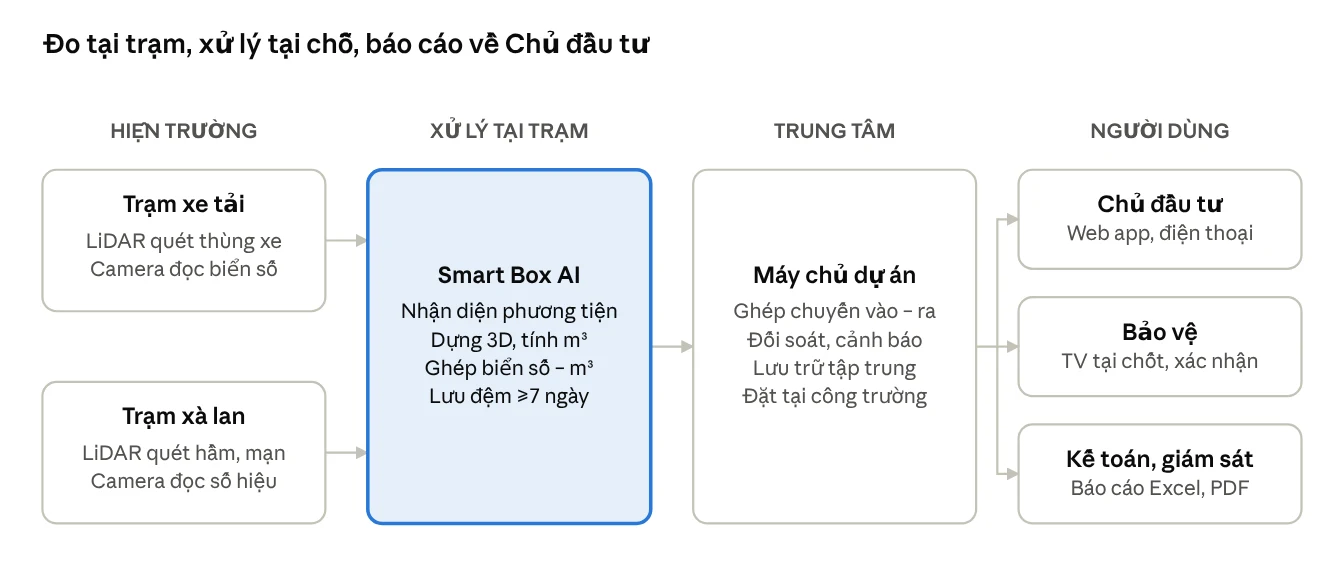
The Smart Box AI — truck and barge volume measurement system solution is developed by Viet Duc Tri Group, supplied and deployed by An Ninh So. The system consists of two types of on-site stations and one server at the construction site:
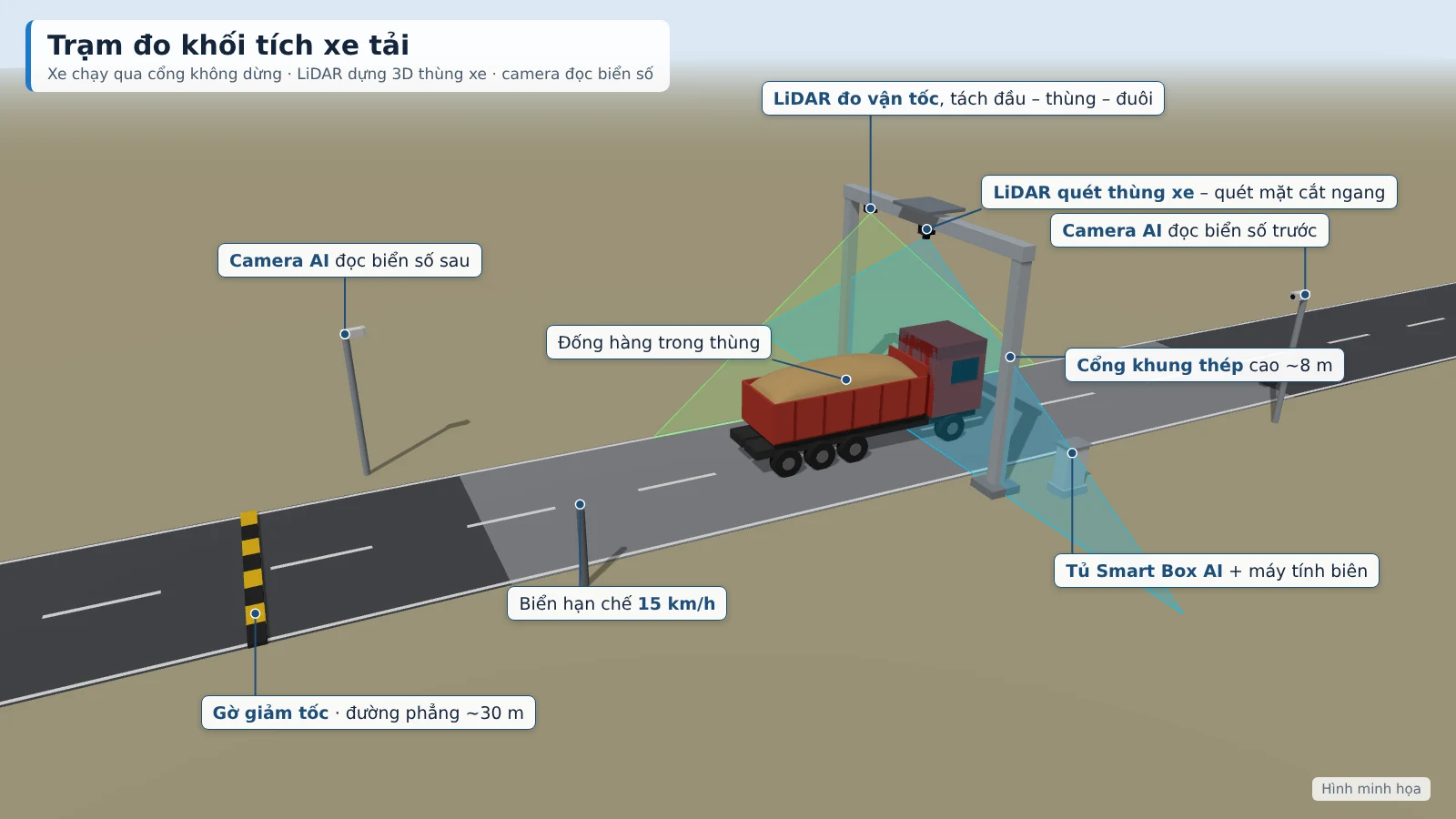
- Truck station: installed at the entrance/exit gate of the construction site, mine or storage yard; LiDAR on the gantry scans the truck bed, cameras read the license plate at the front and rear.
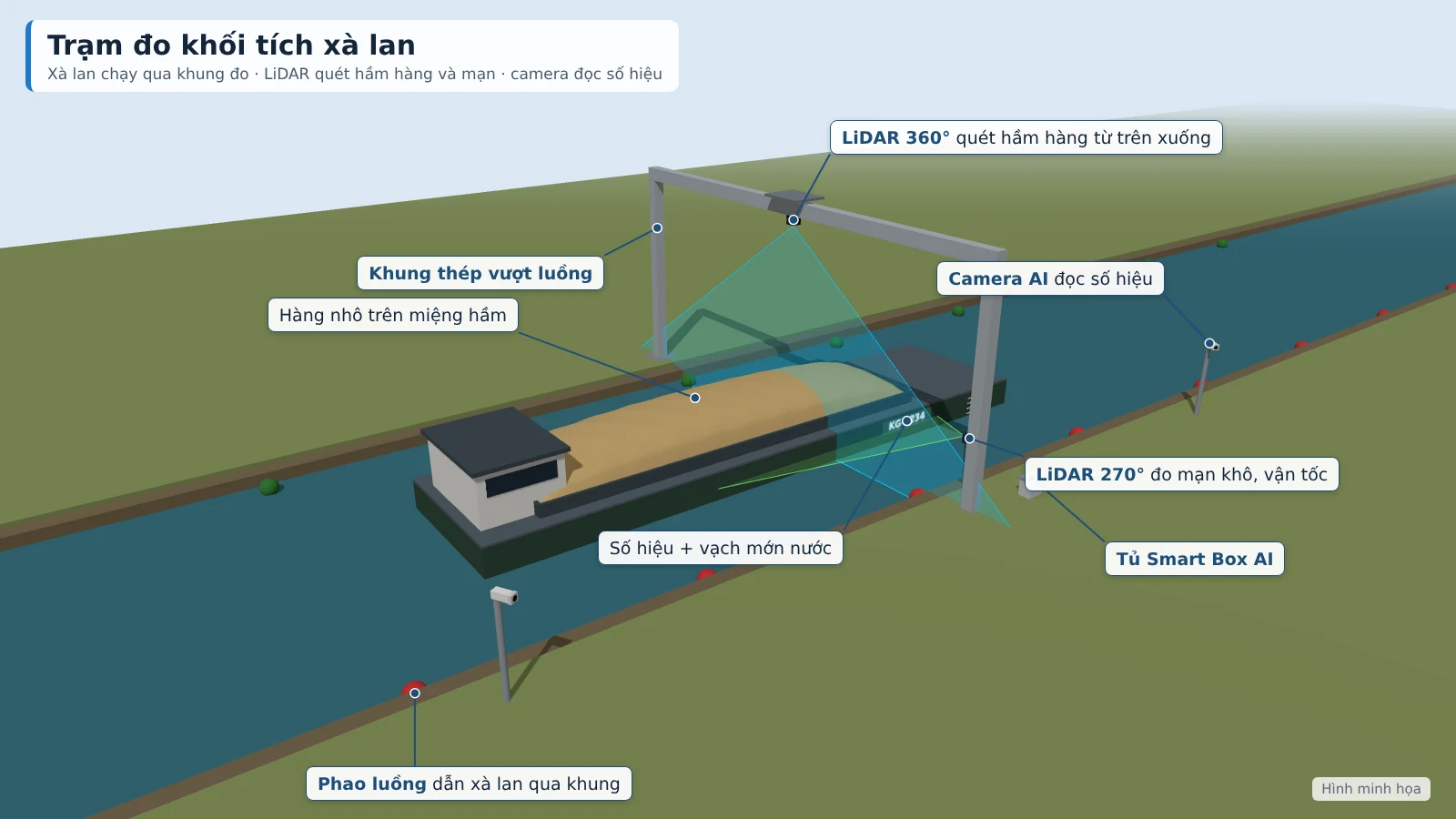
- Barge station: installed at the channel entering the wharf or cargo import port; LiDAR on the cantilever frame scans the cargo hold and sides, cameras read the barge registration number on both sides.
The station operates on the principle of measuring twice per trip: the inbound trip with cargo and the outbound trip empty, from which the actual delivered volume is calculated. This principle determines many of the site requirements below, because both inbound and outbound vehicles must pass through the measurement zone.
Site layout: location of the measurement gate and the straight, flat road section
The truck measurement gate should be placed on a straight, flat road section of about 30 m before and after the gate, with a speed bump and a 15 km/h sign. For barges, guide buoys are needed to direct the barge through the middle of the measurement frame, along with a 5 km/h sign.
Requirements for the truck station
- A straight, flat road section of about 30 m before and after the measurement gate, with no objects obstructing the LiDAR scan range and the camera's field of view.
- A galvanized steel frame gate spanning the road, with a minimum clear height of 6.5 m, sensors mounted at a height of about 8 m, and a roof cover.
- A speed bump and a 15 km/h sign on the road leading to the gate.
- The gate must be positioned so that both loaded inbound vehicles and empty outbound vehicles pass through the same measurement gate.
- Avoid placing the gate right at a curve or where other vehicles cross the measurement zone.
Requirements for the barge station
- A steel frame spanning the channel, or a pillar with a jib extending 6–8 m out over the channel.
- The bottom of the frame must be at least 3 m above the barge's side at peak tide.
- Guide buoys to direct the barge through the middle of the measurement frame; a 5 km/h speed sign.
During the survey, a site layout drawing should be prepared marking the positions of the measurement gate, measurement frame, electrical cabinet, cable routes and the direction of vehicle movement. This drawing is the basis for fabricating the steel structure to the correct dimensions and for acceptance by the project management board.
Power: demand of 1.5–2.4 kWh/day and the solar option
The truck station consumes about 1.5–1.9 kWh/day, the barge station about 1.9–2.4 kWh/day, running 24/7. The investor supplies grid power or a generator to both stations; where no power source is available, a separate solar system for the station can be offered as an add-on.
Because the station runs continuously day and night, the most important requirement is a stable power source. The investor needs to confirm:
- The supply for each station: grid power or generator, and the cable route from the source to the station's electrical cabinet.
- The plan for when the main source is interrupted: the station's electrical cabinet has a UPS for the equipment.
- If a separate solar system is used: a location for the panels that is not shaded, surveyed together with the station location.
- The electrical contact person at the site for coordination in case of incidents.
The equipment monitoring system also tracks the power source of each station and alerts when the signal is lost, helping the operations team detect electrical problems early instead of only finding out at the end of the shift that data is missing.
Electrical cabinet, UPS, surge protection and VPN connection
The station's electrical cabinet is IP65-rated, with a fan and dehumidifier, UPS, power and network surge protection, and grounding; the barge station uses the same configuration as the truck station. The station sends results back to the center via VPN; if the connection is lost, data is buffered and resent.
- IP65 electrical cabinet: dust- and water-resistant, with a fan and dehumidifier for construction site and yard environments.
- UPS: keeps equipment running during short power interruptions.
- Power and network surge protection: protects both the power and network lines entering the cabinet.
- Grounding: a grounding system for the station.
- VPN: a secure connection sending results from the station back to the center.
The VPN connection should be agreed with the investor's IT department right from the survey stage. All data is stored on site and on the project's server, not uploaded to any external service. At the security checkpoint and the center, the existing camera system's recorder, TV and server can be shared.
Vehicle list, registration records and specific gravity table
The Investor provides the list of trucks and barges of each contractor; the barge registration records (hold dimensions, draft); and the specific gravity table by material type for converting m³ to tonnes. This is the input data for configuring the system and reconciling volumes.
The vehicle list should clearly state the license plate or identification number, the vehicle owner and the managing contractor. Each vehicle is then registered with a template once:
- Truck bed template: the empty truck passes through the gate 3 times at different speeds; the system records the bed interior dimensions and bed floor as the reference, and detects when the bed is raised or the vehicle is changed.
- Barge hold template: hold dimensions, capacity and waterplane area per the registration records, re-checked with the first empty scan.
The truck station applies to 2–4 axle dump trucks and open-top semi-trailers carrying sand, soil and stone. The specific gravity table is issued by the Investor; because the specific gravity of bulk materials varies with moisture content and compaction, the table needs to be reviewed when the material source changes. Vehicles not on the list will trigger a "Unknown vehicle" warning, so the list needs to be updated before new trucks or barges enter the station.
Operating rules: opening the tarpaulin, speed and order of passing the gate
The Investor issues rules for contractors: open the tarpaulin before the measurement gate; observe the correct speed of 15 km/h for trucks and 5 km/h for barges; one vehicle at a time; exiting vehicles also pass through the measurement gate. These are the conditions for the station to capture sufficient data and meet the measurement targets.
- Opening the tarpaulin: the truck must open its cover before the measurement gate so the LiDAR can scan the cargo surface.
- Speed: trucks pass through the steel frame gate at under 15 km/h, no stopping required; barges pass through the measurement frame at under 5 km/h following the channel buoys.
- Order: one vehicle at a time through the gate, no driving close together within the measurement zone.
- Exiting vehicles: empty trucks must still pass through the measurement gate on exit to determine the remaining m³.
If a truck is still covered by its tarpaulin, drives too fast or two trucks are too close together, the system reports "Unable to measure" and moves that trip to the pending verification queue. The rules should be communicated to drivers, supervised at the yards and displayed on signs at the measurement gate.
Two-measurement process per trip and data storage
Each trip is measured twice: on entry with cargo and on exit empty. The actual delivered volume equals the entry m³ minus the remaining m³. Each trip stores the license plate, photos, 3D image of the cargo pile, camera clip and a confidence score of 0–100.
The confidence score is graded by speed, occlusion and weather; a poor measurement is automatically forwarded to a verification officer. The officer reviews the photos, 3D image and camera clip, then approves or adjusts; only the Investor may adjust the m³ figure and every change is logged.
For barges, in addition to the 3D scan of the cargo hold, the system measures the draft on entry and on exit to produce a tonnage figure, then cross-checks it against the tonnage converted from m³. This is why the barge registration records need to include full hold dimensions and draft.
The station still measures when the network is down, buffers data for at least 7 days and automatically resends when the connection is restored. For yards with unstable connectivity, this is an important factor in not losing trips.
Calibration and trial run coordination
After installation, the station is calibrated on site and run for a 4-week trial before acceptance. The Investor arranges trucks and barges for reference runs during the trial period, along with channel buoys and signs on the channel and the gate approach road.
The calibration steps requiring coordination:
- Reference block: place a steel block of known dimensions under the measurement gate to align the sensors.
- Empty vehicles: each vehicle passes through 3 times at different speeds to establish the bed template and check repeatability.
- Loaded vehicle reference: level the cargo surface flush with the bed sides and measure manually; where a weighbridge is available, cross-check additionally by tonnage.
- Barges: measure the hold template when empty and compare with the registration records; cross-check with manual draft survey.
- Periodic: re-check with the reference block every month and after each relocation of the station.
A volumetric error of ≤ ±3% for trucks (trips from 10 m³) and ≤ ±5% for barges is a proposed target, to be re-agreed by both parties based on the results of the 4-week trial run. Acceptance is based on 50 truck trips and 10 barge trips with cross-checks over 7 consecutive days; the software exports a comparison table of measured m³, reference m³ and the error for each trip for both parties to sign off. A site that meets the requirements from the start helps avoid redoing this phase.
Summary table of site preparation requirements
The table below summarizes the items the investor needs to prepare before installing a volume measurement station for trucks and barges.
| Item | Requirement | Example |
|---|---|---|
| Measurement gate location | Straight, level road of about 30 m before and after the gate | Speed humps, 15 km/h signs, not located on a curve |
| Barge measurement frame | An over-channel frame or pillar with a 6–8 m reach arm | Frame bottom at least 3 m higher than the barge's side at peak tide |
| Channel buoys | Guide barges through the center of the measurement frame | Channel buoys, 5 km/h speed limit signs |
| Power | ~1.5–1.9 kWh/day (trucks), ~1.9–2.4 kWh/day (barges), running 24/7 | Grid power or a generator; if unavailable, add a separate solar system |
| Electrical cabinet | IP65, fan, dehumidifier, UPS, power and network surge protection, grounding | Send results back to the center via VPN |
| Input data | Vehicle list, barge registration, specific gravity | Update before a new vehicle enters the station |
| Operating rules | Open the tarp, 15 km/h and 5 km/h speed limits, one vehicle at a time, vehicles exit through the measurement gate | Signs at the gate, brief the drivers |
| Calibration | Trucks and barges run reference passes during the trial run | Empty truck runs 3 passes to establish the bed profile |
Common mistakes in site preparation
Most preparation errors fall into three groups: the measurement gate location does not meet the conditions, the power supply and electrical cabinet are inadequate, and there are no operating rules for the contractor.
- Placing the measurement gate on a curved or sloped road section: vehicles do not pass straight through the measurement zone, scan quality drops, and many trips have to be verified.
- Not enough straight road before and after the gate: vehicles are not yet stable when entering the gate, and the camera struggles to read license plates.
- Only allowing vehicles to enter through the measurement gate: without empty exit passes, the remaining m³ cannot be calculated.
- Using a standard electrical cabinet instead of IP65: dust and moisture cause equipment to degrade quickly.
- No UPS and no surge protection: a power incident or propagated lightning surge stops the station from measuring.
- Missing speed and tarp-opening rules: drivers speed, do not open the tarp, and the station reports "Unable to measure".
Related solutions
Truck & barge volume measurement — Smart Box AI: 3D LiDAR and AI cameras measure m³ per trip, with no need for vehicles to stop; each trip has a license plate, photos, and a 3D image as acceptance evidence. View the solution, book an on-site survey →
Frequently asked questions
What site conditions does a truck volume measurement station require?
A straight, level road section of about 30 m before and after the measurement gate is required, with speed humps and a 15 km/h sign, plus a location for the electrical cabinet. The steel gantry over the road must have a minimum clearance of 6.5 m. The steel structure is fabricated to actual dimensions after the site survey.
Does a barge station need navigation buoys?
Yes. Navigation buoys guide barges through the center of the measurement frame, along with a 5 km/h sign. The steel frame spanning the channel or the cantilevered pillars must reach 6–8 m, and the bottom of the frame must be at least 3 m above the barge's side at maximum high tide.
What if the area has no grid power?
The investor supplies grid power or a generator to both stations; if neither is available, a separate solar system can be quoted as an add-on. The truck station uses about 1.5–1.9 kWh/day, the barge station about 1.9–2.4 kWh/day, running 24/7.
Is measurement data lost when the network is interrupted?
No. The station keeps measuring when the network is down, buffers data for at least 7 days and automatically resends it once the connection is restored. Data is stored on site and on the project server, not sent to any external service.
Who is responsible for providing the vehicle list?
The investor provides the list of vehicles and barges for each contractor, the barge registration documents (hold dimensions, draft) and the density table by material type. Vehicles not on the list will be flagged as unknown vehicles, so the list must be updated before new vehicles enter the station.
Are the 15 km/h and 5 km/h speed rules mandatory?
These are rules issued by the investor for contractors, together with removing tarpaulins before the measurement gate, one vehicle at a time, and vehicles also passing through the measurement gate on the way out. Vehicles still covered by tarpaulins, moving too fast, or two vehicles too close together will be reported as not measurable and moved to a queue for verification.
After installation, how long until acceptance?
The station is calibrated on site and run for a 4-week trial before acceptance. An error of ≤ ±3% for trucks (loads from 10 m³) and ≤ ±5% for barges are proposed targets, to be re-agreed by both parties based on the results of the 4-week trial run. The investor arranges trucks and barges for comparison runs during the trial period.
To prepare the site for installing truck and barge volume measurement stations correctly, the first step is a site survey. An Ninh Số surveys the locations for the measurement gate, measurement frame, power supply and the flow of vehicles and barges; proposes the station configuration and gives a live demonstration according to the investor's schedule. Call the hotline 0796 700 777 to book an appointment, or see details on the Smart Box AI volume measurement solution page.