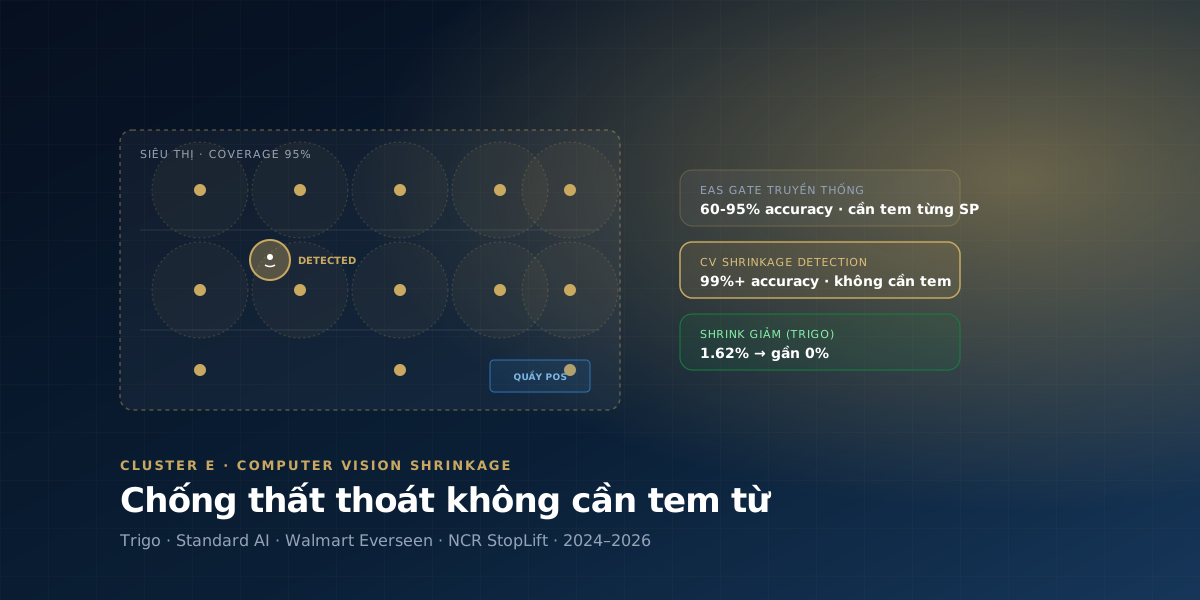
Computer Vision (CV) shrinkage detection replaces traditional EAS gates for retail — no need to attach security tags to products. Vendor commercialize: Trigo (Israel) 99%+ accuracy with Tesco High Holborn (10/2021), REWE Pick&Go (5/2024), ALDI Nord, Auchan; Standard AI + Circle K (Phoenix/Tempe 10/2021); Walmart Missed Scan Detection via Everseen >1,000 stores since 2019; Alibaba Hema 10,000+ self-checkout; NCR StopLift detects >3 million scan-avoidance events. Lesson from Amazon Just Walk Out (4/2024 shutdown of Fresh full-size store) confirms: CV does not fully replace EAS, a hybrid pattern of CV + traditional EAS + human review is the reality. Vietnam adoption: Bach Hoa Xanh uses AI for inventory + shrinkage but has not publicly disclosed accuracy details. CV market forecast CAGR 25.4% 2024-2033.
Anti-theft without tags: Computer Vision is redefining EAS for retail 2026
Global retail shrink in 2024 is estimated at $132 billion. Computer Vision retail market: $1.66B (2024) → $12.56B (2033) CAGR 25.4%. Vendors commercializing: Trigo (99%+ accuracy, Tesco High Holborn 10/2021, REWE Pick&Go 2024), Standard AI + Circle K, Walmart Missed Scan Detection (Everseen >1000 stores), Alibaba Hema 10000+ self-checkout, NCR StopLift >3M scan-avoidance events. Vietnam adoption: Bach Hoa Xanh uses AI but has not publicly disclosed details.
TL;DR
Global retail shrink in 2024 is estimated at **$132 billion** (compared to $112 billion in 2022). The NRF 2024 Security Survey reports an average shrinkage of 1.6% of retail revenue, with theft being the largest component.
Traditional EAS gates (Sensormatic AM, Checkpoint RF, Nedap RFID) have dominated the industry for 30+ years. Pattern: tags attached to products, gates detect untagged items passing through. Effective but with 4 limitations:
- **Each product must be tagged** — cost of 5-15 cents/tag × millions of products/year
- **Tags can be shielded** (e.g., hidden in metal baskets) → gates fail to detect. Accuracy 60-70% under these conditions
- **Sweethearting at checkout** is undetectable — cashier intentionally deactivates tags for "VIP customers"
- **Self-checkout fraud** is undetectable — customers scan fewer items than actual
Computer Vision (CV) reverses the pattern. AI cameras mounted on ceilings monitor every product + every behavior. No tags required. No dependency on tag deactivation. Detects both sweethearting + self-checkout fraud.
### Market Data
- **Global retail shrink 2024**: ~$132 billion
- **Computer Vision retail market**: $1.66 billion (2024) → forecast $12.56 billion (2033), **CAGR 25.4%**
- **ROI CV retail**: 180-400% over 5 years, payback 12-30 months (AI Business Research)
- **Quick-win application** (sweethearting detection only at POS): payback 6-9 months
### Why "now" — cost reduction + frictionless retail leading the way
Cost edge GPU + AI camera decreased by 60% from 2020-2024 — CV deployment becomes affordable. Frictionless retail (Amazon Go from 2018, Trigo 2018, Standard AI 2020) drives mass adoption. By 2024-2026, technology is mature enough for standalone shrinkage detection — not requiring a full autonomous store like Amazon Go.
### Trigo (Israel) — Western leader
**Founded**: 2018; raised 100M USD 10/2022, total funding 200M USD.
**Tech**: Ceiling-mounted camera + proprietary algorithm. **DOES NOT use biometric/facial recognition** — privacy-first design. Same pattern as Amazon Go but designed for traditional retail retrofit, no need to build new stores.
**Customer deployments**:
- **Tesco**: Tesco Express High Holborn London 225 m2, launched 10/2021 — first full autonomous grocery store in the UK
- **REWE Group**: Pick&Go Berlin/Cologne/Düsseldorf, new test phase 5/2024
- **ALDI Nord** (Netherlands), **Netto Marken-Discount** (Munich), **Shufersal** (Israel)
- **Auchan** (France HQ, 5/2023), **Wakefern** (USA)
**Data**: Trigo self-reports accuracy >99%, processing >5 million shopping activities/month (~60 million/year).
**2024 expansion**: Trigo announced an additional **"Computer Vision-AI Powered Loss Prevention Solution"** — separating shrinkage detection to run independently, without requiring a full autonomous store. Claims to reduce shrink rate from **1.62% to nearly 0%**.
### Standard AI / Standard Cognition (USA)
Partnership with **Circle K** (Couche-Tard) announced 8/2020. First store opened in Phoenix/Tempe Arizona 10/2021 (retrofit of existing store).
**Tech**: Ceiling camera + AI/machine vision, DOES NOT use biometrics.
**2024 status**: Standard AI experienced significant shrinkage after Amazon Just Walk Out shutdown at Fresh stores. Standard pivoted to assets like store-mapping. Specific store count in the US <50 as of 2023-2024 — has not scaled as expected.
### Walmart Missed Scan Detection (Everseen integrated)
**"Missed Scan Detection"** program using Everseen AI from 2017-2019, rolled out to >1,000 stores by 2019.
**Capability**: Detects mis-scan + non-scan at manned checkout + self-checkout. Notifies attendant for soft intervention.
**Important note**: Walmart and Everseen emphasize that the majority of errors are **unintentional**, not deliberate. The pattern is not "catching thieves" but "scan assistance" — UX-friendly. Specific accuracy data has not been made public.
### Alibaba Hema/Freshippo (China)
**Launched** 2016 — first wave of New Retail.
**Tech**: Cashierless via mobile app + QR scan + Alipay facial-recognition payment (some stores). **Over 10,000 self-checkout machines** at Alibaba stores + third-party locations.
**Note**: Hema leans toward "scan-and-go mobile-driven" rather than pure computer-vision shrinkage detection — not entirely comparable to Trigo/Standard. After pushback from the Chinese government, Hema was forced to accept cash again.
### Everseen / NCR StopLift / Datalogic — Sweethearting + POS fraud detection
**Everseen** (Ireland, founded 2007): vision AI at POS/self-checkout, claims trusted by 11/20 top global retailers. Detects non-scan, walk-around, ticket-switch, sweethearting (cashier giving goods to friends).
**StopLift ScanItAll** (acquired by NCR 2019): compares video with POS data, flags suspicious activity. Claims to have detected/confirmed **>3 million scan-avoidance events** in the US + globally.
**Datalogic** has a checkout-vision product line (Datalogic Magellan) integrating camera + scanner for anti-sweethearting.
This is a different segment from Trigo/Standard AI — specializing in POS fraud detection rather than full store coverage.
### Accuracy comparison
| Metric | Traditional EAS gate | CV shrinkage detection |
|---|---|---|
| **Item recognition accuracy** | 90-95% with good tags, 60-70% if tags are obscured | 99%+ (CV inventory tracking) |
| **Shrinkage reduction** | 30-50% shrink reduction | Trigo claims reduction from 1.62% to near 0% |
| **Sweethearting detection** | Not detected | Yes, via Everseen/StopLift |
| **Self-checkout fraud** | Not detected | Yes, via Walmart Missed Scan |
### Cost comparison
**Traditional EAS gate** ([Sensormatic](/thuong-hieu/sensormatic/), [Checkpoint](/thuong-hieu/checkpoint-systems/)):
- Gate hardware: ~3,000-8,000 USD/gate
- Tag recurring: 5-15 cents/tag × millions of products/year = ~50,000-150,000 USD/year for large store
- Staff wages for tagging, alarm handling
- **Total Year 1 for 200m2 store**: 60,000-200,000 USD; Years 2-5: 50,000-150,000 USD/year tag recurring
**CV shrinkage detection** (Trigo, BriefCam, Hikvision/Dahua + analytics):
- AI ceiling-mounted camera: 8-15 cameras × 500-1,500 USD/camera = 4,000-22,500 USD
- AI server/edge appliance: 10,000-30,000 USD
- Software license: 20,000-50,000 USD/year
- NO tags required
- **Total Year 1 for 200m2 store**: 35,000-100,000 USD; Years 2-5: 20,000-50,000 USD/year software
### Break-even
CV system typically breaks even in **18-30 months** for stores >200 m2. Quick-win sweethearting detection only (POS checkout counter cameras + Everseen analytics) breaks even in **6-9 months** — much lower investment.
### Trade-off — CV is not always better
**EAS gate is still better** when:
- Small shop <100 m2 — CV cost not yet amortized
- High-value products are concentrated (cosmetics, watches) — specific tags for high-value items
- Deterrent psychological effect needed — visible gate makes customers see security
- Poor lighting / limited camera coverage — CV does not perform well
**CV is better** when:
- Large store >300 m2 with high traffic
- Diverse SKU products (10,000+) — cannot tag each item
- Sweethearting + self-checkout fraud are major issues
- 4K camera infrastructure already exists — CV overlay can leverage it
Lesson from Amazon Just Walk Out shutdown 4/2024: AI "autonomy" in complex multi-person environments still needs human-in-the-loop. Amazon shut down Just Walk Out for Amazon Fresh full-size stores, **still requiring ~1,000 reviewers in India** to ensure accuracy. Only retained in small Amazon Go stores.
Practical conclusion for Vietnamese businesses in 2026: **CV does not completely replace EAS — the hybrid pattern is most effective**.
### Hybrid 3-layer pattern for store enterprise
**Layer 1 — Traditional EAS gate** ([Sensormatic](/thuong-hieu/sensormatic/) AM or [Nedap](/thuong-hieu/nedap-retail/) RFID):
- Detects tagged products leaving the door
- Psychological deterrent effect — customers see visible gates
- Backup when CV fails
**Layer 2 — Ceiling-mounted CV shrinkage detection**:
- Detects hiding behavior in jackets/backpacks
- Detects customers bypassing checkout counters
- Heatmap of hot zones for marketing
**Layer 3 — Camera AI at checkout counters**:
- Detects sweethearting (cashier giving away items)
- Detects self-checkout fraud (scanning fewer items than taken)
- Cross-references video with POS data
When all 3 layers run simultaneously, each layer covers the blind spots of the others — total accuracy can reach 95%+ instead of 60-70% with EAS alone or 90% with CV alone.
### Workflow in Vietnam
An Ninh Số recommends Vietnamese businesses **do not remove EAS gates** immediately. Stepped pattern:
1. **Year 1**: Keep existing EAS gates + add Camera AI at checkout counters (sweethearting detection) — low cost, fast ROI in 6-9 months
2. **Year 2**: Add ceiling-mounted CV for top floor (heatmap + behavior analytics) — measure specific shrinkage reduction ROI
3. **Year 3**: Expand CV if ROI is clear. Still keep EAS gates for psychological effect + backup
Do not force "replace EAS with CV" within the first 12 months — this pattern often fails, as seen with Amazon Fresh.
By April 2026, CV shrinkage detection in Vietnam is still in the early stage:
- **Bach Hoa Xanh** (Mobile World Group) publicly uses AI for inventory control + shrinkage reduction, but public details (vendor, accuracy, % shrink reduction) **not found**
- **WinCommerce** (Winmart/WinMart+) focuses on logistics optimization via the Supra system (reducing logistics costs by 11%) — no public claim about AI camera shrinkage
- **Convenience store chains** (Circle K, GS25, FamilyMart, 7-Eleven) have no AI shrinkage deployment announced in Vietnamese press
- **Accuracy data** in the Vietnamese environment (lighting, customer density, SKU diversity): **no public benchmark available**
### Opportunities for pioneering Vietnamese enterprises
**Supermarket chains with 50+ branches**: pilot CV shrinkage detection at 1-2 stores → measure specific ROI → scale to the entire chain. This pattern suits Coopmart, Lotte Mart, Mega Market, Bach Hoa Xanh with sufficient scale and data.
**Cosmetics + high-end fashion chains**: shrinkage is typically 2-3% of revenue (higher than the 1.6% average) due to high-value products. Hybrid CV (sweethearting POS) + EAS RFID (Nedap iD Cloud for each product) pattern yields fast ROI.
**Fahasa, Phuong Nam bookstore chains**: diverse SKU (10,000+ book titles), cannot tag each book. CV ceiling-mount + EAS RF exit gate is a suitable pattern.
### 2026-2028 Predictions
- 5-10 major supermarket + retail chains in Vietnam will pilot CV shrinkage in 2026-2027
- Bach Hoa Xanh, Coopmart, or Mega Market are likely to lead with large-scale deployment
- CV system cost is expected to decrease by 30-40% in the next 24 months as AI camera mass production scales
- Vendor [Hikvision](/thuong-hieu/hikvision/) Acusense + analytics combined with local partners will be a common combo — lower cost than Trigo/Standard, sufficient for the Vietnamese market
[An Ninh Số offers a 60-90 day CV shrinkage detection pilot package](/giai-phap/chong-that-thoat/) for Vietnamese retail chains — combining existing AI cameras + analytics overlay (BriefCam or proprietary), no mandatory full infrastructure replacement.
**1. Not benchmarked in the Vietnamese environment.** Trigo, Standard AI, Walmart Everseen have data from the US/EU/Israel — lighting conditions, customer density, and SKU diversity differ from Vietnam. A 60-90 day pilot is a hard requirement — do not trust vendor data 100%.
**2. Vietnamese products are diverse and change rapidly.** Vietnamese supermarket chains have 15,000-30,000 SKUs, with 20-30% changes per year due to seasons and promotions. CV requires model retraining when new SKUs appear — it is not plug-and-play.
**3. Limited lighting and camera coverage.** Older stores have weak/uneven lighting and limited camera coverage. CV requires good lighting and 95%+ coverage — remodeling costs may be higher than expected.
**4. Privacy compliance — biometric vs. CV behavior.** CV shrinkage detection does NOT mandate the use of biometrics (face recognition). Trigo and Standard AI are designed privacy-first and do not use facial recognition. However, some Chinese vendors combine facial recognition with behavior analysis — posing compliance risks under Vietnam's Decree 13/2023. Vendors must be carefully vetted.
**5. Lesson from Amazon Just Walk Out 4/2024 — not 100% autonomous.** Amazon shut down Just Walk Out for Fresh full-size stores after discovering AI still required ~1,000 Indian reviewers. General lesson: CV shrinkage detection does NOT completely replace EAS + security personnel. The hybrid 3-layer pattern (EAS + CV ceiling + Camera POS) is the most effective reality for 2026-2028.
Vietnamese enterprises in 2026 should approach CV shrinkage with **realistic expectations** — not as a "silver bullet" replacing EAS, but as a **supplementary layer** to increase detection coverage. An ROI of 18-30 months is realistic, not the 6-month ROI that vendor marketing sometimes claims.