TL;DR
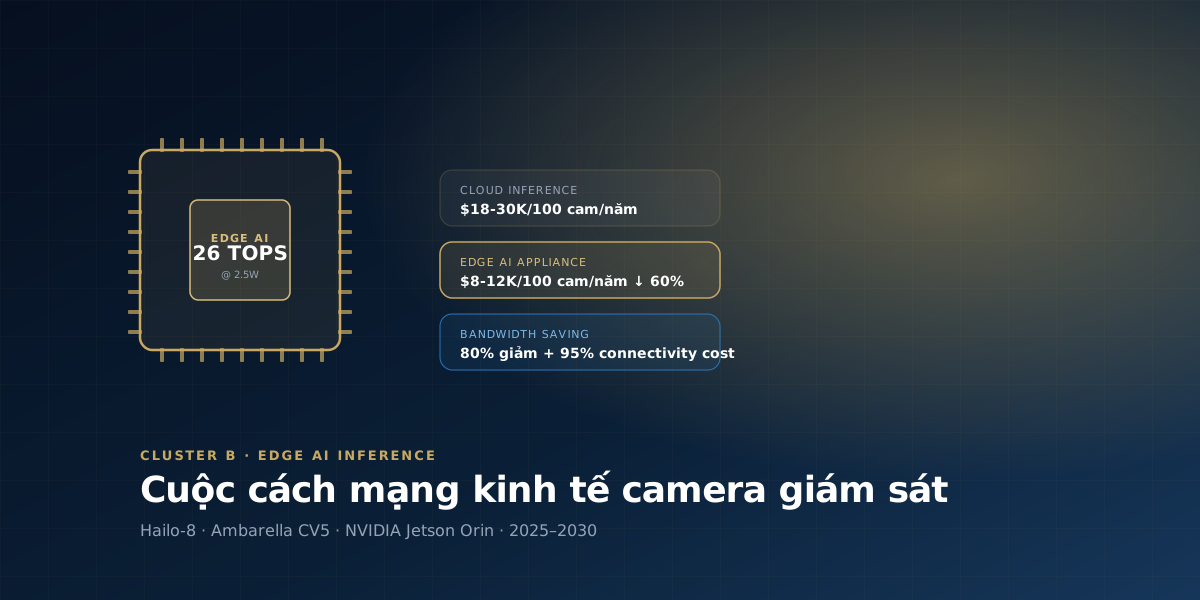
Edge AI inference pushes most AI processing from cloud servers to dedicated chips in cameras or NVRs — reducing cloud inference bills by 30-40%, bandwidth by 80%, and connectivity costs by up to 95% for metadata-only deployments. Three chips dominate the security industry in 2026: Hailo-8 (Israel, 26 TOPS @ 2.5W for individual cameras), Ambarella CV5 (USA, 5nm, single-8K or 4×4K for multi-imager), NVIDIA Jetson Orin (67-275 TOPS for gateways and NVRs). Vendor cameras currently using: Hikvision Acusense (proprietary chip), Avigilon H5A has switched from Ambarella to Intel Movidius, Bosch CPP16 brings edge VLM to cameras in 2026, Axis ARTPEC-9 (11/2024) delivers 3x performance over ARTPEC-8.
Why is 2026 the pivotal year for Edge AI cameras?
Camera surveillance generation 2018-2023 mainly processed AI in the cloud or central NVR. That pattern went far due to two reasons: on-camera chips were not powerful enough to run real deep learning, and Vietnam's enterprise Internet bandwidth was wide enough to stream video.
2024-2026 reverses this pattern. Three pressures push edge AI to the main axis:
- **Dedicated AI chip for cameras drops price 4-5x** in 24 months (Hailo-8, Ambarella CV5 entry-level)
- **Cloud inference cost increases** due to GPU AI prices on AWS/Azure rising 30-40% after the generative AI boom 2023-2024
- **Privacy compliance tightens** — Vietnam Decree 13/2023, EU AI Act, China PIPL encourage on-site biometric data processing instead of cloud upload
Economic math for 100 4K cameras operating 24/7:
- **Cloud inference + storage tier** ($15-25/camera/month according to Verkada/Rhombus public pricing): **$18,000-30,000/year**
- **Edge AI appliance** one-time + maintenance: **$8,000-12,000/year after amortization**
- **5-year TCO 30-60% lower** with high-volume video (>100 cameras). At smart city / large warehouse scale, year-1 data plan often exceeds hardware cost
Forasoft and Clarifai report edge deployment reduces **80% bandwidth** (sending only alerts + short clips instead of full stream) and **95% connectivity cost** in metadata-only deployment — cameras send only event tags, no raw video. This is a decisive savings for multi-branch enterprises in Vietnam with high Internet leased line costs.
Edge AI vs Cloud AI — architectural differences and when to use which
There are 3 AI deployment models for surveillance cameras:
### Cloud AI (model 2018-2023, still in use)
Camera streams video to a cloud server. The AI model runs on large GPUs (NVIDIA H100, AWS Inferentia). Suitable when: the business has few cameras (<50), no onsite IT team, prioritizes SaaS to reduce CAPEX. Limitations: high long-term subscription costs, 200-500ms latency, dependent on Internet, data sovereignty issues.
### Edge AI on-camera (2024-2026 main axis)
AI chip in the camera processes real-time on-site. Only sends metadata + alert clips to the server or cloud. Suitable when: the business has >100 cameras, multi-branch deployment, prioritizes privacy, has an onsite IT team. Limitations: camera AI chip limited to 1-5W power, insufficient for running heavy VLM (still requires intermediate appliance).
### Hybrid edge-cloud (default architecture 2026)
Camera handles light AI processing (object detection, attribute tag) at the edge. Intermediate appliance handles heavy AI processing (VLM search, multi-camera correlation). Cloud only stores archives and admin. This is the architecture most vendors are pushing: Hikvision AcuSeek NVR, Avigilon AI Appliance 2X, Bosch CPP16 chipset roadmap 2026.
**Practical rules** for choosing a model:
- Under 30 standalone cameras → cloud AI (Verkada, [Hanwha](/thuong-hieu/hanwha-vision/) Wisenet WAVE Cloud)
- 30-100 cameras at 1 branch → edge AI on-camera + local NVR
- 100+ cameras across multiple branches → hybrid edge-cloud, intermediate appliance per site
- Data-sensitive businesses (banks, US-EU FDI, government projects) → prioritize edge + fully on-premise
Three dedicated chips dominate the security camera industry in 2026
### Hailo-8 (Israel) — entry-mid range standalone camera chip
**Specs**: 26 TOPS (INT8), TDP 2.5W, form factor M.2 / mPCIe. On-die integrated memory.
**Vendor adoption**: Vicon Industries (security camera) integrated with Paravision face recognition, QNAP QVR Face NVR, Frigate NVR open-source, Dell ruggedized gateway, Limelight 4 smart camera (CES 2025).
**Best suited for**: Entry-mid range standalone cameras requiring edge AI on-camera with low power budget. Lowest cost among the 3 chips — popular for large-scale deployments of 500+ cameras.
### Ambarella CV5 (USA) — multi-imager chip
**Specs**: 5nm process, single-8K or 4×4K@30fps, under 2W power, dual ARM A76. CV5S (multi-imager 4×8MP) and CV52S (single sensor advanced AI) are dedicated security lines.
**Vendor adoption**: Ambarella does not disclose official TOPS. Historically present in many Chinese OEMs and Western tier-2 vendors since 2021. Vendor information from 2025 onward is not publicly detailed — this is a trade secret.
**Best suited for**: Multi-sensor 360° cameras (PNM-style of [Hanwha](/thuong-hieu/hanwha-vision/)) saving 4-6 cameras at a single location. Power efficiency is the strongest advantage for outdoor cameras.
### NVIDIA Jetson Orin (USA) — gateway/NVR/AI appliance
**Specs**: Orin Nano 67 TOPS @ 7-25W, Orin NX 157 TOPS @ 10-40W, Orin AGX 275 TOPS @ 15-60W.
**Best suited for**: Gateway / NVR / AI appliance rather than standalone cameras due to high power budget. Currently the most powerful platform for transformer / VLM edge. **[Milestone](/thuong-hieu/milestone-systems/) Hafnia VLM runs on NVIDIA Cosmos** — inheriting Jetson architecture.
### Security camera vendor × chip comparison table
| Vendor | Camera series | Chip / SoC | Notes |
|---|---|---|---|
| [Hikvision](/thuong-hieu/hikvision/) | Acusense, DeepinView | Hisilicon proprietary + dedicated NPU | NPU classifies human/vehicle/other on-device, claims 90% false alarm reduction |
| [Avigilon](/thuong-hieu/avigilon/) | H5A | Intel Movidius (switched from Ambarella legacy) | Server-side AI via AI Appliance 2X for VLM features |
| [Bosch](/thuong-hieu/bosch-security/) | IVA Pro / IVA Pro Context | CPP4/6/7, CPP13/14, CPP16 (edge VLM 2026) | New CPP16 capable of running visual language model on-camera |
| [Axis](/thuong-hieu/axis-communications/) | ARTPEC-9 (11/2024) | In-house ARTPEC SoC | 3x processing power compared to ARTPEC-8, supports AV1 |
| [Dahua](/thuong-hieu/dahua/) | WizMind 5 | HiSilicon or licensed Ambarella CV22 | Pure deep-learning classification, no VLM as of 04/2026 |
| [Hanwha](/thuong-hieu/hanwha-vision/) | Wisenet 9 series | Wisenet 9 SoC dual NPU | 3x inference of Wisenet 7, launched 04/2025 |
Important note for Vietnam projects: **Avigilon has switched from Ambarella to Intel Movidius** — a notable fact when comparing chip vendors. This chip supplier change affects the firmware ecosystem and update path.
Four Edge AI use cases with clear ROI in 2026
### Retail chain with 50+ branches — bandwidth saving
A chain of 50 stores × 8 cameras/branch = 400 cameras. Old cloud AI pattern: 400 continuous 4K streams to central server = ~4 Gbps total bandwidth. Edge AI pattern: cameras process locally, only upload event clips + metadata = ~50 Mbps total. **Saves 98% bandwidth**, enough for each branch to use a 30-50 Mbps leased line instead of 200+ Mbps. This translates to 70-80% savings in annual enterprise Internet costs.
### FDI factory with 200+ cameras — privacy compliance
FDI factories have strong privacy requirements, especially US-EU FDI must comply with GDPR and Vietnam Decree 13/2023. Edge AI on-camera processes tagging and detection locally — no video frames uploaded over the internal network. Audits are easier to pass because frames never leave the edge device. Vendors like [Bosch](/thuong-hieu/bosch-security/) IVA Pro Context CPP16 (2026) are specifically designed for this use case.
### Grade A building — multi-imager 360° saves cameras
One PNM multi-imager 4-channel ([Hanwha](/thuong-hieu/hanwha-vision/) using Ambarella CV5S) replaces 4-6 individual cameras in lobbies and hallways. Saves 60-70% on installation costs + reduces blind spots through single-vendor configuration. Edge AI on the multi-imager processes 4×4K streams simultaneously without requiring a powerful NVR.
### Smart city / traffic — no-frame-sending
Traffic surveillance cameras need continuous 30 fps processing for LPR, traffic flow, incident detection. Cloud AI is not feasible due to latency. Hailo-8 or Ambarella CV5 on traffic cameras process locally, only upload alerts + thumbnails when events occur — reducing data plan by 95% for urban surveillance networks with 1,000+ cameras.
Which Edge AI chip will Vietnamese enterprises choose in 2026?
**Step 1 — Determine the camera vendor first, chip later.** Vietnamese enterprises typically do not design chips themselves — choose the camera vendor (Hikvision, Dahua, Axis, Bosch, Hanwha) and the chip follows. The vendor has optimized the firmware for the specific chip; purchasing loose individual chips has no practical meaning.
**Step 2 — Decide the architecture based on scale**:
- 30-100 cameras per branch → Hikvision AcuSense or Dahua WizMind 5 with Hisilicon NPU chip
- 100-500 cameras across multiple branches → Hybrid: edge AI on-camera (Hikvision/Dahua) + intermediate AI Appliance (Avigilon AI Appliance 2X or Hikvision AcuSeek NVR)
- 500+ enterprise cameras → Mid-tier camera ([Bosch](/thuong-hieu/bosch-security/) CPP14, [Axis](/thuong-hieu/axis-communications/) ARTPEC-9) + VLM appliance (Bosch CPP16 2026, Milestone Hafnia)
- Multi-sensor 360° at lobbies and entrances → [Hanwha](/thuong-hieu/hanwha-vision/) PNM with Ambarella CV5S
**Step 3 — Measure 5-year TCO, not just initial price.** Hikvision/Dahua cameras are 30-50% cheaper than Axis but have a design lifespan of 4-5 years compared to Axis's 8-10 years. Calculate the total project TCO: replacement costs, firmware update costs, vendor migration costs after end-of-life.
An Ninh Số recommends **not locking into a single chip vendor** for long-term projects. ONVIF Profile S/G/T compatibility is a default requirement to allow mixing cameras from multiple brands — protecting investment when a vendor end-of-life a product line. [Contact us for consultation](/lien-he/) so the An Ninh Số engineering team can analyze your specific scale and propose the optimal chip + camera combination.
Trends Edge AI 2026-2030 — four predictions
### 1. Discriminative → Generative shift
Edge SoCs are beginning to natively support transformers / LLMs / VLMs, not just CNNs. Smartphone NPUs in 2025 will reach 10-45 TOPS @ 0.5-5W — this pattern is spreading to security cameras. **Bosch CPP16 (2026) is the first Western vendor to bring edge VLM down to the camera**, without requiring an intermediate appliance.
### 2. Memory bandwidth is the new bottleneck
3D-stacked DRAM is being adopted for next-gen inference chips because transformers are very memory-hungry. This is why the Jetson Orin AGX has a high price and high TDP — memory bandwidth is more important than raw TOPS.
### 3. AI chip for edge inference market CAGR 23.7% (2026-2034)
The main driver is generative AI at the edge. Investment in edge AI chips is scaling up significantly, according to a Research Intelo report. Chip costs are expected to decrease by 30-40% over the next 24 months as mass production scales.
### 4. Clear separation between standalone cameras vs. appliances/NVRs
Standalone cameras (Hailo-8, Ambarella CV5, ARTPEC-9) handle classification + light VLM. Appliances/NVRs (Jetson Orin, AcuSeek, AI Appliance 2X) handle heavy VLM + multimodal search. **Hybrid edge-cloud is becoming the default architecture for enterprises**.
Vietnamese enterprises deploying new systems in 2026 should design their architecture from the start based on this hybrid pattern — not locked into pure cloud (like Verkada) or pure on-premise (like a simple NVR). Flexibility between the two models depending on the camera segment is the most practical pattern.