TL;DR
TL;DR: Frictionless visitor management for Grade A buildings eliminates the security process of calling tenants for confirmation — instead, tenants send mobile passes via app, and guests self-check-in at lobby kiosks. HID Origo Mobile Access, Honeywell Pro-Watch Integrated, and Lenel OnGuard integrated with tenant portals reduce processing time by 60-80%, increase tenant satisfaction by 30-50%, and decrease security workload by 40-60%. ROI is recovered within 18-24 months through labor savings and increased rental value. Deployment takes 30-60 days for buildings with 20-40 floors.
Why traditional visitor management frustrates Grade A building tenants?
The traditional visitor process at a Grade A building in Vietnam takes 8-15 minutes per guest: security logs in, calls the tenant for confirmation, waits for a response, prints a temporary card, and provides elevator guidance. Tenants are interrupted 3-8 times a day by confirmation calls — especially annoying during meetings or focus work. Guests wait in the lobby for 5-12 minutes, creating an unprofessional impression.
Enterprise tier-1 businesses leasing space in Grade A buildings expect an experience equivalent to a 5-star hotel — guests are welcomed immediately without waiting for confirmation. The manual phone-based process does not scale when a building has 30-50 tenants and 200-400 visitors per day. Security guards become overloaded, leading to errors: forgetting to call, calling the wrong room, or letting guests onto the wrong floor.
An Ninh Số found that tenants are willing to pay 8-15% higher service fees if the building provides frictionless visitor management — this factor directly affects lease renewal decisions. Grade A building owners need to upgrade their [access control](/giai-phap/kiem-soat-ra-vao/) system to retain tenants and increase the occupancy rate in 2026.
How does frictionless visitor management for Grade A buildings work?
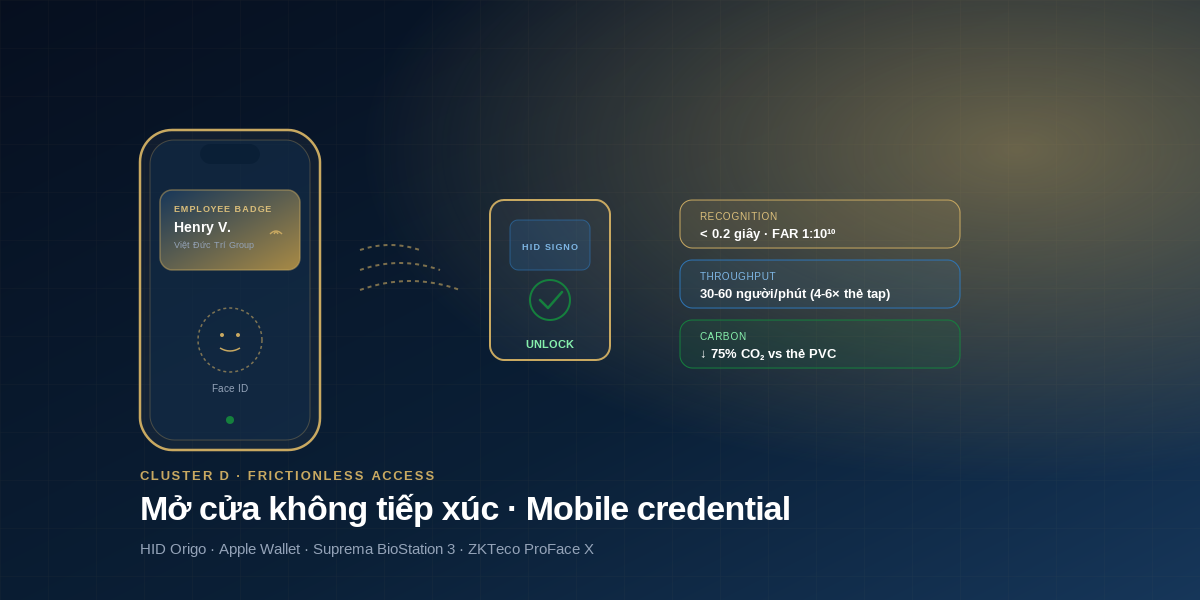
Workflow frictionless eliminates the phone confirmation step by transferring control to the tenant. The tenant creates a visitor pass via web portal or mobile app 1-48 hours in advance — entering the guest's name, time, purpose, and sending a QR code/NFC pass via email or SMS. The guest arrives at the lobby, scans the QR at an automated kiosk or taps NFC at the turnstile — the system authenticates the pass, prints a temporary badge, and opens the elevator to the correct floor.
Security guards only monitor a dashboard instead of handling each guest — intervening only when there are alerts for expired passes, guests without passes, or abnormal behavior. The tenant receives real-time notification when the guest checks in at the lobby, helping them prepare to welcome or send staff down. The system fully logs entry/exit history for audit and compliance.
[HID Global](/thuong-hieu/hid-global/) Origo Mobile Access integrates with the tenant portal, allowing the creation of one-time or recurring passes — suitable for frequent guests like maintenance contractors. [Honeywell](/thuong-hieu/honeywell-security/) Pro-Watch Integrated connects BMS and elevator destination dispatch — guests are assigned to optimal elevators, reducing wait times. [Lenel S2](/thuong-hieu/lenel-s2/) OnGuard integrates video analytics to alert for tailgating or guests going to the wrong floor.
### Measurable benefits for tenants and building owners
Tenants save 60-80% of guest processing time — no interruptions from confirmation calls, self-manage guest lists, and receive notifications instead of waiting for security to report. Guests have a better experience: check-in in 1-2 minutes instead of 8-15 minutes, no need to explain their purpose to security, and automatically reach the correct floor.
Building owners reduce lobby security workload by 40-60% — reassign 2-3 staff to monitoring or floor patrol. Labor costs save $1,500-3,000/month for a 30-50 floor building. Tenant satisfaction increases by 30-50% according to internal surveys — a key factor in retaining tenants and increasing renewal rates by 10-20%.
Three enterprise vendors for visitor management in Vietnam’s Grade A buildings
The Vietnamese market has three main vendors providing frictionless visitor management solutions integrated with [access control](/giai-phap/kiem-soat-ra-vao/) enterprise: HID Global, Honeywell, and Lenel S2. All three support mobile credential, tenant portal, and elevator integration — the differences lie in deployment complexity and cost.
| Vendor | Platform | Strengths | License Cost | Deployment Time |
|--------|----------|-----------|--------------|-----------------|
| HID Global | Origo Mobile Access + VertX controller | Gold standard mobile credential, integrates with 200+ elevator systems | $8-15K for 5,000 credentials | 30-45 days |
| Honeywell | Pro-Watch Integrated | Deep BMS and destination dispatch integration, unified dashboard | $12-20K for a 30-50 floor building | 45-60 days |
| Lenel S2 | OnGuard + BlueDiamond mobile | Integrated video analytics, detailed audit trail for compliance | $10-18K for 10,000 cardholders | 40-60 days |
[HID Global](/thuong-hieu/hid-global/) Origo is suitable for buildings prioritizing mobile credential and fast integration — the tenant app iOS/Android allows pass creation in 30 seconds, sent via SMS or email. Origo supports NFC and Bluetooth Low Energy (BLE) — guests use smartphones as credentials instead of temporary cards. Lowest hardware cost: $150-250/door for VertX controller and reader.
[Honeywell](/thuong-hieu/honeywell-security/) Pro-Watch Integrated is suitable for buildings already using Honeywell BMS — integrating HVAC, lighting, and fire alarm on the same platform reduces operational costs. Destination dispatch automatically assigns elevators to guests based on destination floor — reducing peak hour wait times by 20-30%. The unified dashboard allows facility managers to monitor visitors, energy, and maintenance on one screen.
[Lenel S2](/thuong-hieu/lenel-s2/) OnGuard is suitable for buildings requiring detailed audit trails — full logs of who created the pass, who approved it, when the guest entered, and on which floor and for how long. Integrated video analytics alerts for tailgating or guests going to the wrong floor — security receives real-time alerts for intervention. OnGuard scales well for multi-building complexes: centrally managing 5-10 buildings from one server.
ROI of frictionless visitor management upgrade for Grade A buildings
The cost of upgrading to frictionless visitor management for a 30-50 floor building ranges from $25-45K: software license $10-20K, 2-3 automatic kiosks $8-15K, elevator integration $5-8K, and deployment $2-5K. Operating costs increase by $200-400/month for cloud hosting, tenant portal, and mobile credentials.
Savings on security personnel $1,500-3,000/month — shifting 2-3 staff from guest processing to monitoring or patrol. Tenant satisfaction increases by 30-50%, helping retain tenants — each tenant renewing for an additional 1-2 years saves $5-10K in new tenant acquisition costs and vacancy time. Building owners can increase service fees by 5-10% when providing a frictionless experience — enterprise tenants are willing to pay more for enhanced amenities.
Payback period is 18-24 months for buildings with occupancy ≥70%. New buildings or those seeking tenants achieve faster payback of 12-18 months because frictionless visitor management is a major selling point during leasing — tenants directly compare with other buildings. An Ninh Số observes that building owners prioritize upgrading visitor management over AI cameras or analytics because the ROI is clearer and tenants experience it directly.
### Factors Affecting ROI
Current occupancy rate — buildings with ≥80% occupancy achieve faster payback because a larger tenant base shares the cost. Tenant type — FDI enterprises or tier-1 Vietnamese enterprises value frictionless experience more than SMEs. Existing integration — buildings already using HID/Honeywell/Lenel for KSRV reduce upgrade costs by 30-50% since controllers don't need replacement.
Building owners should pilot on 1-2 floors before full building rollout — collect tenant feedback and adjust workflows. A 4-6 week pilot helps identify pain points: tenants unfamiliar with the app, guests not knowing how to use kiosks, or elevators not integrating correctly. Pilot cost is $5-8K — much less than fixing errors after full building deployment.
Implementation visitor management frictionless — timeline 30-60 days
Implementing frictionless visitor management for a 20-40 floor building takes 30-60 days depending on the complexity of elevator and BMS integration. Phase 1 (weeks 1-2): survey current KSRV status, determine lobby kiosk locations, check network, and plan elevator integration. Phase 2 (weeks 3-4): install server, deploy tenant portal and mobile app, configure credential format, and test workflow.
Phase 3 (weeks 5-6): install lobby kiosks, integrate elevator destination dispatch, and conduct end-to-end testing from tenant pass creation to guest check-in. Phase 4 (weeks 7-8): train tenant admins and security guards, pilot 1-2 floors, and collect feedback. Full building rollout after successful pilot — notify tenants 1-2 weeks in advance for preparation.
### Common implementation challenges
Integration with old elevators — elevators ≥15 years old do not support destination dispatch, requiring controller upgrades or simple floor lockout. Elevator upgrade costs $3-8K/cabin — building owners must weigh ROI against frictionless benefits. Insufficient network — kiosks and controllers require Ethernet PoE, and older buildings may need new cabling costing $1-3K.
Tenant adoption — some tenants are unfamiliar with technology or concerned about guest data security. Solution: 1-on-1 training for tenant admins, provide instructional videos, and 24/7 hotline support for the first month. GDPR or [Decree 13/2023](/blog/nghi-dinh-13-2023-biometric-checklist-doanh-nghiep-vietnam/) compliance — FDI tenants require data residency and encryption. Enterprise vendors like HID/Honeywell/Lenel support on-premise deployment and GDPR compliance.
An Ninh Số recommends building owners work with integrators experienced in grade A buildings — avoid vendors who only handle SMEs or factories due to workflow differences. A good integrator provides 99.5% uptime SLA, 24/7 support, and free tenant training for the first 3-6 months.
2026 Visitor Management Trends — AI Receptionist and Autonomous Check-in
Visitor management 2026 is transitioning from frictionless to autonomous — AI receptionist handles guests without passes, chatbot guides guests via voice and facial recognition replacing QR codes. Verkada Guest adds AI receptionist 03/2025 — guests interact with on-screen avatars, AI identifies purpose and calls tenant automatically. Honeywell Pro-Watch 2026 roadmap integrates facial recognition for frequent guests — no smartphone required.
Mobile credential expands to [coworking and flex office](/blog/mobile-credential-coworking-flex-office-sharry-kisi/) — tenants renting by the hour or day need more flexible visitor management than traditional buildings. Sharry and Kisi patterns allow tenants to auto-generate passes when booking meeting rooms — guests receive credentials immediately after tenant confirms booking.
An Ninh Số observes that Grade A building investors in Vietnam are interested in AI receptionists to further reduce security personnel — but are waiting for vendors to demonstrate ≥95% accuracy before deployment. Facial recognition faces compliance challenges with [GDPR](/blog/gdpr-camera-workplace-fdi-my-eu-vietnam/) and Decree 13/2023 — requiring clear consent and Vietnam data residency. Vendors are developing hybrid mode: facial recognition for opt-in guests, QR codes for those declining biometrics.