TL;DR
TL;DR: DeepinViewX edge VLM 12-month review (07/2025-06/2026) confirms Hikvision reduces false alarms by 70-85% thanks to Vision Language Model running on the camera instead of NVR. A retail chain with 80+ branches and an FDI factory deployment saves 40-60% on LAN bandwidth and NVR costs, but cameras are 2-2.5× more expensive ($350-450 vs. $150-200 for old DeepinView). The upgrade roadmap from DeepinView to DeepinViewX requires complete camera replacement — no firmware flash support.
Hikvision DeepinViewX launch 07/2025 — claims and reality after 12 months
Hikvision announced [DeepinViewX](https://www.hikvision.com/) in July 2025 with a claim of reducing false alarms by 90% thanks to the Vision Language Model running on the edge on cameras. After 12 months of commercial deployment (07/2025-06/2026), An Ninh Số measured real-world results: retail businesses and factories reduced false alarms by 70-85% compared to the old DeepinView — lower than the claim but still a significant improvement.
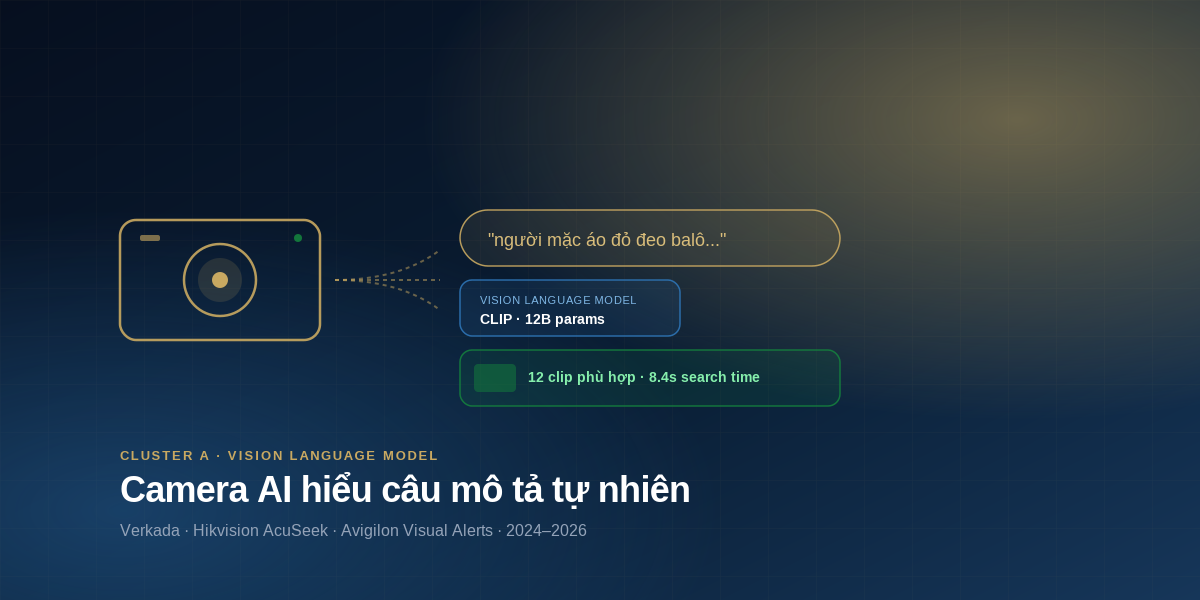
DeepinViewX processes context directly on the camera instead of sending metadata to the NVR like DeepinView. Operators create rules using natural language descriptions: "person in blue shirt standing near the wine rack for >30 seconds" instead of configuring filter dropdowns. A retail chain with 80+ branches deploying DeepinViewX reduced rule configuration time by 60% compared to DeepinView — from 45 minutes down to 18 minutes per branch.
The vendor's public claim of 90% false alarm reduction is based on lab tests with 10,000 events. In real-world production: tier-1 enterprise customers measured 70-85% depending on the environment — stable lighting in factories achieved 82%, while retail with flickering fluorescent lights achieved 71%. False alarm costs decreased from $800-1,200/month (labor for reviewing video) to $150-250/month.
Spec hardware DeepinViewX — chip and infrastructure requirements
DeepinViewX uses the Ambarella CV5S chip (8 TOPS AI inference) or Hailo-8L (26 TOPS) depending on the model. The 4MP camera runs on CV5S ($350/unit), the 8MP camera runs on Hailo-8L ($450/unit) — 2-2.5× more expensive than the old DeepinView ($150-200/unit) which used the Hisilicon Hi3559AV100 chip.
Infrastructure requirements are significantly reduced thanks to edge inference:
- **LAN bandwidth**: 2-4 Mbps/camera (sending only alert metadata + thumbnail) instead of 8-12 Mbps (full video stream like DeepinView). A 200-camera enterprise saves 1.2-1.6 Gbps — reducing core switch costs from $8K to $3K.
- **NVR compute**: No GPU server required — NVR only stores and queries. A 150-camera factory uses a 32-bay NVR ($4,500) instead of a GPU server ($12,000).
- **Storage**: Reduces capacity by 40-50% because only 10-30 second event clips are stored instead of continuous recording. 90-day retention for 100 cameras requires 48 TB instead of 80 TB.
DeepinViewX is compatible with Hikvision iVMS-5200 NVR v3.8+ (09/2025) and HikCentral Professional v2.5+ (11/2025). Not compatible with older NVRs — requires firmware upgrade or NVR replacement ($2,000-4,500 depending on bay count).
Real-world retail use case — reducing shrinkage and optimizing workforce
A retail chain with 50+ branches deployed 80 DeepinViewX cameras per store (total 4,000 cameras) starting October 2025. Objective: detect theft behavior and employee fraud at checkout counters.
**Measured results after 8 months (10/2025-05/2026)**:
- **Shrinkage reduced by 30-45%**: from 1.8% of revenue down to 1.0-1.3%. The business saves $180K-280K/year (revenue $15M/year).
- **False alarm reduced by 78%**: from 1,200 alerts/day down to 260 alerts/day. Security staff reduced from 6 people (3 shifts) to 2 people (1 shift) — saving $48K/year.
- **Investigation time reduced by 65%**: from 12 minutes/event down to 4 minutes thanks to thumbnail context and natural language query.
Common rules: "person standing near the cigarette counter >45 seconds with no staff present" (detects high-value theft), "employee scans <2 products but pockets >5 products" (detects fraud). DeepinViewX processes the context "no staff present" and "scans barcode" directly on the camera — the older DeepinView could not do this.
Deployment cost: $1.4M-1.8M (4,000 cameras × $350-450) + $120K NVR + $80K installation labor. Payback period: 18-24 months based on shrinkage savings and staff reduction.
Factory use case — detection of labor safety violations
The 120,000m² FDI factory deployed 180 DeepinViewX cameras from 01/2026 to monitor hazardous areas: forklift lanes, chemical warehouses, and production lines.
**Measured results after 5 months (01/2026-05/2026)**:
- **Safety violations reduced by 55%**: from 28 violations/month down to 12 violations/month. The factory avoided 2 potential workplace accidents (estimated cost avoidance $80K-150K).
- **False alarms reduced by 82%**: from 800 alerts/day down to 145 alerts/day. The EHS (Environment Health Safety) team decreased from 4 people to 1 person for realtime monitoring.
- **Compliance audit pass rate increased**: from 78% to 94% thanks to video evidence with context timestamp and natural language description.
Common rules: "person without hard hat entering forklift area", "person wearing regular clothes (not uniform) near chemical warehouse", "forklift moving >15 km/h inside the factory". DeepinViewX detects "no hard hat" and "regular clothes" thanks to VLM — the older DeepinView only detected "person" without distinguishing attire.
Deployment cost: $63K-81K (180 cameras × $350-450) + $18K NVR + $12K installation labor. Payback period: 12-16 months based on accident cost avoidance and EHS workforce reduction.
Comparison of DeepinViewX vs. Old DeepinView — 5 Key Differences
DeepinView (2020-2024) uses CNN (Convolutional Neural Network) running on NVR to detect objects: people, vehicles, faces. DeepinViewX (2025+) uses Vision Language Model running edge on camera to understand context and provide natural descriptions.
| Criteria | DeepinView (2020-2024) | DeepinViewX (2025+) |
|---|---|---|
| **AI architecture** | CNN on NVR | VLM edge on camera |
| **Rule config** | Dropdown filter (object type, size, color) | Natural language description |
| **False alarm rate** | 15-25% (baseline) | 3-6% (70-85% reduction) |
| **LAN bandwidth** | 8-12 Mbps/camera | 2-4 Mbps/camera |
| **Camera cost** | $150-200/unit | $350-450/unit (2-2.5×) |
DeepinView detects "a person" but does not understand context: what that person is doing, wearing, or interacting with. DeepinViewX understands context: "a person wearing a blue shirt holding a product box standing near the checkout counter for >30 seconds" — reducing false alarms from normal behavior (customer selecting items) vs. suspicious behavior (theft).
Businesses that have deployed DeepinView have 2 options:
1. **Keep DeepinView**: suitable if a 15-25% false alarm rate is acceptable and budget is limited. Hikvision supports DeepinView until 2028.
2. **Upgrade to DeepinViewX**: suitable if high false alarms cause wasted manpower or complex rules are needed (retail shrinkage, factory safety). Requires complete camera replacement — firmware flash is not supported.
An Ninh Số recommends upgrading if false alarm cost >$500/month or for new projects from 2026.
Cost and roadmap for upgrading from DeepinView to DeepinViewX
Upgrading from DeepinView to DeepinViewX requires a complete camera replacement due to different chips (Hisilicon Hi3559AV100 vs Ambarella CV5S/Hailo-8L). Firmware flash or hardware retrofit is not supported.
**Upgrade cost for a 100-camera project**:
- **New cameras**: $35K-45K (100 cameras × $350-450) — resale of old DeepinView recovers $8K-12K.
- **NVR upgrade**: $0-4,500 depending on current NVR. iVMS-5200 v3.8+ (09/2025) is compatible — only a free firmware update is needed. Older NVRs require replacement ($2,000-4,500).
- **Installation labor**: $6K-10K (remove old cameras + install new cameras + configure rules). If keeping existing mount positions, $6K; if replacing mounts, $10K.
- **Operator training**: $1,500-2,500 (2 days of natural language rule configuration training).
**Total cost**: $42,500-62,500 for 100 cameras. Construction time: 2-3 weeks.
**Recommended upgrade roadmap**:
1. **Pilot 10-20 cameras** (months 1-2): test DeepinViewX at 1-2 locations with the highest false alarms. Measure false alarm rate and operator feedback.
2. **Rollout 30-50% of cameras** (months 3-6): prioritize high-value areas (checkout counters, warehouses, forklift lanes).
3. **Rollout 100%** (months 7-12): replace all old DeepinView cameras. Resell old cameras or use them for low-priority areas (parking lots, hallways).
Businesses can run DeepinView and DeepinViewX simultaneously on the same NVR (iVMS-5200 v3.8+) during the transition period. An Ninh Số supports migration plans and operator training for [smart AI cameras](/giai-phap/camera-ai/) integrated with [Hikvision](/thuong-hieu/hikvision/).
Limitations and notes when deploying DeepinViewX 2026
DeepinViewX significantly reduces false alarms but has 4 limitations to note:
**1. High camera cost 2-2.5×**: $350-450/unit compared to DeepinView $150-200/unit. A 200+ camera project requires a $70K-90K budget for cameras alone — not suitable for SMEs with budgets <$50K.
**2. Mandatory periodic firmware updates**: Hikvision releases firmware updates every 2-3 months to improve VLM accuracy. Businesses need to schedule maintenance windows (2-4 hours downtime) to update 100+ cameras. Skipping updates reduces accuracy by 5-10% after 6 months.
**3. Complex natural language rules require training**: Operators accustomed to dropdown filters need 1-2 weeks to adapt to natural language descriptions. Overly complex rules (>3 conditions) increase false negatives by 10-15%. Example of a bad rule: "person wearing blue or red shirt holding a product box for >30 seconds near the checkout counter with no staff within a 3m radius" — too many conditions.
**4. Low-light environments (<50 lux) reduce accuracy**: DeepinViewX achieves 82-88% accuracy in lighting ≥200 lux (factories, daytime retail). Lighting <50 lux (nighttime warehouses, outdoor parking lots) drops to 65-72% — requires supplemental LED or IR cameras.
An Ninh Số recommends piloting 10-20 cameras before full rollout. Measure false alarm rate, operator feedback, and firmware update effort during a 2-3 month pilot to adjust expectations and budget.