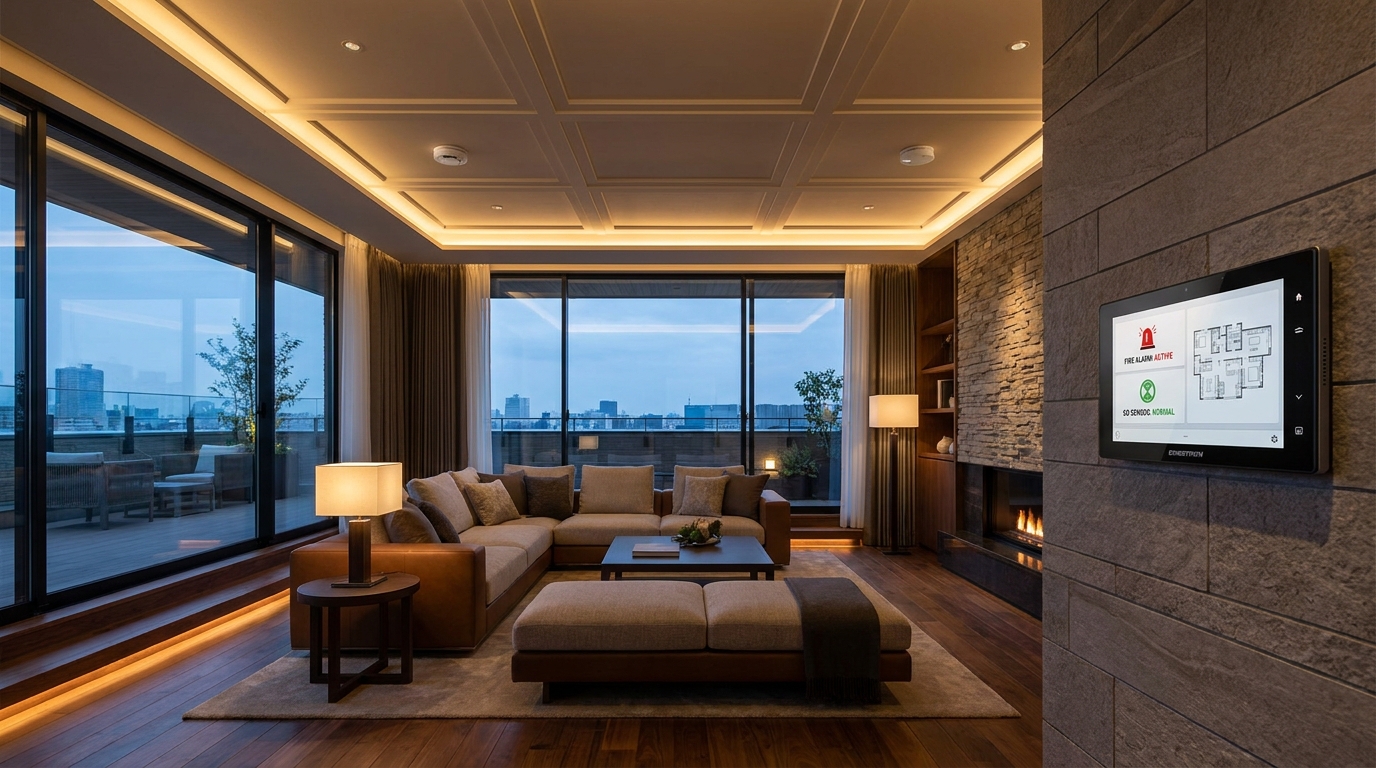
The fire alarm and CO sensor system for high-end villas is not just standalone equipment but an active protection layer, integrated with smart home platforms like Crestron or Lutron. In Vietnam, villas of 200-500m² typically invest 15-35 million VND for this solution, including photoelectric smoke sensors, electrochemical CO sensors, and BACnet/IP communication modules.
What components make up a villa fire alarm and CO sensor system?
A complete system includes: smoke sensors (ionization or photoelectric), heat sensors (rate-of-rise), CO sensors (electrochemical), a fire alarm control panel, alarm bells/sirens, communication modules for Crestron/Lutron, and a UPS backup power supply. Devices typically meet EN 54 or NFPA 72 standards to ensure reliability.
High-end villas often install photoelectric smoke sensors in hallways, living rooms, and bedrooms because they have fewer false alarms than ionization types. Heat sensors are placed in kitchens and garages to avoid interference from steam or cooking smoke. CO sensors are installed near fireplaces, gas water heaters, and basements — where CO gas easily accumulates. The control panel can be addressable, allowing precise identification of the fire zone and supporting automation scenarios.
Criteria for selecting smoke and heat sensors for smart villas
Photoelectric smoke sensors respond quickly to smoldering fires, suitable for bedrooms. Rate-of-rise heat sensors detect sudden temperature increases, ideal for kitchens and garages. Both should support BACnet, Modbus, or dry-contact protocols for integration with smart home villa systems.
- Photoelectric smoke sensors: Early detection of smoldering fires, sensitivity 0.5-2.0%/ft, low false alarms. Price: 1.5-3 million VND/unit.
- Ionization smoke sensors: Fast response to flaming fires, but prone to false alarms from steam. Price: 1-2 million VND/unit.
- Rate-of-rise heat sensors: Activates when temperature rises >8°C/minute or exceeds 57°C threshold. Price: 1.5-2.5 million VND/unit.
- Multi-criteria combination: Integrates smoke + heat + CO in one module, reducing false alarms by 60-70%. Price: 3-5 million VND/unit.
When integrated with Crestron, these sensors send signals via communication modules (e.g., Crestron C2N-IO or Lutron RA2 Select) to trigger scenarios: turn off HVAC, open curtains, turn on emergency lights, and send alerts via app.
CO sensors for villas: electrochemical or metal oxide type?
Electrochemical CO sensors offer high accuracy of ±5ppm, lifespan of 5-7 years, and low power consumption. Metal oxide (MOS) types are cheaper but easily affected by humidity and temperature, with a lifespan of only 2-3 years. For high-end villas, choose electrochemical types with UL 2034 or EN 50291 certification.
Dangerous CO concentrations: 50ppm for 8 hours causes headaches; 200ppm for 2-3 hours causes unconsciousness; 800ppm leads to death in 2-3 minutes. Electrochemical sensors allow flexible alarm thresholds: early warning at 30ppm, critical alarm at 100ppm. When integrated with Lutron, CO sensors can trigger scenarios: automatically open all windows, turn off gas water heaters, and make emergency calls via the intercom system.
| Parameter | Electrochemical CO Sensor | Metal Oxide CO Sensor |
|---|---|---|
| Accuracy | ±5ppm | ±15-25ppm |
| Lifespan | 5-7 years | 2-3 years |
| Power Consumption | <10µA | 50-200mA (requires heating) |
| Safety Standard | UL 2034, EN 50291 | Usually none |
| Reference Price | 2-4 million VND/unit | 0.5-1.5 million VND/unit |
For villas with basements or gas heating systems, install at least 1 electrochemical CO sensor per 200m², placed 1-2 meters away from windows and ventilation fans to avoid errors.
Integrating fire alarms with Crestron/Lutron: automation scenarios
Integration via dry-contact or BACnet/IP allows the automation system to respond immediately to fire or CO leaks. Typical scenarios: turn off HVAC to prevent smoke spread, open emergency exits, turn on emergency lights, send notifications via app, and activate alarms throughout the villa.
For example, with Crestron 3-series or 4-series, you program logic: if smoke sensor zone 1 activates → turn off first-floor air conditioning, open window curtains, turn on hallway lights, send an alert email to security. With Lutron RadioRA 3 or HomeWorks, similar scenarios are set up via Pico remote or app, combined with CO sensors to automatically open windows when CO levels exceed thresholds. Integration costs an additional 5-10 million VND for communication modules and programming.
This integration also allows remote monitoring via app, checking battery status, alarm history, and periodic testing. Some high-end systems support the Matter 1.3 protocol (2025), ensuring compatibility with Apple HomeKit, Google Home, and Alexa — aligning with the trend of smart home installation for high-end villas.
Installation cost for fire alarms and CO sensors for villas 200-500m²
Average cost is 15-35 million VND for a 200-500m² villa, including: 4-8 smoke/heat sensors (8-16 million VND), 2-4 CO sensors (4-12 million VND), a control panel (4-8 million VND), Crestron/Lutron integration module (3-5 million VND), and installation labor (3-5 million VND). Costs may increase by 20-30% if fire safety certification or AI camera integration is required.
Reference price list (excluding VAT):
- Honeywell photoelectric smoke sensor: 1.8-2.5 million VND/unit
- Bosch FCP-500 smoke sensor: 2-3 million VND/unit
- Honeywell C2-6 electrochemical CO sensor: 2.5-4 million VND/unit
- Bosch B5512 addressable control panel: 6-8 million VND
- Crestron C2N-IO communication module: 3-5 million VND
- Installation labor: 3-5 million VND (depending on complexity)
To optimize costs, you can combine this package with the smart home system quote for villas 200-500m² from An Ninh Số, saving 10-15% on labor and equipment costs when deploying synchronously.
Notes on installation and maintenance of villa fire alarm systems
Smoke and CO sensors need periodic checks every 6 months, battery replacement once a year, and replacement after 5-7 years. Installation positions: smoke sensors 10-30cm from the ceiling, CO sensors 1.5-1.8m from the floor (breathing level). Avoid installing near windows, ceiling fans, or humid areas to reduce false alarms.
Additionally, check the connection to the automation system after each maintenance. If the villa already has smart villa cameras, you can program hybrid scenarios: when a smoke sensor activates, AI cameras confirm the fire before calling the fire department, reducing false alarms by 50-60%.
Frequently Asked Questions
Should a CO sensor be installed in the bedroom?
Yes. CO is a colorless, odorless gas, slightly heavier than air, and easily accumulates at low levels. Installing a CO sensor in the bedroom (1-2 meters away from the bed) helps detect leaks from gas water heaters or fireplaces while sleeping. Choose an electrochemical type with a ppm concentration display.
Does the fire alarm system integrated with Crestron require separate wiring?
It can use wireless (Zigbee, Z-Wave) or wired (RS-485, BACnet). For high-end villas, wired is recommended for reliability and to avoid signal interference. The Crestron C2N-IO communication module receives dry-contact signals from the fire alarm control panel and converts them into automation commands.
What is the annual maintenance cost for a villa fire alarm system?
Approximately 2-4 million VND/year, including: sensor checks, battery replacement, probe cleaning, and Crestron/Lutron connection testing. If replacing sensors after 5-7 years, the cost increases by an additional 10-15 million VND.
Do photoelectric smoke sensors have many false alarms?
Fewer than ionization sensors. Photoelectric sensors only alarm when smoke particles are >1 micron, while ionization sensors react to tiny particles (0.1-0.5 micron) like steam or dust. However, false alarms can still occur if installed near range hoods, ovens, or steam rooms.
Does the fire alarm system need fire safety certification?
Yes. In Vietnam, fire alarm systems for high-end villas must comply with TCVN 5738:2021 and be approved by the Fire Prevention Police if the property is a combined residential-commercial building or a villa in an urban area. Request the installer to provide completion documents and certification.
Contact An Ninh Số via hotline 0796 700 777 or email [email protected] for consultation on installing fire alarm & CO sensor systems integrated with Crestron/Lutron for your villa. The technical team offers free site surveys and detailed quotes within 24 hours.