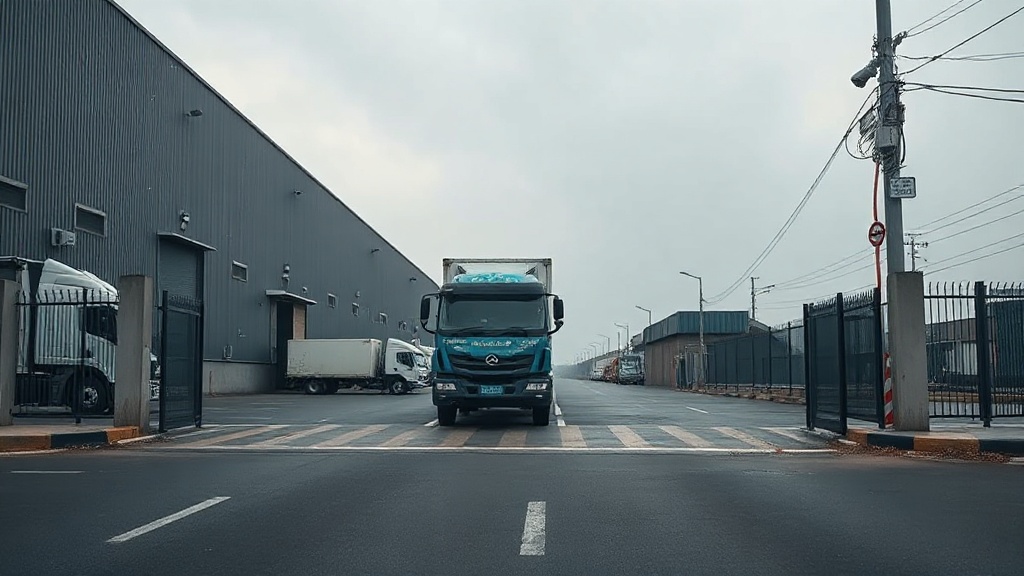
The vehicle control system for manufacturing plants is a combination of automatic barriers, license plate recognition (LPR) cameras, RFID card readers, and centralized management software, enabling real-time control of truck and employee vehicle flow. In Vietnam, industrial parks such as VSIP, Trảng Bom, and Bắc Ninh are heavily investing in this solution to reduce gate congestion time by 40-60% and prevent cargo loss.
What equipment does the vehicle control system for manufacturing plants include?
A complete system includes automatic barriers (choose a type with a 3-5 ton load capacity for trucks), LPR cameras for license plate recognition, RFID card readers for familiar vehicles, loop detectors or radar to prevent barrier drops, and centralized management software. Depending on the scale, information display screens, ticket printers, and vehicle counters can be added.
The core equipment is the automatic barrier — choose a barrier arm 4-6 meters long, with a 24V DC or AC motor, and an opening/closing time of 1-3 seconds. For plants with heavy trucks, prioritize heavy-duty barriers with a steel frame and IK10 impact resistance. LPR cameras should be 2MP or higher, with integrated infrared lights, capable of recognizing Vietnamese license plates (white plates, yellow plates) with over 95% accuracy. UHF RFID readers allow familiar vehicles to pass without stopping, reducing wait time to 2-3 seconds per vehicle.
Technical criteria for selecting barriers for heavy trucks
Barriers for manufacturing plants differ from office barriers in mechanical durability and load capacity. Check: barrier arm length (4-6 meters), motor (DC 24V for high frequency), wind resistance (level 8-10), and integrated safety sensors. Heavy-duty barriers typically weigh 50-80 kg, have a powder-coated steel frame, and IK10 impact resistance.
For plants with a traffic volume of 100-300 trucks per day, choose a DC 24V motor barrier with an opening/closing time of 1-2 seconds and a motor lifespan of over 1 million cycles. The barrier arm should be made of aluminum alloy or fiberglass with LED indicator lights. Loop detectors or radar to prevent barrier drops are mandatory to avoid collisions when vehicles haven't fully passed. If the plant gate is frequently exposed to strong winds, choose a barrier with an automatic mechanical lock and a manual mode for power outages.
Comparison of 3 popular vehicle control methods
There are three main methods: RFID cards (familiar vehicles), LPR (license plates), and paper tickets/QR codes (unknown vehicles). Each method suits different operational scenarios. The table below compares cost, speed, and accuracy.
| Method | Investment cost (million VND/lane) | Gate pass-through speed (seconds/vehicle) | Accuracy | Suitable for |
|---|---|---|---|---|
| UHF RFID Card | 15-25 | 2-3 | 99% | Company vehicles, long-term contract vehicles |
| LPR Camera | 20-35 | 3-5 | 95-98% | Unknown vehicles, delivery vehicles, guests |
| Paper Ticket / QR Code | 5-10 | 8-15 | 90% | Occasional vehicles, events |
In practice, plants should combine at least two methods: RFID for familiar vehicles (accounting for 70-80% of traffic) and LPR for unknown vehicles. This reduces the burden on security guards and increases traffic flow speed by 3-4 times compared to manual methods.
Case study: Vehicle control deployment at a 2000m² plant
Tân Phát mechanical plant (Bình Dương) has a traffic volume of 150 trucks per day, frequently experiencing gate congestion during peak hours. Before the upgrade, the average wait time was 15-25 minutes per vehicle. An Ninh Số deployed a solution combining the Kapaisi KPS-KJ-9001 heavy-duty barrier, Kapaisi LPR Module camera, and UHF RFID reader. Results after 3 months: gate pass-through time reduced to 3-5 seconds per vehicle, an 80% reduction in driver complaints, and 3 cases of license plate fraud detected through data cross-referencing.
The solution includes 2 entry lanes and 1 exit lane, a DC 24V motor barrier with a 5-ton load capacity, and a 2MP LPR camera with integrated AI for license plate recognition in low-light conditions. The management software allows admins to view vehicle entry/exit reports by day, week, month; and alerts when unknown vehicles intentionally enter the familiar vehicle lane. The total investment cost is approximately 80-120 million VND, with an expected payback period of 8-12 months thanks to savings on security personnel and reduced losses.
Integrating vehicle control systems with KSRV and timekeeping
An effective vehicle control system needs to integrate with access control (KSRV) and timekeeping to create a unified data flow. When a vehicle enters, the system records the license plate, time, and automatically links it to employee data (if the vehicle is registered). This helps manage driver working hours, control vehicles leaving outside office hours, and alerts when vehicles stay beyond the permitted time.
For example, when a registered company truck enters the gate at 7:30 AM, the system records it and automatically clocks in the driver (if integrated with ZKTeco or Suprema timekeeping machines). When the vehicle exits, the system compares the time with the delivery schedule, alerting if the vehicle returns 15-30 minutes late. This data can be exported for HR and logistics departments. This solution is particularly useful for plants with many after-hours delivery vehicles or 24/7 operations.
Construction and installation process for vehicle control systems
Installing a vehicle control system for a plant requires following a process: site survey (traffic volume, vehicle types, electrical infrastructure), design of equipment layout drawings, trenching for cables, pouring concrete for barrier foundations, equipment installation, software configuration, and acceptance testing. Average construction time is 3-5 days per lane.
Some notes: the barrier foundation needs to be 40-60 cm deep, poured with concrete grade 200 or higher, with embedded bolts. Signal cables should be run separately from power cables, using waterproof conduits. LPR cameras should be installed at a height of 2-2.5 meters, with a 30-45 degree angle relative to the road surface. Loop detectors need to be placed 5-7 cm deep under the road surface, 1-1.5 meters from the barrier. The management software needs to be configured to synchronize with employee and vehicle data from the existing KSRV system.
Frequently Asked Questions
Yes. Most current systems support integration with AI cameras via ONVIF protocol or API. You can connect to Hikvision cameras or Dahua cameras for license plate recognition, collision detection, or intrusion alerts in restricted areas.
Costs range from 80-150 million VND for 2-3 vehicle lanes, including barriers, LPR cameras, card readers, software, and installation. For plants with higher requirements (integration with KSRV, timekeeping), costs can reach 200-300 million VND. Average payback period is 8-18 months.
Yes. Automatic barriers usually have a backup battery for 50-100 open/close cycles. Additionally, the system has a manual mode (crank) for hand operation. LPR cameras and card readers should be connected to a UPS to ensure continuous operation for at least 30 minutes during a power outage.
High-quality LPR cameras have integrated infrared lights and anti-noise AI algorithms, ensuring 90-95% accuracy even in heavy rain or fog. Choose cameras with an IP67 waterproof rating or higher and install a rain shield if necessary.
Yes. The management software allows classifying vehicles into groups (trucks, cars, employee vehicles, guest vehicles) and configuring priority rights. For example, trucks are only allowed through gate 1, employee vehicles through gate 2, and guest vehicles need prior registration. The system automatically rejects vehicles in the wrong lane or without authorization.
No. The vehicle control system can integrate with old barriers if they have a communication port (RS485, dry contact) or a compatible DC/AC motor. An Ninh Số can upgrade by adding LPR cameras, card readers, and management software without replacing the barrier, saving 30-50% in costs.
Contact us immediately at 0796 700 777 for a consultation on a vehicle control solution for your manufacturing plant that fits your scale and budget.