TL;DR
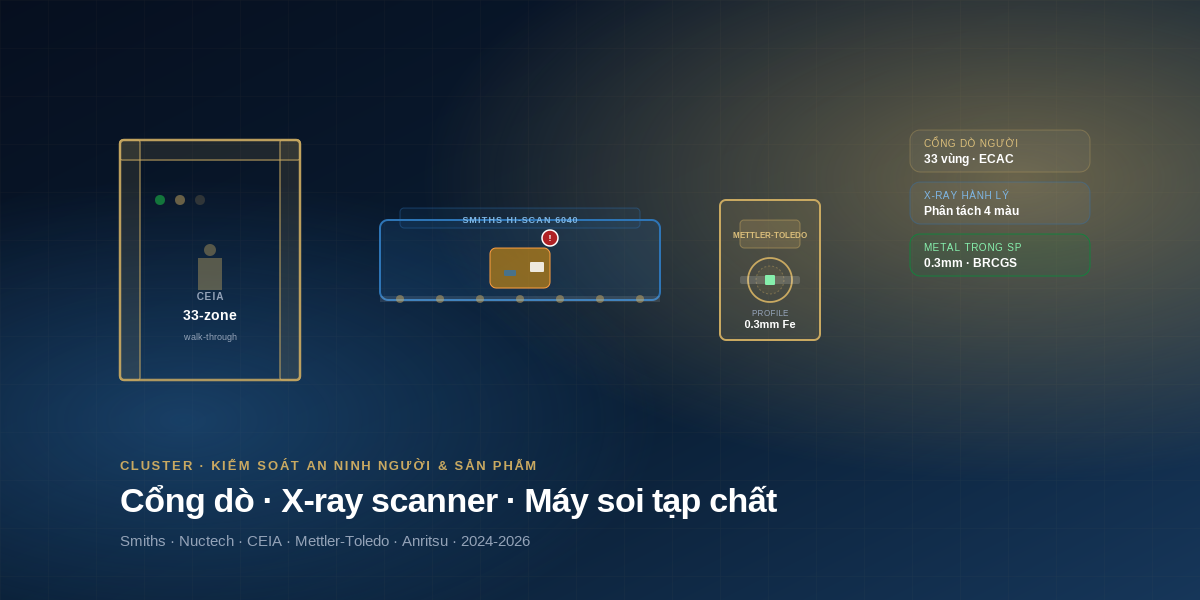
TL;DR: BRCGS audit requires food factories to demonstrate 100% metal detection of products with automatic audit trail. Mettler-Toledo Profile detects 0.3mm Fe in bread/snacks, integrates ProdX Software to log realtime reject records and export BRCGS-ready reports. Cost $18K-35K/line is higher than Anritsu Sentinel ($12K-22K) but passes audit 3-6 months faster thanks to ready-made templates. Measured ROI: reduces insurance premiums by 20-30%, avoids recall costs of $50K-200K/batch, and shortens BRCGS timeline from 18 months to 12-15 months.
What does the BRCGS audit require regarding metal detection for food factories in Vietnam?
BRCGS (Brand Reputation Compliance Global Standards) is a mandatory food safety standard for factories exporting to the EU/US or supplying large retail chains. Clause 4.10.2 requires metal detection or X-ray inspection of 100% end-of-line products, along with an automatic audit trail recording reject events and monthly reports.
Based on [An Ninh Số](/giai-phap/kiem-soat-an-ninh/)'s experience deploying for tier-1 food businesses, BRCGS auditors check 3 points:
- **Sensitivity test log**: The factory must run test pieces (standard 0.5mm Fe/0.8mm non-Fe metal spheres) every shift and retain results for at least 2 years.
- **Reject mechanism**: Products detected with metal must be automatically rejected from the line, with no manual operator intervention allowed.
- **Traceability**: Each reject event must record a timestamp, batch code, metal type, and product image (if an integrated camera is available).
Factories failing these 3 points will be downgraded from AA to A or fail the audit, losing contracts with international buyers. The cost of recalling a single defective metal batch is estimated at $50K-200K (transportation + destruction + legal), 3-10 times higher than the price of the detection machine.
[Mettler-Toledo Safeline](/thuong-hieu/mettler-toledo-safeline/) and [Anritsu](/thuong-hieu/anritsu/) are 2 vendors already recognized by BRCGS auditors due to their report templates and ISO 17025 calibration certificates.
How does the Mettler-Toledo Profile detect 0.3mm metal in food?
Mettler-Toledo Profile is a metal detector line featuring balanced coil 3-frequency (50 kHz/200 kHz/1 MHz) for conveyor belts, detecting 0.3mm Fe in bread/snacks and 0.5mm non-Fe (copper/stainless steel) in wet products such as sauce.
**Multi-Simultaneous Frequency (MSF)** technology scans 3 frequencies simultaneously to distinguish real metal from product effect (interference from salt/water in food). High-moisture products like baozi/dimsum create strong interference at 50 kHz, but the Profile filters using 200 kHz and 1 MHz to maintain 0.4mm Fe sensitivity.
The **Profile Advantage** model ($18K-25K) is used for lines with speeds of 30-60 m/min, with an aperture of 300x100mm suitable for small packaged biscuits/snacks. The **Profile Plus** model ($28K-35K) increases the aperture to 450x150mm for 5-10kg cartons, integrating a pneumatic reject arm and a camera to capture images of defective products.
**ProdX Software** (included with Profile) automatically logs rejects into an SQL database, exports BRCGS-ready PDF reports with sensitivity trend charts per shift. A factory running 2 shifts/day will have approximately 500 test piece logs/month, which auditors can download directly without manual operator compilation.
Vendor public claim: Profile detects 99.9% of metal ≥0.3mm in 1 million tested products, with false reject rate <0.01% (1 good product incorrectly rejected per 10,000 products). Estimated false reject cost is $0.5-2/reject depending on product value.
Comparison of Mettler-Toledo Profile vs Anritsu Sentinel — which vendor is suitable for BRCGS Vietnam?
Anritsu Sentinel is a cost-down option of $12K-22K for medium enterprises, with a sensitivity of 0.4mm Fe (lower than Profile's 0.1mm) but sufficient to pass BRCGS if the product is not too small.
| Criteria | Mettler-Toledo Profile | Anritsu Sentinel |
|---|---|---|
| **Sensitivity Fe** | 0.3mm (cookies/snacks) | 0.4mm (bread/carton) |
| **Software audit trail** | ProdX integrated with ERP (SAP/Oracle) | KD7 Software — manual CSV export |
| **Reject mechanism** | Pneumatic arm + camera imaging | Simple pusher, no camera |
| **Investment cost** | $18K-35K/line | $12K-22K/line |
| **BRCGS timeline** | 12-15 months (ready templates) | 15-18 months (requires custom reports) |
| **Service in VN** | Official representative in Hanoi/HCMC | Distributor — spare parts wait 2-4 weeks |
According to VN market analysis, factories exporting to the EU (requiring high sensitivity) choose Profile, while factories supplying domestic or ASEAN markets (requiring basic BRCGS) choose Sentinel to save 30-40% capex.
Enterprise tier-1 businesses (3+ production lines) typically buy Profile due to deep integration with MES/ERP systems, automatically stopping the line when 3 consecutive rejects are detected (a sign of raw material defects). Sentinel lacks this feature, requiring operators to monitor manually.
[People and product security control](/giai-phap/kiem-soat-an-ninh/) by An Ninh Số integrates both Profile and Sentinel into a common dashboard, monitoring reject rate in real-time via 4G/LAN.
How long does BRCGS implementation with Mettler-Toledo Profile take?
The metal detection implementation timeline for BRCGS audit is divided into 4 phases:
### Months 1-3: Gap analysis and equipment selection
A BRCGS auditor (or consultant) assesses the current factory status, identifies metal detector installation locations (after packaging, before palletizing) and required sensitivity. Factories with diverse products (cookies + snacks + sauces) need 2-3 Profiles with different apertures.
Estimated BRCGS consultant cost is $3K-8K for gap analysis, including operator training on test piece procedures.
### Months 4-6: Installation and calibration
Mettler-Toledo installs the Profile onto the conveyor and runs calibration with 10 representative product types (varying in moisture/salt/sugar). Each product is tested 100 times with a 0.3mm Fe test piece to determine stable sensitivity.
ProdX Software configures the reject threshold and connects to the factory's SQL database. Installation cost is $2K-4K/line, including 2-day training for the QC team.
### Months 7-12: Trial run and audit trail collection
The factory runs normal production, and ProdX automatically logs rejects and test pieces. The auditor requires a minimum of 6 months of data before issuing the BRCGS certificate.
This phase detects 80-90% of issues: false rejects due to electromagnetic interference from conveyor motors, or operators forgetting to run test pieces at the start of shifts. The Profile sends SMS/email alerts when no test has been performed for 4 hours, reducing human error.
### Months 13-15: BRCGS audit and certificate
The auditor conducts a 2-day onsite inspection, downloads the ProdX report, and runs random test pieces. The factory passes the audit if:
- Reject rate <0.5% (low false rejects)
- Test piece log is complete for 100% of production shifts
- No gap >8 hours in the audit trail
The BRCGS certificate is valid for 1 year, with an annual re-audit costing $2K-5K. The Profile reduces re-audit preparation time by 50-70% thanks to automated reports.
According to An Ninh Số's experience, factories using the Profile shorten the timeline from 18 months (industry average) to 12-15 months thanks to the ready-made BRCGS template.
ROI of BRCGS metal detectors — pass audit and reduce insurance
The investment cost for Mettler-Toledo Profile is $18K-35K/line, with payback within 18-30 months through three cost savings:
**1. Reduce insurance premiums by 20-30%**
Insurance companies (Liberty/AIG/Bảo Việt) offer a 20-30% premium reduction for factories with a BRCGS certificate and 100% product metal detection. A factory with $5M/year revenue pays insurance premiums of ~$50K-80K, saving $10K-24K/year.
**2. Avoid recall costs of $50K-200K/batch**
A 10-ton batch of biscuits exported to the EU found to contain metal will be fully recalled, with transportation + disposal + legal + reputational costs estimated at $50K-200K. Profile detects 99.9% of metal before shipment, reducing recall probability from 2-3 times/year to 0-1 times/5 years.
**3. Shorten BRCGS timeline by 3-6 months**
The factory passes BRCGS 3-6 months earlier thanks to a ready-made audit trail, enabling earlier contract signing with international buyers. Each month of delay results in lost revenue opportunities of $200K-500K (depending on scale), with this opportunity value being 5-15 times the machine cost.
Vendor public claim: Mettler-Toledo customers in Asia achieve average capital payback in 24 months, 30-40% faster than other vendors due to less downtime and low false reject rates.
Mid-sized enterprises choosing Anritsu Sentinel ($12K-22K) have a longer ROI of 30-36 months due to higher false reject costs and the need for manual BRCGS report customization (costing 2-4 hours/month of QC staff).
Notes when implementing BRCGS metal detection in Vietnam
**Installation location**: The Profile must be placed after final packaging, before palletizing. Installing it before packaging will not pass the audit because products may be contaminated with metal from the sealing machine/carton erector.
**Electromagnetic interference**: Factories with large motors (>10 HP) near the conveyor need to install an EMI filter ($500-1K) to reduce interference. The Profile has an auto-learn mode to filter noise during the first 24 hours, but excessive interference can still cause false rejects of 1-2%.
**Test piece management**: Each line requires 3 sets of test pieces (0.3mm Fe/0.5mm non-Fe/1.0mm stainless steel) with ISO 17025 calibration certificates, replaced every 1-2 years. Cost: $200-400/set. A factory with 3 lines spends $600-1.2K/year.
**Training operator**: QC staff must run test pieces at the start and end of each shift and log records into ProdX. A factory lacking training will have gaps in the audit trail, leading auditors to downgrade the certificate. Mettler-Toledo provides a 30-minute video training in Vietnamese, reducing human error by 60-80%.
**Service and spare parts**: The Profile requires maintenance every 6 months (coil cleaning, reject arm inspection), costing $300-600/time. Anritsu Sentinel spare parts take 2-4 weeks from Japan, while the Profile has stock in Vietnam with delivery within 3-5 days.
According to VN market analysis, 70-80% of FDI food factories (Japanese/Korean/Taiwanese) choose the Profile due to corporate compliance requirements, while medium-sized Vietnamese enterprises choose the Sentinel to save initial CAPEX.