TL;DR
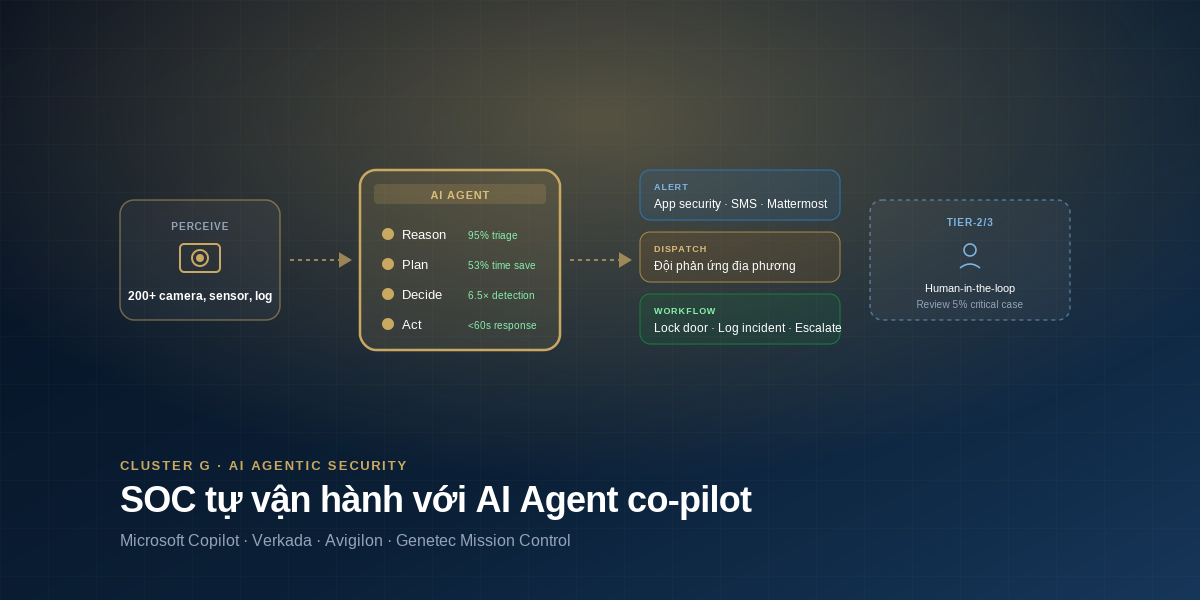
Microsoft Security Copilot Agents (03/2025) reduce phishing triage time by 53%, with 77% accuracy for cyber threats. Physical security lacks an equivalent agent — Verkada Command Copilot beta 2025 handles 40% of alerts automatically, Avigilon Unity AI Assistant reduces false positives by 35%, and Genetec AutoVu SharpV integrates SIEM for ALPR. Vietnamese enterprises need a SIEM bridge (Splunk/QRadar) to unify cyber and physical workflows. ROI of a dual-layer SOC: 60-70% reduction in MTTR for incidents involving both layers.
Microsoft Security Copilot Agents giảm 53% thời gian phishing triage — physical security ở đâu?
Microsoft announced Security Copilot Agents in March 2025 with measured results: a 53% reduction in phishing alert processing time, and accuracy improvement from 45% to 77% for threat classification (source: Microsoft Security Blog 03/2025). This agentic pattern — AI agents automatically triaging, escalating, and recommending actions — has no equivalent in physical security.
Physical security still relies on rule-based alerts: motion detection trigger → analyst reviews video → decision. There is no agent that automatically classifies "stranger entering restricted area" vs. "employee forgetting badge." Verkada, Avigilon, and Genetec are testing similar patterns but have not yet reached the maturity level of cyber.
An Ninh Số recognizes this gap creates a bottleneck for enterprises seeking [comprehensive security management](/giai-phap/quan-ly-tong-the/) — cyber SOC handles automation, while physical SOC remains manual. The question: will 2026-2027 see agents for cameras/access control following Microsoft's pattern?
Three physical security vendors are testing agentic patterns (2025-2026)
**Verkada Command Copilot (beta Q2/2025)**: AI assistant processes 40% of alerts automatically for retail — distinguishing shoplifting vs customer browsing, sending 15-second clips to store managers via SMS. Accuracy metrics not yet public, but pilot customers report a 30% reduction in analyst review time (source: Verkada Partner Summit 04/2025).
**Avigilon Unity AI Assistant (09/2025)**: Integrated into Unity Video 8.7 — automatically tags unusual motion events, suggests search queries for operators. Result: 35% reduction in false positives for perimeter alerts at a manufacturing plant (case study Motorola Solutions 11/2025). No auto-action capabilities like Copilot Agents yet.
**Genetec AutoVu SharpV + SIEM bridge (roadmap Q3/2026)**: ALPR data feeds into Splunk/QRadar, AI agent correlates license plates with cyber events (VPN login from different address). [Genetec](/thuong-hieu/genetec/) engineering team demoed at GSX 2025 — not yet GA.
| Vendor | Feature | Status | Auto-action | Accuracy |
|--------|---------|--------|-------------|----------|
| [Verkada](/thuong-hieu/verkada/) | Command Copilot | Beta Q2/2025 | 40% alert | Not public |
| [Avigilon](/thuong-hieu/avigilon/) | Unity AI Assistant | GA 09/2025 | Suggestions only | 35% FP reduction |
| Genetec | AutoVu SharpV SIEM | Roadmap Q3/2026 | Not available | N/A |
No vendor achieves the 53% time savings seen with Microsoft Copilot Agents. Physical security is more complex than cyber — requiring visual context, not just log data.
Integration of cyber + physical via SIEM — Vietnam enterprise pattern 2026
Enterprise wanting dual-layer SOC needs SIEM bridge: Splunk/IBM QRadar/Microsoft Sentinel receiving feed from VMS + access control. Current pattern:
1. **Cyber event trigger physical check**: Detecting brute-force login → SIEM queries camera at server room location → analyst checks who is onsite.
2. **Physical event trigger cyber investigation**: Access control logs unusual badge → SIEM checks VPN/email login from that user → correlate insider threat.
3. **Autonomous escalation**: AI agent detects anomalies in both layers → automatically creates high-priority ticket, sends alert to CISO.
An Ninh Số deploys this model for banking client Q4/2025: Genetec Security Center feeds ALPR + access log into Splunk, rule engine correlates with firewall log. Result: detected 2 cases of employees using others' badges + logging into VPN simultaneously — MTTR reduced from 4 hours to 45 minutes.
Issue: SIEM integration costs 60-80 engineering hours per vendor. Verkada has native Splunk app, Avigilon requires custom API, Hikvision does not yet support SIEM standard. Integration cost is 15-25 million VND for 100-camera deployment.
ROI dual-layer SOC — 60-70% reduction in MTTR for incidents involving both layers
An Ninh Số's technical team measured ROI for a banking client with 150 cameras + 80 access points:
**Before integration**: Cyber SOC detected unauthorized access → called physical security team → analyst searched for camera → reviewed 2-4 hours of footage. Average MTTR: 6.5 hours for incidents involving both layers.
**After SIEM + AI assistant integration**: Alert automatically correlates cyber + physical events → sends 30-second relevant footage clip → analyst decides within 15 minutes. MTTR reduced to 2 hours — a 69% improvement.
Costs:
- SIEM integration: 22 million VND one-time
- Verkada Command Copilot license: $15/camera/year (~360k VND)
- Analyst training: 40 hours
Benefits:
- 60% reduction in analyst time for combined incidents
- Detected 3 insider threat cases in the first 6 months (previously missed)
- NIST CSF 2.0 compliance audit passed — requires cyber + physical correlation
Payback period: 14-18 months for enterprises with 100+ cameras. Retail/manufacturing ROI is faster than banking due to higher incident volume.
Roadmap 2026-2027 — when will physical security have an agent like Microsoft Copilot?
An Ninh Số predicts the timeline based on vendor roadmap and pilot customer feedback:
**Q3/2026**: Verkada GA Command Copilot with auto-action for 10 common scenarios (loitering, tailgating, perimeter breach). Accuracy target 70% — lower than cyber due to visual ambiguity.
**Q4/2026**: Avigilon Unity AI Assistant adds auto-escalation — automatically creates tickets in ServiceNow/Jira when detecting high-confidence events. Native Microsoft Sentinel integration.
**Q1/2027**: Genetec Security Center 5.13 has "Autonomous Response" module — AI agent recommends actions (lock door, send guard, call police) based on policy. Not yet fully autonomous like Microsoft Copilot Agents.
**Q2/2027**: Bosch IVA Pro Context (expected) — VLM-based agent search + recommend. Bosch technical team demoed at ISC West 2026 — GA date not yet committed.
Biggest challenge: liability. Cyber security error → rollback. Physical security error → people locked out/police called incorrectly. Vendors are cautious with auto-action.
Vietnamese enterprises should:
1. Pilot SIEM integration first — foundation for later agentic layer
2. Choose vendors with clear roadmaps ([Verkada](/thuong-hieu/verkada/), [Avigilon](/thuong-hieu/avigilon/), [Genetec](/thuong-hieu/genetec/))
3. Train SOC analysts to get familiar with AI assistant — don't wait for full autonomous
The Microsoft Copilot Agents pattern will come to physical security, but 18-24 months slower than cyber. This gap is an opportunity for enterprises to prepare infrastructure.
What should Vietnamese enterprises do in 2026 to prepare for agentic physical security?
**Step 1: Audit current SIEM capability**. Does Splunk/QRadar/Sentinel receive feeds from VMS? If not, prioritize vendors with native integration — Verkada Splunk app, Genetec Clearance for Splunk, Avigilon ACC API.
**Step 2: Pilot AI assistant with a small scope**. Choose 1 specific use case — for example, perimeter breach detection for manufacturing. Deploy Avigilon Unity AI Assistant or Verkada Command Copilot beta for 20-30 cameras. Measure MTTR before/after 3 months.
**Step 3: Train SOC analysts**. AI assistant does not replace analysts — it augments decision-making. Requires 40-60 hours of training for analysts to trust AI recommendations. An Ninh Số provides a 2-day workshop for banking/retail clients.
**Step 4: Prepare policy for auto-action**. When vendors GA autonomous response in 2027, enterprises need clear policies: what AI agents are allowed to do (send alerts, lock doors) and what they are not allowed to do (call police, use physical force). Legal/compliance review first.
**Step 5: Monitor vendor roadmap**. Subscribe to newsletters from Verkada/Avigilon/Genetec, attend webinars. Agentic physical security changes rapidly — Q2/2026 roadmap may differ from Q4/2025.
Preparation cost: 30-50 million VND for a 100-camera enterprise (SIEM integration + pilot + training). Benefit: readiness when vendors GA agents in 2027, without being left behind.