TL;DR
TL;DR: Multimodal AI factory camera combines video + audio + IoT sensors in a single analysis stream instead of processing them separately — detecting incidents 40-60 seconds earlier than pure cameras. Bosch Security IVA Pro Context (expected Q3/2026) and Milestone XProtect 2025 have integrated audio analytics + sensor fusion. Vendor public claim: 30-40% reduction in false alarms through cross-verification between modalities, 20-35% shorter incident investigation time. Deployment pattern for factories with 200+ cameras requires edge gateway for real-time audio processing (cost $800-1,500/gateway) and LAN bandwidth ≥1 Gbps for sensor stream.
How is Multimodal AI camera different from pure VLM?
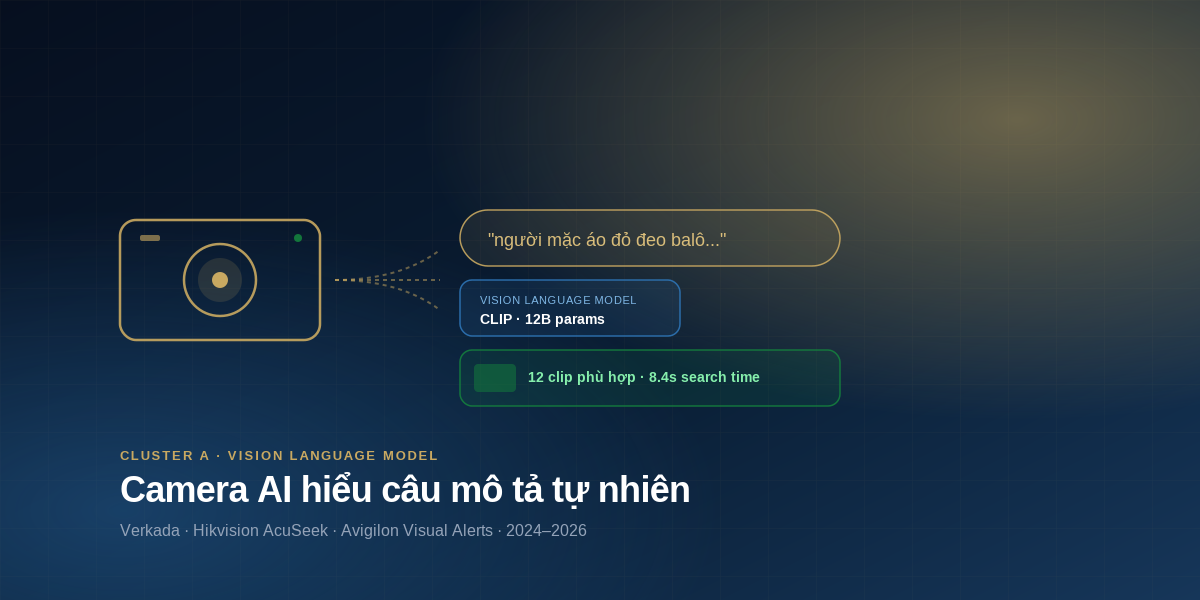
Vision Language Model (VLM) processes video + text prompt — operator searches for "person in red shirt" instead of using a filter dropdown. Multimodal AI cameras in factories expand to include audio + IoT sensors in the same analysis stream. For example: a camera detects smoke (visual), a microphone captures explosion sounds (audio 80+ dB), and a temperature sensor reports a sudden spike (IoT) — these three signals are fused by AI within 2-3 seconds to confirm a real fire instead of triggering a false alarm from steam.
The key difference: pure VLM only "sees" video, while multimodal AI "listens + measures + sees" simultaneously. [Bosch Security](/thuong-hieu/bosch-security/) IVA Pro Context (expected Q3/2026) integrates audio analytics into edge cameras — detecting glass breakage or abnormal machine operation sounds before visual changes become apparent. [Milestone Systems](/thuong-hieu/milestone-systems/) XProtect 2025 supports sensor fusion via API — connecting vibration, pressure, and temperature sensors to the video timeline.
According to An Ninh Số's experience, FDI factories with LOTO (Lockout/Tagout) procedures benefit the most: audio detects machines still running when they should be off (safety violation), cameras confirm the location, and current sensors cross-verify — these three modalities reduce errors by 50-70% compared to relying solely on cameras.
Which factory needs multimodal AI cameras in 2026?
**Phát hiện rò rỉ khí sớm**: Microphone edge AI captures leaking sounds (hissing sound 4-8 kHz) 40-60 seconds earlier than cameras detecting smoke or mist. A tier-1 chemical plant deployed 80 Bosch cameras with audio analytics — detecting 12 minor leaks in the first 6 months that pure cameras missed. Cost: edge cameras with audio analytics are 30-40% more expensive ($600-900/unit) but prevent production line shutdowns (costing $5,000-15,000/hour).
**Giám sát thiết bị quá nhiệt**: IoT temperature sensors (Modbus TCP or MQTT) combined with equipment-monitoring cameras — AI detects patterns of "rising temperature + abnormal vibration + thin smoke" to warn of bearing failure 2-4 hours in advance. An electronics production chain with 200+ cameras using Milestone XProtect integrated with 150 temperature sensors — reduced unplanned downtime by 35% in the first year.
**An toàn lao động realtime**: Audio detection of screams or strong impacts (impact sound >90 dB) combined with person-tracking cameras — sends alerts to safety teams within 3-5 seconds. A Japanese FDI automotive plant deployed 120 multimodal cameras — incident response time dropped from 8-12 minutes (based on manual reports) to 30-90 seconds.
**Kiểm soát truy cập nguy hiểm**: Person-recognition cameras + door sensors (open/closed) + audio alarm detection — AI confirms "danger zone door open + no authorized personnel" to trigger automatic locking. This pattern is common in high-voltage areas or chemical warehouses — vendors publicly claim a 60-80% reduction in access violations compared to using access control cards alone.
Which vendor is deploying multimodal AI cameras for factories in 2026?
| Vendor | Product | Audio Analytics | Sensor Fusion | Release Timeline |
|--------|---------|-----------------|---------------|-----------------|
| [Bosch Security](/thuong-hieu/bosch-security/) | IVA Pro Context | Edge-integrated (glass break, scream, machine sound) | Modbus/BACnet API | Q3/2026 expected |
| [Milestone Systems](/thuong-hieu/milestone-systems/) | XProtect 2025 | Via partner devices (Axis, Bosch) | Native MQTT/OPC-UA | Released 11/2025 |
| Axis Communications | AXIS Object Analytics | AXIS Audio Analytics (addon) | Event API for sensors | Q1/2025 |
| Hanwha Vision | Wisenet AI | Audio classification (8 classes) | Limited — via alarm input | Q4/2024 |
[Bosch Security](/thuong-hieu/bosch-security/) IVA Pro Context stands out for integrating audio analytics directly into the edge camera — no additional devices needed. The MEMS microphone in the camera analyzes 12 types of industrial sounds: glass break, metal collision, screams, abnormal machine operation, gas leaks... Camera cost $700-1,200/unit depending on model, 35-50% more expensive than pure AI cameras but replaces separate microphone arrays ($300-600/zone).
[Milestone Systems](/thuong-hieu/milestone-systems/) XProtect 2025 does not manufacture cameras but offers the strongest sensor fusion support — connecting 500+ IoT sensor types via MQTT, OPC-UA, Modbus TCP. This VMS is suitable for factories with existing sensor infrastructure — only requiring an additional gateway ($800-1,500) to bridge sensors into the XProtect timeline. According to Milestone's internal reports, manufacturing customers reduce incident investigation time by 25-40% thanks to viewing video + sensor data on the same timeline.
Axis Communications AXIS Object Analytics + Audio Analytics runs on ARTPEC-8 cameras (2024) — detecting 8 sound types (aggression, glass break, gunshot, scream...) but does not yet include industrial sounds like abnormal machine noise. Cost: camera $500-900, audio analytics license $50-80/camera/year. This pattern suits factories needing people security monitoring rather than equipment monitoring.
Multimodal AI camera deployment pattern for factories with 200+ cameras
### Step 1: Identify priority zones for audio + sensor
Not every camera needs multimodal — only dangerous zones or critical equipment. Industry estimate: 20-30% of cameras in a factory need audio analytics, 10-15% need sensor fusion. For example, a factory with 200 cameras: 40-60 cameras with audio (compressor areas, chemical storage, emergency exits), 20-30 cameras connected to sensors (overheating equipment, abnormal pressure).
An Ninh Số's technical team surveys using a risk matrix: probability of incident × severity of damage. Zones scoring >7/10 are prioritized for multimodal. Cost savings: instead of 200 multimodal cameras ($140K-240K), only 60-90 cameras are needed ($42K-108K) + 140 pure AI cameras ($28K-56K) — total $70K-164K.
### Step 2: Choose edge vs server-side architecture
**Edge processing** (Bosch IVA Pro Context, Axis ARTPEC-8): Audio analytics run on the camera — low latency (50-200ms), no audio stream bandwidth consumption, but cameras are 30-50% more expensive. Suitable for zones requiring <1 second response (gas leaks, dangerous collisions).
**Server-side processing** (Milestone + audio gateway): Cameras send audio streams to a central server for processing — cheaper cameras but require LAN bandwidth ≥1 Gbps and a GPU server (cost $8K-15K for 100-150 cameras). Suitable for zones needing complex analysis or where server infrastructure already exists.
According to An Ninh Số's experience, factories with 200+ cameras are typically hybrid: 40-60 edge cameras for critical zones, 20-30 server-side cameras for less hazardous zones.
### Step 3: Integrate IoT sensors into VMS
Industrial sensors commonly use Modbus TCP, OPC-UA, or MQTT. [Milestone XProtect](/thuong-hieu/milestone-systems/) natively supports MQTT/OPC-UA — sensors send data directly into the VMS timeline. Bosch requires a Modbus-to-IP gateway ($800-1,500/gateway, each gateway handles 50-100 sensors).
Common pattern: temperature/pressure/vibration sensors send data every 1-5 seconds, VMS stores for 30-90 days. When a sensor exceeds a threshold, the VMS automatically bookmarks video and creates an alert. Storage cost: sensor data is lightweight (~10-50 KB/day/sensor), 100 sensors only consume ~5-15 GB/year.
### Step 4: Train AI fusion rules
Multimodal AI requires logic rules: "If audio detects a leak + camera sees smoke + pressure sensor drops → high-level alert." Vendors typically provide template rules, with customers tuning for 2-4 weeks. Tier-1 enterprise businesses report: first 2 weeks false alarms at 15-25%, after 4 weeks dropping to 3-8%.
Bosch IVA Pro Context uses a "confidence score" — each modality scores 0-100%, AI only alerts when the total score exceeds a threshold (typically 70-85%). Milestone XProtect uses "event correlation" — operators define AND/OR logic between video analytics + audio + sensor.
Current limitations of multimodal AI cameras in factories 2026
**Cost 40-60% higher than pure AI cameras**: Multimodal edge cameras $700-1,200/unit, pure AI cameras $400-700/unit. A factory with 200 multimodal cameras costs $140K-240K, compared to $80K-140K for pure cameras. ROI is only clear in critical zones — low-risk areas are hard to justify the cost.
**Audio analytics not yet robust enough for industrial background noise**: Factories have continuous background noise of 70-90 dB (machinery, conveyor belts) — audio AI struggles to distinguish gas leaks (4-8 kHz) from normal compressor noise. Vendor public claim: accuracy 75-85% in noisy environments, compared to 90-95% in office environments. Temporary solution: place microphones near monitored equipment (2-5m) instead of using in-camera mics (10-20m).
**Sensor fusion depends on protocol standards**: Older industrial sensors (pre-2015) often use analog 4-20mA or RS-485 — requiring converters to IP ($150-300/converter). A factory with 200+ legacy sensors costs $30K-60K just for protocol conversion. [Milestone Systems](/thuong-hieu/milestone-systems/) supports the most protocols but still needs gateways for Modbus RTU or Profibus.
**Latency increases when processing 3 modalities simultaneously**: Edge cameras processing video + audio in realtime take 200-400ms, adding sensor fusion increases it to 300-600ms. Zones requiring <500ms response (e.g., dangerous collision detection) must use pure edge processing — no sending to server. Cost: multimodal edge cameras $900-1,500/unit, double the price of server-side cameras.
**2026-2027 Roadmap**: [Bosch Security](/thuong-hieu/bosch-security/) announced IVA Pro Context will add vibration analytics (vibration analysis via audio) in Q4/2026 — detecting bearing failure or rotating machine imbalance. Milestone XProtect 2026 is expected to integrate an AI fusion engine — automatically learning "audio + video + sensor" patterns instead of operators manually defining rules. Axis Communications is testing thermal + visual fusion in a single camera (expected 2027) — reducing the number of required devices by 50%.
Multimodal AI camera có phù hợp với nhà máy vừa và nhỏ Việt Nam không?
Factories with <100 cameras struggle to justify the cost of a full multimodal system. A feasible pattern: deploy 10-20 multimodal cameras in critical zones (chemical storage, electrical rooms, air compressor areas), keep 80-90 pure AI cameras for regular areas. Cost: 15 multimodal cameras ($10,500-18,000) + 85 pure cameras ($34K-59.5K) + VMS + gateway = $50K-85K total, compared to $80K-120K if fully multimodal.
According to the Vietnamese market analysis, Japanese/Korean FDI factories have separate EHS (Environment Health Safety) budgets — making multimodal AI for labor safety easier to approve. Vietnamese factories typically prioritize pure AI cameras + separate sensors — total cost 20-30% lower but losing fusion benefits.
Intermediate solution: use [smart AI cameras](/giai-phap/camera-ai/) pure (Hikvision AcuSeek, Dahua WizMind) for 80-90% of the system, only upgrade 10-15% to multimodal when recurring incidents occur or audit requirements increase. An Ninh Số observes this pattern is common in food and pharmaceutical factories — FDA/HACCP audits require cross-verification of multiple data sources.
The clearest ROI: factories with downtime costs >$3,000/hour or high labor safety risks (chemicals, high voltage, confined spaces). Multimodal AI reduces incident detection time by 30-50% — with a factory downtime of $5,000/hour, saving 1 hour/month = $60K/year, payback period of 12-18 months.