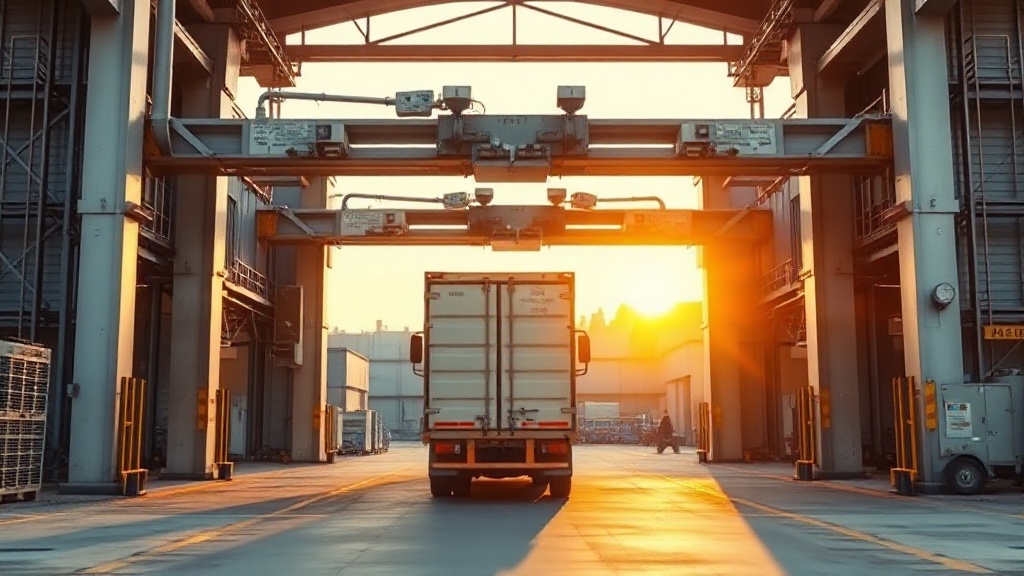
Measuring truck volume is a core operational challenge at factories, warehouses, and seaports in Vietnam. The two leading technologies are LiDAR (3D laser scanning) and AI Camera (computer vision) — each solution has its own advantages and disadvantages regarding accuracy, cost, and deployment conditions. This article provides a detailed comparison from principles to actual ROI, helping businesses choose the optimal investment direction for 2026.
How do LiDAR 3D laser scanning and AI Camera image processing differ in principle?
LiDAR emits infrared laser pulses, measuring the time of flight (ToF) to create a 3D point cloud with millimeter-level accuracy. AI Cameras capture 2D images from multiple angles, using computer vision algorithms (Stereo Matching, Structure from Motion) to reconstruct 3D shapes and calculate volume. Both provide volume results, but their data collection mechanisms are completely different.
LiDAR (Light Detection and Ranging) uses rotating or solid-state laser sensors, scanning the surface of goods on trucks at speeds of 100,000-1,000,000 points/second. Point cloud data is processed using noise filtering and segmentation algorithms to calculate accurate volume. This technology is independent of light, performing well in darkness or dusty environments.
AI Cameras use 2-4 cameras installed on a gantry, capturing images from multiple angles as the truck passes. The system processes images in real-time using deep learning models, extracts geometric features, removes the background, and calculates volume based on depth estimation algorithms. The advantage is low cost and easy software upgrades, but accuracy decreases in low light or rain.
LiDAR vs. AI Camera comparison table: 5 core criteria
The table below summarizes the key differences between LiDAR and AI Cameras across 5 criteria: accuracy, cost, environmental conditions, processing speed, and maintenance. Data is based on common commercial systems in the Vietnamese market in 2026.
| Criteria | LiDAR (3D laser scanning) | AI Camera (computer vision) |
|---|---|---|
| Volume accuracy | ±2-5 mm (varies by brand: SICK, Velodyne, Ouster) | ±5-15 mm (depends on light and algorithm) |
| Investment cost (equipment + installation) | 300-800 million VND | 50-150 million VND |
| Operation in low light | Good (independent of light) | Average (needs supplemental LED lighting) |
| Weather impact (rain, dust, fog) | Minimally affected (905nm/1550nm wavelength) | Accuracy decreases 15-30% in heavy rain |
| Annual maintenance | 15-25 million (optical cleaning, calibration) | 5-10 million (lens cleaning, firmware updates) |
LiDAR has advantages in accuracy and all-weather operation, but its investment cost is 3-5 times higher than AI Cameras. For small and medium enterprises in Vietnam, AI Cameras are often a more feasible choice if the environment is indoors with controlled lighting.
Advantages and disadvantages of LiDAR for truck volume measurement
LiDAR offers superior accuracy and stable operation in all environmental conditions, but has high investment costs and complex installation requirements. Suitable for seaports, large factories, or outdoor warehouses.
Advantages:
- High accuracy (±2-5mm), unaffected by color or surface texture of goods.
- Operates 24/7 in darkness, light rain, industrial dust — ideal for harsh environments.
- Fast scanning speed (under 2 seconds/truck), suitable for high-throughput weigh stations.
- Point cloud data easily integrates with WMS (Warehouse Management System) and ERP.
Disadvantages:
- High initial investment cost (300-800 million), difficult for SMEs to access.
- Complex periodic maintenance (optical cleaning, laser calibration).
- Cannot distinguish types of goods (measures volume only, no recognition).
- Large equipment size, requires sturdy support frames.
Advantages and disadvantages of AI Cameras for truck volume measurement
AI Cameras have low cost, easy deployment, and can integrate additional features like license plate recognition and goods type identification. However, accuracy depends on lighting and weather conditions, suitable for indoor warehouses and manufacturing plants.
Advantages:
- Low investment cost (50-150 million), suitable for Vietnamese SME budgets.
- Integrates additional features like license plate recognition (LPR), goods type identification, anomaly detection.
- Easy software upgrades (AI model), no hardware changes needed.
- Compact size, flexible installation on gantries or ceilings.
- Image data can be used for monitoring and quality inspection purposes.
Disadvantages:
- Lower accuracy than LiDAR (±5-15mm), especially with reflective or dark-colored surfaces.
- Dependent on lighting: needs supplemental LED lighting, performance decreases 15-30% in heavy rain.
- AI algorithms require training data suitable for each type of goods (sand, cement, cardboard boxes).
- Does not perform well in dusty environments or thick fog.
Case study: Installing AI Cameras for truck volume measurement at Tan Phat Brick Factory, Binh Duong
Tan Phat Brick Factory (Binh Duong) needed to measure the volume of trucks carrying raw materials (clay, sand) and finished products (bricks) with a budget under 100 million. After a survey, An Ninh Số advised a stereo AI Camera solution installed at the entry/exit gate.
The system includes 2 Dahua WizMind 4MP cameras (installed opposite each other), infrared LED lights, and an embedded computer (NVIDIA Jetson) for real-time AI processing. Results: volume measurement accuracy reached ±12mm (meeting the ±15mm requirement), measurement time per truck under 5 seconds. Investment cost: 85 million (equipment + installation + software). Compared to LiDAR (quoted at 450 million), the business saved 365 million, with a payback period under 8 months thanks to a 7% reduction in raw material loss and optimized transport schedules.
The system also integrates license plate recognition and goods type identification, enabling automated warehouse management. After 6 months of operation, Tan Phat recorded a 12% reduction in logistics costs thanks to accurate volume data. Giải pháp kiểm soát xe tòa nhà văn phòng: Hướng dẫn A-Z 2026 also applies a similar principle for smart parking lots.
Cost and ROI: Comparing LiDAR and AI Camera investment for Vietnamese businesses
For Vietnamese businesses, ROI is the deciding factor. LiDAR has a high investment cost (300-800 million) but superior accuracy, suitable for businesses with high truck volume (>200 trucks/day). AI Cameras (50-150 million) are suitable for SMEs with a volume of 50-150 trucks/day.
Assume a business has 100 trucks per day, each carrying goods worth an average of 50 million. A 5% volume measurement error with AI Cameras (compared to 1% with LiDAR) leads to a loss of 2.5 million/truck, equivalent to 250 million/day. However, if the business only needs ±15mm accuracy (which AI Cameras can meet), the actual loss is only 1-2%. With an investment cost difference of 200-600 million, the payback period for AI Cameras is 3-5 times faster than LiDAR.
The table below compares the hypothetical ROI for a business with 100 trucks/day, operating 300 days/year:
| Metric | LiDAR | AI Camera |
|---|---|---|
| Investment cost | 500 million | 100 million |
| Annual maintenance cost | 20 million | 8 million |
| Annual reduction in goods loss | 180 million (thanks to high accuracy) | 120 million |
| Labor savings (reducing 2 manual measurers) | 120 million | 120 million |
| Payback period | ~18-24 months | ~6-10 months |
Frequently Asked Questions
LiDAR or AI Camera, which solution is more accurate for truck volume measurement?
LiDAR has higher accuracy (±2-5mm compared to ±5-15mm for AI Cameras), especially in low light or bad weather. However, for most commercial applications (freight billing, warehouse management), the ±15mm accuracy of AI Cameras is sufficient. Businesses need to balance cost and actual requirements.
Can AI Cameras measure truck volume outdoors?
Yes, but they require supplemental LED lighting and rain protection. Performance decreases 15-30% in heavy rain or fog. If the outdoor environment is harsh (seaports, mines), LiDAR is a better choice.
What is the installation cost for a truck volume measurement system using AI Cameras?
Costs range from 50-150 million depending on the number of cameras, AI model type, and network infrastructure. A basic package (2 stereo cameras + embedded computer) is around 70-90 million. An advanced package (integrating LPR, WMS) is around 120-150 million. Chi Phí Lắp Đặt Bãi Giữ Xe Tự Động TTTM 2026: Bảng Giá & ROI references similar costs for vehicle control systems.
Can the volume measurement system integrate with warehouse management software (WMS)?
Both LiDAR and AI Cameras can integrate with WMS/ERP via RESTful API or Modbus TCP protocol. AI Cameras are easier to integrate thanks to open SDKs from brands like Dahua, Hikvision. Tích hợp kiểm soát xe với BMS: Hướng dẫn kỹ thuật 2026 describes the connection process in detail.
Is maintaining an AI Camera volume measurement system complicated?
Maintenance is simple: periodic camera lens cleaning (once/month), AI firmware updates (2-3 times/year). Annual maintenance cost is about 5-10 million. Compared to LiDAR (15-25 million), AI Cameras are significantly more economical.
Should a Vietnamese SME choose LiDAR or AI Cameras?
With a budget under 150 million and an indoor environment, AI Cameras are the optimal choice. If the business has a budget over 300 million, requires high accuracy, and operates outdoors, LiDAR is a long-term investment. Refer to Hệ thống kiểm soát xe TTTM: 8 tính năng cần có 2026 for an overview.
Contact An Ninh Số via hotline 0796 700 777 or email [email protected] for consultation on truck volume measurement solutions suitable for your business's budget and operating environment.