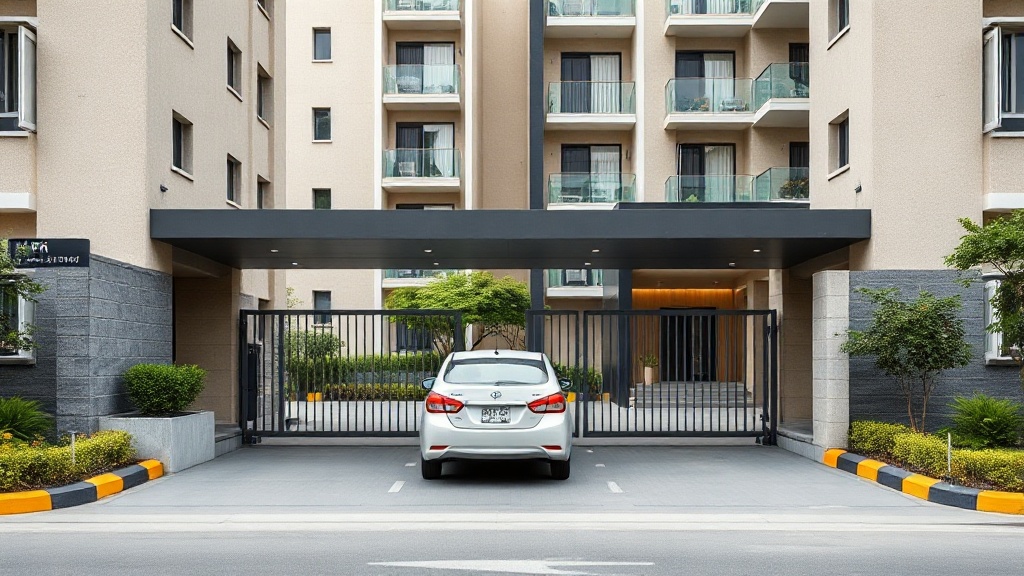
License Plate Recognition (LPR) and RFID cards are the two most popular vehicle access control technologies at apartment buildings in Vietnam. LPR uses AI cameras and OCR algorithms to automatically read license plates, while RFID cards rely on RFID readers and plastic cards attached to vehicle windshields. Each technology has its own advantages and disadvantages regarding cost, accuracy, security, and user experience.
How do LPR and RFID card technologies fundamentally differ?
LPR (License Plate Recognition) technology uses AI cameras integrated with Optical Character Recognition (OCR) algorithms to read license plates as vehicles approach the barrier. RFID card technology operates based on 125kHz or 13.56MHz RFID readers, requiring drivers to stop and bring the card close to the reader. LPR does not require a physical card, while RFID cards require issuance and management.
Comprehensive comparison table: LPR vs RFID cards for apartment buildings
| Criteria | LPR (License Plate Recognition) | RFID Card |
|---|---|---|
| Operating Principle | AI Camera + OCR automatically reads license plates | RFID reader + plastic card 125kHz/13.56MHz |
| Recognition Time | 1-3 seconds (no need to stop vehicle) | 3-8 seconds (need to stop, present card) |
| Initial Installation Cost | 25-80 million VND/lane (camera + barrier + software) | 15-35 million VND/lane (reader + barrier + cards) |
| Annual Maintenance Cost | 3-8 million VND (camera cleaning, software updates) | 2-5 million VND (replacing damaged cards, reader cleaning) |
| Anti-Spoofing Capability | High (difficult to fake license plates, can integrate AI checks) | Low (cards can be copied, swapped) |
| User Experience | Very good (no action required, no card needed) | Average (need to stop, find card, present to reader) |
| Suitable For | High-end apartments, offices, large parking lots (>200 vehicles) | Budget apartments, small parking lots (<100 vehicles) |
Installation and maintenance costs for each technology
The installation cost for an LPR system for one vehicle entry lane at an apartment building ranges from 25-80 million VND, including a dedicated AI camera, automatic barrier, management software, and installation. RFID cards have a lower cost, 15-35 million VND/lane, but incur additional costs for cards (5-15 thousand VND/card) and the RFID reader.
Periodic maintenance costs for LPR are about 30-50% higher than for RFID cards due to the need for camera cleaning, infrared light checks, and recognition software updates. However, LPR has no costs for replacing damaged or lost cards — a hidden cost that apartment management boards often overlook. For a parking lot with 300 vehicles, the annual cost of replacing cards could reach 5-10 million VND if the loss/damage rate is 10-15%.
Accuracy and fraud prevention capability
LPR achieves 95-99% accuracy in daylight conditions and 90-95% at night if the camera has high-quality infrared lights. RFID cards have near-absolute accuracy (99.9%) if the card is functioning, but are susceptible to copying, swapping, or loss.
The biggest security issue with RFID cards is their copyability. 125kHz RFID cards can be cloned using inexpensive equipment (under 500 thousand VND) within 5-10 seconds. Some apartment buildings have recorded cases of criminals copying residents' cards for unauthorized entry. LPR is much harder to spoof because license plates are unique and registered to the owner. However, LPR can fail if the license plate is dirty, faded, or if a vehicle uses a fake plate.
User experience and waiting time at the barrier
LPR allows vehicles to pass through the barrier without stopping, reducing waiting time from 3-8 seconds (RFID cards) down to 1-3 seconds. This is particularly important during peak hours when dozens of vehicles are entering and exiting simultaneously.
In high-end apartment buildings, residents highly value the "touchless" experience of LPR — no need to lower the window, no need to search for a card in a wallet. Conversely, RFID cards cause inconvenience as drivers must stop, lower the window, and present the card to the reader, sometimes having to reverse for a re-read if the card is not positioned correctly. For apartments with sloping basement ramps, stopping to swipe a card also poses a risk of accidents due to vehicle rollback.
Case study: A 300-unit apartment building switching from RFID cards to LPR
La Me Apartment Building (Binh Thanh District, Ho Chi Minh City) operated an RFID card system for its 200-space basement parking lot for 3 years. The average card loss rate was 12%/year, and complaints about waiting time increased by 40% after 2 years. The management board decided to upgrade to LPR at a cost of 55 million VND for 2 entry/exit lanes.
Results after 6 months: waiting time reduced by 70%, no more complaints about lost cards, operating costs decreased by 25% due to no longer printing new cards. However, the management board recorded 3-5 cases/month where the camera could not read the license plate due to dirty plates or modified vehicles — requiring a staff member to be stationed at the barrier for manual handling.
Hybrid solution: Combining LPR and RFID cards for apartment buildings
Many high-end apartment buildings in Vietnam are deploying a hybrid solution: LPR as the primary method, RFID cards as a backup for visitors or cases of camera failure. This solution leverages the advantages of both technologies.
Specifically, residents register their license plates in the system, and vehicles are automatically recognized upon entry/exit. Visitors are issued temporary cards at the security desk. If the LPR camera fails to read the license plate (due to dirt, fading, bad weather), the barrier can still be opened using the backup RFID card. The cost for a hybrid solution is approximately 40-100 million VND/lane, higher than LPR alone but ensuring continuous operation.
When to choose LPR, when to choose RFID cards?
LPR is suitable for high-end apartment buildings, parking lots with >150 spaces, high security requirements, and a good user experience. RFID cards are suitable for budget apartments, small parking lots with <80 spaces, and limited budgets under 30 million VND.
The choice depends on 3 main factors: parking lot size, investment budget, and security requirements. For apartment buildings with 50-100 units, RFID cards remain an economical solution. For buildings with >200 units or high-end apartments (price >3 billion VND), LPR is a worthwhile investment that increases property value and resident satisfaction.
Frequently Asked Questions
Does the LPR system work well in rainy or stormy conditions?
Dedicated LPR cameras for apartment buildings typically have an IP67 water resistance rating and high-power infrared lights. In light to moderate rain, accuracy decreases by about 5-10% due to water blurring the lens and license plate. Heavy rain or thick fog can reduce the successful read rate to 70-80%. The solution is to install a canopy for the camera and arrange for a staff member to be at the barrier to assist during bad weather.
What is the cost of replacing lost or damaged RFID cards?
The cost of printing a new RFID card ranges from 10-30 thousand VND/card, depending on the material (standard PVC or waterproof PVC composite). For an apartment building with 300 units, the average card loss/damage rate is 10-15%/year, equivalent to 30-45 cards, costing 300-1.350 million VND/year. This does not include the labor cost for management, data updates, and the waiting time for residents to get new cards.
Can LPR integrate with existing security camera systems?
Yes, most current LPR cameras support ONVIF and RTSP protocols, allowing integration with VMS (Video Management System) systems like Milestone, Genetec, or NVRs from Hikvision, Dahua. However, it should be noted that dedicated LPR cameras have sensors and lenses optimized for license plate recognition (2-5MP resolution, 25-30fps capture speed), which differ from standard security cameras. Using existing security cameras for LPR typically yields low accuracy (<80%).
What is the Return on Investment (ROI) period for LPR?
For an apartment building with 200-300 units, the investment cost for a 2-lane LPR system is about 50-80 million VND, with an average payback period of 18-24 months thanks to savings on card printing, card management labor, and reduced complaints. If including the benefit of increased property value (apartments with LPR are often valued 5-10% higher than those using RFID cards), the ROI can be shortened to 12-15 months.
Can an RFID card system be easily upgraded to LPR?
Upgrading from RFID cards to LPR requires replacing the entire reader, barrier, and management software. However, the electrical and network infrastructure can be reused. The upgrade cost is about 60-80% of a completely new installation. It is advisable to choose an LPR solution that supports a backup RFID card reader (hybrid) to avoid wasting the previous investment in RFID cards.
Contact An Ninh Số via hotline 0796 700 777 or email [email protected] for a free survey and consultation on vehicle access control solutions for your apartment building, tailored to your budget and parking lot size. We provide a full range of solutions from basic RFID cards to high-end LPR, integrated with automatic barriers and centralized management software.