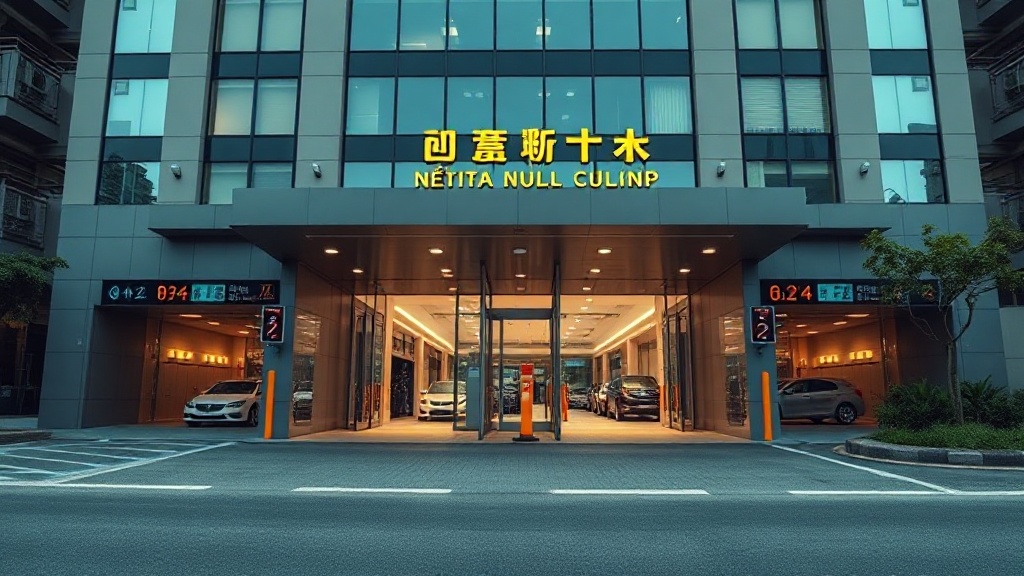
Integrating vehicle control systems with Building Management Software (BMS) is a solution that allows automatic barriers, License Plate Recognition (LPR) cameras, and EAS gates to communicate centrally through a single platform. In Vietnam, this trend is being implemented in grade A office buildings, high-end apartments, and shopping centers to optimize vehicle flow, reduce parking lot labor costs by 40-60%, and enhance resident experience.
What is Vehicle Control Integration with BMS?
Vehicle control integration with BMS is the process of connecting hardware devices such as automatic barriers, LPR cameras, RFID card readers, and parking space sensors to a centralized building management system. Data from these devices is synchronized in real-time, enabling automated operations: the barrier opens when a registered license plate is recognized, updates the number of available spaces on the lobby LED screen, and records entry/exit history for parking fee reconciliation.
This system operates based on standard building communication protocols such as BACnet, Modbus RTU/TCP, or REST API. Some popular solutions on the market include access control gates from Sensormatic combined with Kapaisi automatic barriers and LPR cameras with built-in BMS communication modules.
Operational Benefits of Integrating Vehicle Control with BMS
Integrating vehicle control with BMS brings 5 main benefits: reducing vehicle processing time by 40-60%, saving 30-50% on parking lot labor costs, increasing parking space utilization by 20-30%, reducing parking fee reconciliation errors by 70-80%, and providing real-time data for building operations management.
- Reduced waiting time: LPR cameras recognize license plates in 0.3-0.5 seconds, barriers open automatically, vehicles don't need to stop for tickets. Average time per vehicle decreases from 15-25 seconds to 3-5 seconds.
- Labor savings: For a 100-200 space parking lot, reduce 2-3 guards/shift, equivalent to saving 150-250 million VND/year.
- Optimized parking: Sensor system reports real-time available spaces, guides drivers to empty spots via LED signs, increasing the number of parked vehicles by 20-30% in the same area.
- Revenue loss prevention: Automatic reconciliation between entry/exit data and parking fees, reducing 70-80% of errors from manual input by parking staff.
- Management data: BMS compiles reports on vehicle counts by hour/day/month, supporting operational planning and marketing for shopping centers.
Common Connectivity Protocols: BACnet, Modbus, and REST API
Three main protocols are used for integrating vehicle control with BMS: BACnet (US standard for commercial buildings), Modbus RTU/TCP (popular in industry and Asian parking lots), and REST API (used for cloud/hybrid systems). Each protocol has its own advantages regarding cost, latency, and compatibility.
| Protocol | Advantages | Disadvantages | Suitable for |
|---|---|---|---|
| BACnet | Open standard, compatible with multiple manufacturers (Honeywell, Siemens, Johnson Controls) | Higher investment cost, requires BACS certified technicians | Grade A office buildings, 5-star hotels |
| Modbus RTU/TCP | Low cost, easy to deploy, wide compatibility (Kapaisi, ZKTeco, Dahua) | Low bandwidth, does not support complex data | Apartments, factories, small to medium parking lots |
| REST API | Flexible, supports cloud, easy to scale | Dependent on internet connection, latency 100-500ms | Hybrid systems, building chains |
In practice in Vietnam, Modbus RTU/TCP accounts for about 65-70% of the parking lot integration market due to low cost and easy maintenance. However, grade A buildings are gradually shifting to BACnet to meet LEED and WELL standards. The Kapaisi automatic barrier system supports all 3 protocols, providing flexibility when integrating with popular BMS.
5-Step Integration Deployment Process
The deployment process for integrating vehicle control with BMS consists of 5 steps: site survey, system architecture design, equipment and protocol selection, integration programming, and operational testing. The average time for a 500-2000m² building is 2-4 weeks.
- Step 1 - Survey: Assess existing network infrastructure, current BMS type, number of barriers/cameras/sensors to integrate. Determine the appropriate connection protocol (BACnet/Modbus/API).
- Step 2 - Design: Draw system architecture diagram, identify connection points, required bandwidth (minimum 100Mbps for 50-100 devices).
- Step 3 - Equipment Selection: Choose barriers, LPR cameras, card readers that support compatible protocols. Example: Kapaisi KPS-DZ-8006 barrier supports Modbus TCP, Kapaisi LPR Module camera supports REST API.
- Step 4 - Programming: Configure gateway/PLC to convert data between devices and BMS. Write logic processing scripts: barrier opens when LPR recognizes correct license plate, update available space count on LED screen.
- Step 5 - Testing: Run 100-200 simulated vehicle passes, check latency (target < 1 second), reconcile data, train operations staff.
Cost Comparison of 3 Integration Configurations
The cost of integrating vehicle control with BMS depends on parking lot size, number of devices, and connection protocol. Below are 3 popular configurations for buildings in Vietnam, from basic to premium.
| Configuration | Main Equipment | Protocol | Cost (VND) | Suitable for |
|---|---|---|---|---|
| Basic | 2 Kapaisi automatic barriers, 2 LPR cameras, 1 Modbus gateway | Modbus RTU/TCP | 30-45 million | Mini apartments, buildings < 100 spaces |
| Standard | 4 Kapaisi barriers, 4 LPR cameras, parking sensors, LED screen, PLC | Modbus TCP + REST API | 50-80 million | Office buildings, shopping centers 100-300 spaces |
| Premium | 6+ Kapaisi barriers, 6+ LPR cameras, parking sensors, LED screen, BACnet BMS integration, parking management software | BACnet + REST API | 100-200 million | Grade A buildings, 5-star hotels, large hospitals |
The above costs include equipment, installation, and integration programming. They do not include network infrastructure upgrade costs if needed. Return on Investment (ROI) is typically achieved within 12-18 months thanks to labor savings and increased revenue from parking services.
Case Study: Grade A Office Building Reduces Parking Errors by 70%
A grade A office building in District 1, Ho Chi Minh City (area 1500m², 200 parking spaces) deployed an integrated vehicle control system with Honeywell BMS. Results after 6 months: 70% reduction in parking fee reconciliation errors, 180 million VND/year saved in labor costs, 25% increase in parking space utilization thanks to real-time guidance sensors.
The system uses 4 Kapaisi KPS-DZ-8005 barriers, 4 Kapaisi LPR Module cameras, ultrasonic parking sensors, and a BACnet gateway connected to Honeywell BMS. Deployment time: 3 weeks. Investment cost: 120 million VND. ROI achieved after 8 months. Mr. Minh, the building's Operations Director, stated: "Since the integration, we no longer need night shift parking attendants; the system automatically reports vehicle entry/exit counts every morning. Parking errors have been reduced to nearly zero."
Frequently Asked Questions
Is the vehicle control system compatible with old BMS?
Yes, most current barriers and LPR cameras support multiple connection protocols. If the old BMS only supports BACnet, you can use a Modbus-to-BACnet conversion gateway. Gateway cost is approximately 5-10 million VND. An Ninh Số has successfully deployed integrations with Honeywell, Siemens, and Johnson Controls BMS from 2015-2020.
What is the annual maintenance cost for the integrated system?
Average maintenance cost is 8-12% of the initial investment value per year, including hardware maintenance (barriers, cameras, sensors), firmware updates, and BMS connection checks. For example, an 80 million VND system has a maintenance cost of 6-10 million VND/year. An Ninh Số offers a comprehensive maintenance package of 8 million VND/year for standard systems.
How long does integration deployment take for a 1000m² building?
Average deployment time is 2-4 weeks, depending on the complexity of the existing BMS and the number of devices to integrate. For a 1000m² building (approximately 100-150 parking spaces), the time is usually 2-3 weeks: 1 week for survey and design, 1 week for equipment installation, 1 week for programming and testing.
Can automatic payment features be added?
Yes, the system can integrate an automatic payment module via RFID cards, QR codes, or mobile applications. When a vehicle exits, the system automatically calculates the fee based on parking duration and deducts it from the pre-loaded account. This feature is popular in shopping centers and hospitals. The cost for adding the payment module: 15-25 million VND.
Does the system work during a power outage?
Yes, barriers and LPR cameras can be equipped with a backup UPS for 30-60 minutes. Gateways and network switches should also have backup power. For extended power outages, barriers can be operated manually (using a manual crank) and LPR cameras have backup batteries for 2-4 hours. An Ninh Số recommends investing in a 1000VA UPS for standard systems (cost 3-5 million VND).
Contact the hotline 0796 700 777 now for consultation on vehicle control integration solutions with BMS suitable for your building.