A truck weighbridge tells you how many tonnes a shipment weighs. A volume measurement system tells you how many m³ the shipment contains. Backfill, sand, soil and stone extraction contracts are mostly paid by m³, so tonnage alone is not enough of a basis for acceptance with the contractor.
This article compares the two measurement methods, points out where each is strong and weak, and how to combine them in a single workflow. The volume measurement example is taken from the Smart Box AI truck and barge volume measurement solution developed by Viet Duc Tri Group and deployed by An Ninh So.
A truck weighbridge gives tonnage; a LiDAR-based volume measurement system gives m³ together with the license plate, photos and a 3D model for each trip. Backfill and extraction contracts calculated by m³ need volume measurement; if you want to cross-check against tonnage, convert using a density table, or integrate an existing weighbridge via API as a project-based extension.
What is a truck weighbridge?
A truck weighbridge is a scale platform set on a foundation; the truck drives on and stops to weigh the total mass of the vehicle and its load. Subtracting the empty vehicle weight gives the tonnage of the shipment.
Weighbridges are common at material depots, concrete batching plants, cement factories and mines that are already in stable operation. The advantage is that the quantity is clear-cut, and both buyer and seller are used to reading weigh tickets.
The limitation is that tonnage does not show the shape of the shipment. The scale does not know whether the truck bed is full or partly empty, does not know whether the bed has been enlarged compared with its registration, and has no image of the load for cross-checking when the two parties dispute. The tonnage of sand, soil and stone also changes with moisture: the same volume of sand is heavier when wet than when dry. If the contract is calculated by m³, converting tonnes to m³ with a fixed factor will drift with the weather and the material source.
What is a volume measurement system?
A volume measurement system uses LiDAR sensors to scan the truck bed or cargo hold, builds a 3D model of the load and calculates the m³. An AI camera reads the license plate or vehicle number at the same time, so each measurement is tied to exactly one trip.
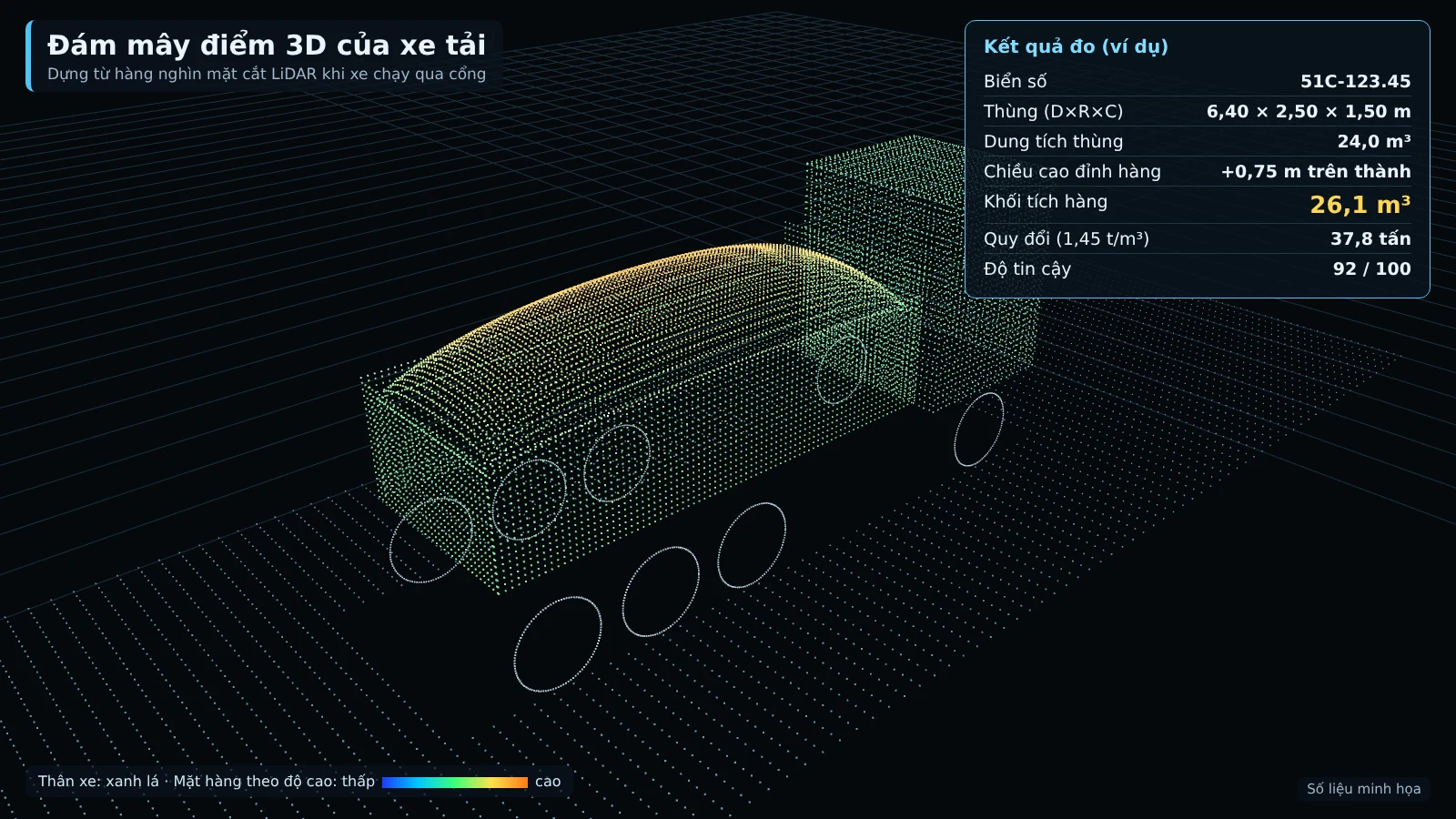
LiDAR emits laser pulses and measures the distance to surfaces, forming a point cloud that describes the shape of the truck bed and the load surface. From the point cloud, the software builds a 3D surface and calculates the volume of the load inside the bed plus the part protruding above the sides.
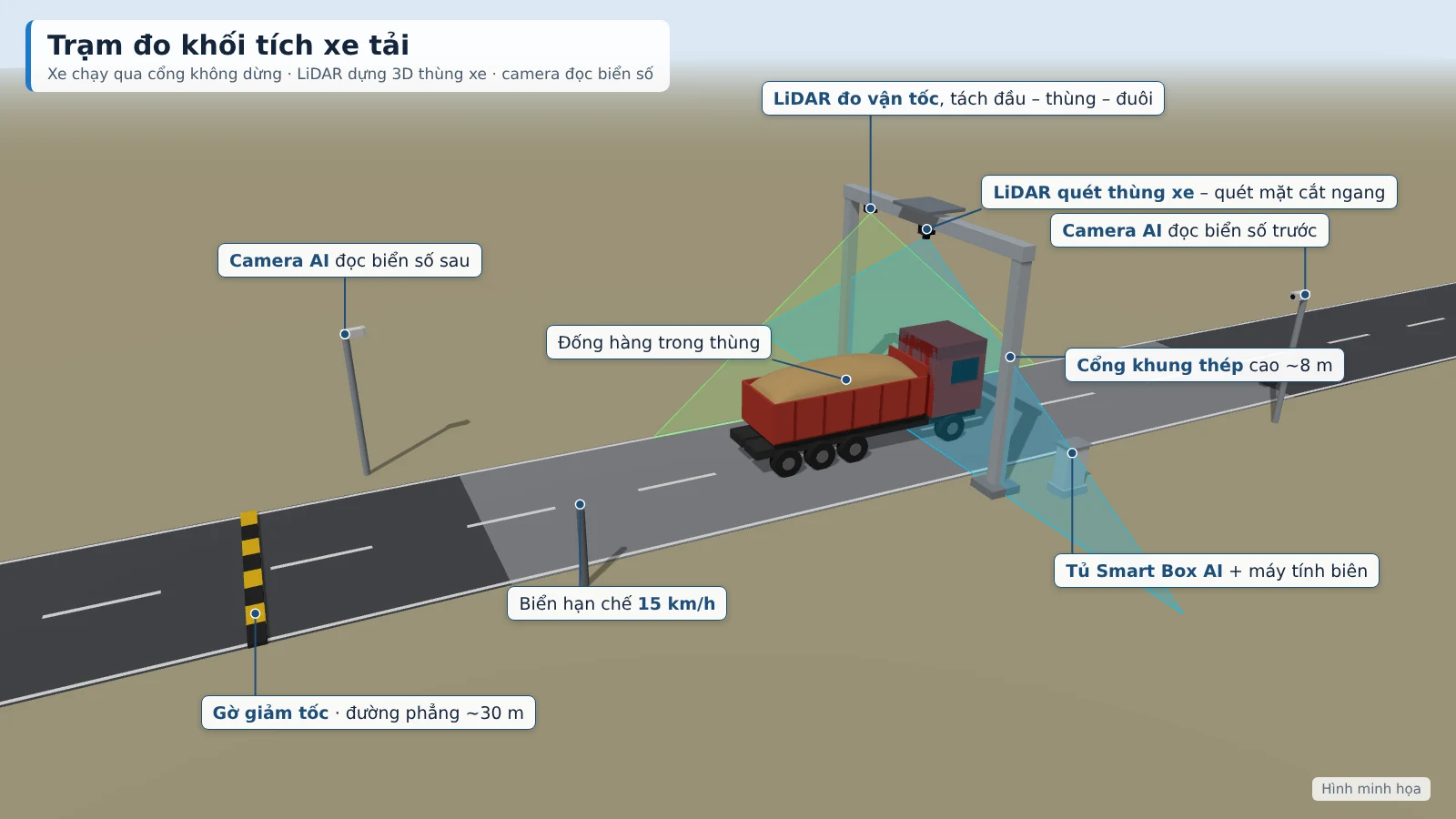
With Smart Box AI, trucks drive through a steel gantry at under 15 km/h without stopping. Each trip is measured twice at the same gantry: on the way in with a load and on the way out empty. The system pairs the two passes of the same vehicle and calculates the actual delivered m³ = m³ in − m³ remaining. The data recorded for each trip includes:
- Front and rear license plates, contractor, clearest photo.
- Entry time, exit time, time the vehicle spent on site.
- Length, width and height of the truck bed and of the load.
- m³ in, m³ remaining, actual delivered m³, the part of the load protruding above the bed sides.
- Converted tonnes by material type.
- 3D model of the load, photos and camera clips at the gantry.
- Measurement quality score from 0 to 100; poor measurements are automatically forwarded to staff for verification.
For barges, the station is set up on the channel into the berth. The barge passes through the measurement frame at under 5 km/h, LiDAR builds a 3D model of the cargo hold and measures the freeboard. Both the loaded entry and the empty exit are measured; the difference in draft gives the tonnage of the cargo, and the system then compares it with the tonnage converted from m³. If the two methods differ by more than 8%, the trip is forwarded to staff for confirmation.
The difference between weighbridges and volume measurement
A weighbridge measures weight (tonnes); a volume measurement system measures volume (m³). A weighbridge answers how heavy the shipment is; volume measurement answers how many m³ the shipment contains, whether the container is full, and whether it has been fully discharged.
| Criterion | Truck weighbridge | Volume measurement (Smart Box AI) |
|---|---|---|
| Primary quantity | Tonnes | m³, with tonnes converted using density |
| Must the vehicle stop | Stop on the weighbridge platform | No stop, drive through the gate at under 15 km/h |
| Detection of underloading | Indirectly via the tonne figure | Alert when m³ is below the registered level (default 85% of container capacity) |
| Detection of raised sides, vehicle swap | No | Compared against the registered container profile, alert on deviation |
| Residual material on exit | Must re-weigh the empty vehicle | Measured on exit, alert when residue exceeds 0.5 m³ |
| Evidence per trip | Weigh ticket | License plate, photo, 3D image, camera clip, m³ per pass |
| Effect of material moisture | Tonne figure varies with moisture | m³ figure does not depend on moisture; the converted tonne figure does |
| Volume error (trucks) | Not applicable | Proposed target ≤ ±3% (trips from 10 m³) |
| Applicable to barges | No | Yes, 3D scan cross-checked against draft |
The error figures in the table are proposed targets, to be re-agreed by both parties based on the results of a 4-week trial run. The two tools do not fully replace each other. They measure two different quantities, and the difference between those two quantities is itself useful information for managers.
When should both solutions be combined?
Combining is advisable when the contract is settled by m³ but the project also needs tonne figures for cross-checking, or when you want to know the actual density of the material instead of using a fixed coefficient.
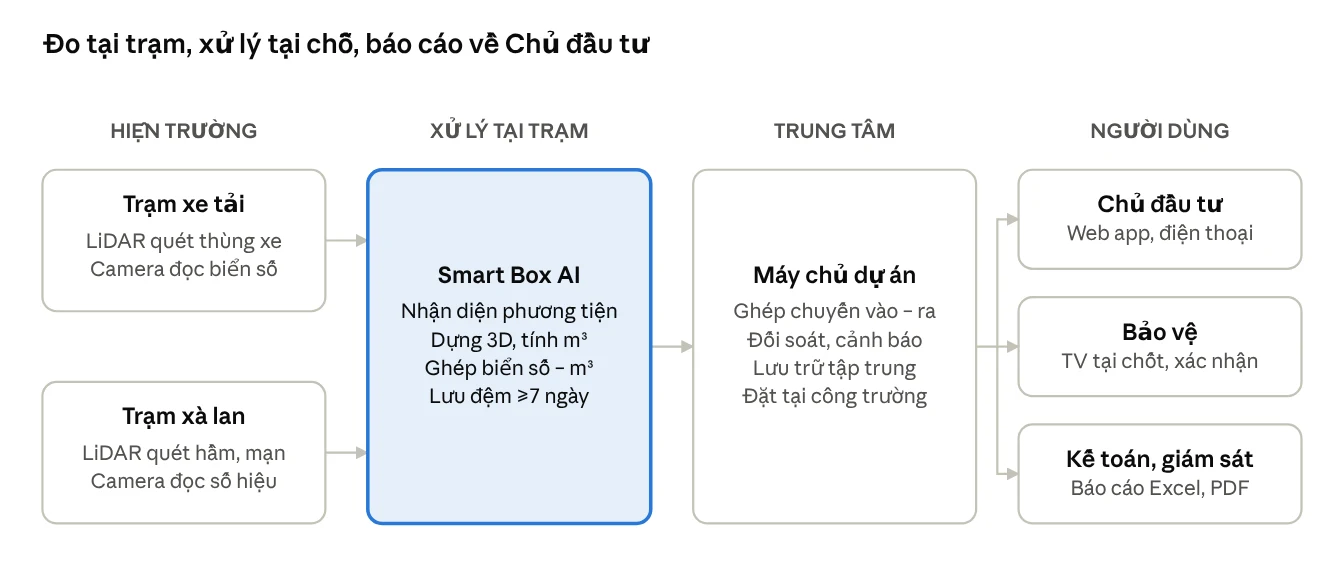
There are three common situations:
- The site already has a weighbridge, and the contract is calculated by m³. The tonne figure from the weighbridge is not sufficient for m³ acceptance. Volume measurement provides the m³ figure directly, while the weighbridge serves as an independent cross-check source.
- The material's moisture varies by season. When each trip has both m³ measured by LiDAR and tonnes from the weighbridge, the project can track the actual density of each material type over time.
- Receiving goods both by truck and by barge. Barges do not pass through a road weighbridge. The barge station cross-checks two methods itself: 3D scanning of the cargo hold and draft measurement.
When not yet integrated with a weighbridge, Smart Box AI converts m³ to tonnes using the density table for each material type issued by the Investor. When integrated, the system has an API to connect to the weighbridge or the project's accounting software, and can export Excel/CSV.
One point to note regarding mineral management: the Ministry of Agriculture and Environment has consulted (03/2025) on a draft decree detailing the 2024 Law on Geology and Minerals, proposing the installation of smart AI-enabled cameras at locations where minerals are transported out of the mining site. This is a draft and is not yet in effect. Per-trip data including license plate, time, photos and m³ is an available foundation should the regulation be issued.
Calibration and cross-checking before acceptance
The m³ figures can only be used for payment once the station has been calibrated on site and cross-checked. An existing weighbridge is a good source of cross-checking during this phase.
- Reference block: place a steel block of known dimensions under the measurement gantry and align the sensors.
- Empty vehicle: each vehicle passes through 3 times at different speeds to establish the bed profile and check repeatability.
- Cross-check with a loaded vehicle: level the material across the truck bed and measure manually; if a weighbridge is available, cross-check additionally by tonnage.
- Barge: measure the hold profile when empty and compare with the registration records; cross-check with a manual draft survey.
- Periodic: re-check with the reference block every month and after each relocation of the station.
Calibration is followed by a 4-week trial run. Acceptance is based on 50 truck trips and 10 barge trips with cross-checks over 7 consecutive days; the software exports a comparison table of measured m³, cross-checked m³ and the error for each trip for both parties to sign off. The error levels of ≤ ±3% for trucks (trips from 10 m³) and ≤ ±5% for barges are proposed targets, to be re-agreed by both parties based on the results of the 4-week trial run.
Glossary summary table
The terms below appear when comparing a weighbridge with volumetric measurement and when reading reconciliation reports.
| Term | Definition | Example |
|---|---|---|
| Truck weighbridge | Measures the weight of the vehicle and cargo in tonnes | Collection yard, concrete batching plant |
| Volumetric measurement system | 3D scanning with LiDAR, calculating cargo volume in m³ | Landfill site gate, mine, barge wharf |
| m³ actually delivered | m³ on entry minus m³ remaining on exit | Basis for payment reconciliation with the contractor |
| Bed profile | Bed interior dimensions established from empty-vehicle passes | Detecting raised sides, vehicle changes |
| Bulk density | Conversion factor from m³ to tonnes by material type | Table issued by the Investor |
| Draft | The barge's depth of immersion; the difference between entry and exit gives the cargo tonnage | Compared with tonnes converted from 3D scanning |
Common mistakes
Most discrepancies at acceptance come from using the wrong quantity or lacking evidence for each trip, not from the equipment.
- Accepting an m³ contract using tonnage converted by a fixed factor, ignoring moisture and material source.
- Measuring only on entry and not on exit, so trips that do not discharge fully are still counted in full.
- Not establishing a bed profile for each vehicle, so raised beds or vehicle changes cannot be detected.
- Letting vehicles run with tarpaulins covering the load or pass quickly through the measurement gantry; the system will report "Unable to measure" and that trip must be re-verified.
- Not storing images, 3D models and adjustment logs, so there is no basis for comparison in the event of a dispute.
Related solutions
Truck & barge volumetric measurement — Smart Box AI: 3D LiDAR and AI cameras measure m³ per trip, with no need for vehicles to stop; each trip has a license plate, image and 3D model as acceptance evidence. View the solution, book an on-site survey →
Frequently Asked Questions
1. Can a truck weighbridge measure cargo volume?
No. A truck weighbridge gives weight in tonnes. It does not know whether the truck bed is full or partially loaded, whether it has been raised, and it cannot convert to m³ without the density of the material at the time of weighing.
2. Does the volume measurement system give a tonnage figure?
Yes, in converted form. Smart Box AI calculates m³ using LiDAR and then converts to tonnes according to the density table for each material type issued by the Investor. For barges, the system also calculates tonnes based on the difference in draft at entry and at exit to cross-check against the tonnes converted from m³.
3. When should a weighbridge and volume measurement be combined?
When the contract pays by m³ but the project still needs tonnage for cross-checking, or when you want to track the actual density of the material instead of using a fixed coefficient. A common case is landfilling sites, mines and yards that already have a weighbridge.
4. Can Smart Box AI be integrated with an existing weighbridge?
Yes. The system has an API to connect to the weighbridge or the project's accounting software, and can export Excel/CSV. Integrating the weighbridge to track actual density is a project-based extension, configured after surveying the existing weighbridge.
5. How can the measured m³ figures be reliable enough for acceptance?
The station is calibrated on site using standard weights, an empty vehicle making 3 runs and a loaded control trip; where a weighbridge is available, cross-checking is additionally done by tonnes. Trucks must have their tarpaulin open and travel at exactly 15 km/h, barges at 5 km/h. An error of ≤ ±3% (trucks, trips from 10 m³) and ≤ ±5% (barges) are proposed targets, to be re-agreed by both parties based on the results of a 4-week trial run.
Want to know whether your site should use a weighbridge, volume measurement, or both combined? An Ninh Số conducts on-site surveys: locations for the measurement gate, existing weighbridges, truck and barge flows, then demonstrates the Smart Box AI truck and barge volume measurement solution directly. Call the hotline 0796 700 777 to book an appointment.