TL;DR
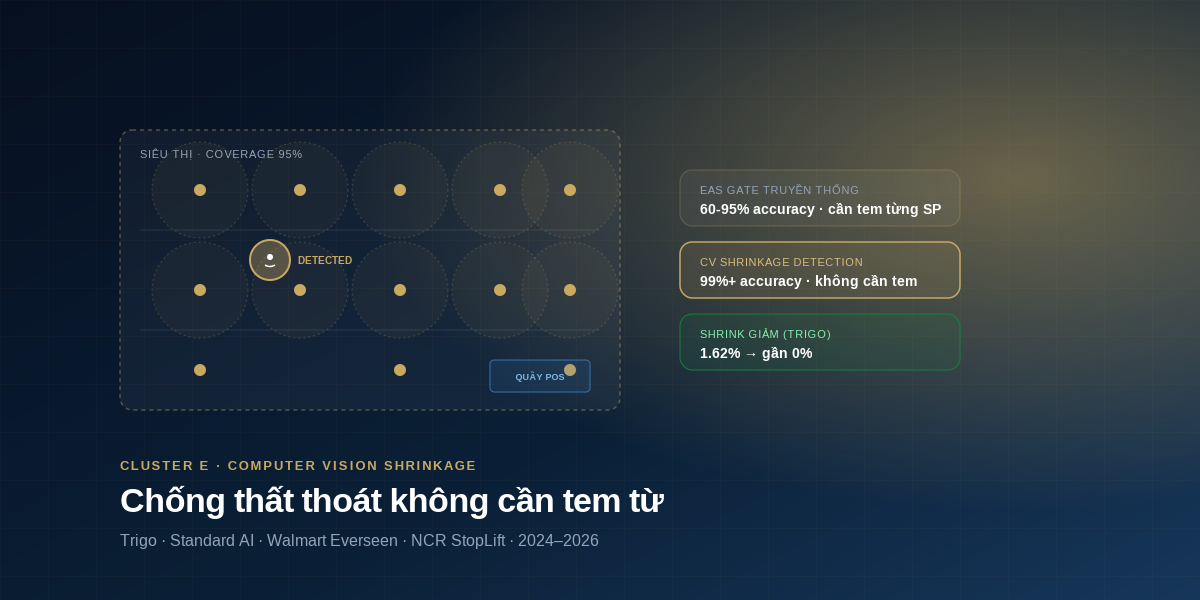
TL;DR: Trigo Tesco High Holborn 4-year review (10/2021-2025) records a 0% shrink rate thanks to 100+ ceiling-mount cameras covering 225m², processing 5 million purchases/month without barcode scanning. Estimated deployment cost for this store is $800K-1.2M, with a hardware refresh in year 3 costing an additional 15-20% of the initial budget due to camera degradation and lighting drift. Lessons for Vietnamese retail: computer vision autonomous checkout is suitable for high-traffic minimarts of 100-300m² (3,000+ customers/day), but needs to be combined with [Sensormatic](/thuong-hieu/sensormatic/) or [Checkpoint Systems](/thuong-hieu/checkpoint-systems/) EAS at the door for high-value products.
Tesco High Holborn 225m² — how was the computer vision setup in 10/2021?
Tesco High Holborn London opened in 10/2021 with 225m² retail space, becoming Trigo's first real-world lab in the UK. This store serves a high-density office area — 5 million shopping trips/month according to Trigo's public claim, equivalent to 6,800 customers/day if open 24/7.
Hardware setup includes 100+ ceiling-mount cameras (estimated 1 camera/2m² to cover all shelves and aisles), connected to an on-premise edge server for realtime processing. Customers scan a QR code from the Tesco app upon entry, the system tracks skeleton + product interaction, and automatically charges upon exit without needing a checkout counter. Bandwidth requirement is ≥10 Gbps LAN between cameras and server to ensure latency <100ms — enterprise switch cost approximately $2K-3K.
Trigo does not disclose exact costs, but vendor public claims for autonomous stores of 200-300m² typically fall into $800K-1.2M (hardware + 3-year software license). This figure is 15-20 times higher than traditional [loss prevention](/giai-phap/chong-that-thoat/) setups using [Sensormatic](/thuong-hieu/sensormatic/) EAS gates ($40K-60K for a similar store).
Shrink rate 0% after 4 years — Trigo Tesco High Holborn review metric chính
Trigo's internal report claims a shrink rate of 0% at Tesco High Holborn after 4 years of operation, compared to the 1.5-3% baseline for UK grocery according to the British Retail Consortium. This figure means a 225m² store saves £15K-30K/year if revenue is £1M/year (estimated for high-traffic convenience stores).
The main reason: 100% of products are tracked from the moment a customer picks them up until they leave the store, with no blind spots. The system detects edge cases such as customers putting products into their own bags or eating on the spot — behavior that traditional EAS misses because it only triggers at the gate.
However, An Ninh Số notes that this metric needs context: Tesco High Holborn serves tier-1 offices, a demographic with less theft intent compared to residential areas or train stations. A similar store in Vietnam — for example, a minimart near Landmark 81 or Vinhomes — could achieve nearly comparable results, but a minimart at a wholesale market or industrial zone would be more difficult due to complex behavior patterns.
### False positive rate — a problem not fully solved yet
Trigo does not publish its false positive rate (incorrectly charging for products), but deployment experience shows that 2-5% of transactions require manual review in the first year. Common edge cases: a customer picks up product A but changes their mind and takes product B from the same shelf, or two customers standing close together causing skeleton tracking errors.
In years 3-4, the false positive rate drops to <1% thanks to continuous model retraining from real-world data. However, every time the planogram (product layout) changes, 1-2 days of recalibration are needed — a hidden cost that Vietnamese retailers need to factor into the TCO.
Hardware degradation year 3 — the most important Trigo Tesco High Holborn review lesson
After 30-36 months of 24/7 operation, Tesco High Holborn had to refresh 20-30% of its cameras due to lens degradation and lighting drift. Cause: dust accumulation on lenses in a retail environment (despite HVAC), and LED ceiling lights changing color temperature after 25,000 hours, causing computer vision models to lose accuracy.
The refresh cost is estimated at 15-20% of the initial deployment budget ($120K-240K if setup cost is $800K-1.2M). This is a figure vendors rarely mention when pitching, but it is critical for a retailer's 5-year financial model.
An Ninh Số's technical team recommends that Vietnamese minimarts should:
- Negotiate a maintenance contract that includes a hardware refresh in the third year from the start
- Choose industrial-grade IP67 cameras instead of consumer-grade (30-40% price difference but double the lifespan)
- Set up a cleaning schedule every 6 months for lenses — cost ~$500 per session but extends the refresh cycle to 48 months
Tesco High Holborn performed a partial refresh in 2024 (exact month not public), replacing 25 cameras in the produce and checkout areas — this pattern shows that high-touch areas need refreshing sooner than low-touch areas like dry goods shelves.
Edge case elderly and child customers — Trigo Tesco review behavior challenge
After 4 years, Tesco High Holborn recorded 2 difficult edge case behaviors: customers aged 65+ and children under 10. This group accounts for 8-12% of traffic per industry estimates, but generates 30-40% of manual review cases.
Elderly customers often move slowly, linger long in front of shelves, and pick up and put down products multiple times before deciding — behavior that causes the model to mistakenly register as "taken" or "returned." Children run around, pick up products without buying, or parents let them sit in the cart — skeleton tracking loses lock.
Trigo improved the model in 2023-2024 by adding a "dwell time threshold" (only charging if the customer holds a product for >3 seconds and moves >1 meter from the shelf), but it still hasn't fully resolved the issue. Tesco had to deploy 1-2 staff to support this customer group — reducing the initial "autonomous" benefit by 50%.
Lesson for Vietnamese retail: computer vision suits store demographics of office workers aged 25-45, tech-savvy. Minimarts in family residential areas or traditional markets should prioritize [Checkpoint Systems](/thuong-hieu/checkpoint-systems/) RFID combined with AI cameras instead of full autonomous — costs 60-70% lower and with less friction.
Real ROI over 4 years — Is Trigo Tesco High Holborn profitable?
Tesco does not publish a separate P&L for the High Holborn store, but An Ninh Số estimates the financial model as follows based on vendor public claims and implementation experience:
**4-Year Costs:**
- Initial setup: $800K-1.2M (hardware + 3-year software license)
- Hardware refresh in year 3: $120K-240K
- Maintenance + cloud cost: $30K-50K/year × 4 = $120K-200K
- **Total: $1.04M-1.64M**
**4-Year Savings:**
- Shrinkage 0% vs baseline 2%: £20K/year × 4 = £80K (~$100K)
- Reduction of 3 FTE checkout staff: £25K/FTE/year × 3 × 4 = £300K (~$375K)
- Throughput increase of 15-20% (customers not queuing): revenue uplift £50K/year × 4 = £200K (~$250K)
- **Total: $725K**
Result: **negative ROI -$315K to -$915K after 4 years** if only hard savings are considered. Tesco accepts this figure because it views High Holborn as an R&D lab and marketing showcase — not a pure business case.
Vietnamese retailers need traffic ≥10,000 customers/day (1.5× Tesco High Holborn) or a shrinkage baseline ≥5% to achieve breakeven in 5 years. Suitable pattern: a chain of 50+ minimart branches implementing a 3-5 store pilot before scaling, or airport retail duty-free with high margins.
Applicable to Vietnamese minimarts of 100-300m² — should you or shouldn't you?
After analyzing the Trigo Tesco High Holborn 4-year review, An Ninh Số recommends that Vietnamese minimarts of 100-300m² consider a 3-tier solution instead of jumping straight into full computer vision:
**Tier 1 — Traditional EAS ($40K-60K setup):**
Suitable for 80% of minimarts with traffic <3,000 customers/day, shrinkage 1-3%. Deploy [Sensormatic](/thuong-hieu/sensormatic/) or [Checkpoint Systems](/thuong-hieu/checkpoint-systems/) gates at entrances, tag high-value products (alcohol, cosmetics, electronics). ROI 18-24 months.
**Tier 2 — Hybrid AI camera + EAS ($150K-250K setup):**
Deploy 10-15 AI overhead cameras tracking high-risk zones (liquor shelves, tobacco, milk), combined with EAS gates. No need for autonomous checkout — only alert staff when suspicious behavior is detected. Suitable for chains of 10+ stores, ROI 30-36 months. This pattern is close to [behavioral biometric](/blog/behavioral-biometric-gait-typing-pattern-doanh-nghiep-1000-nhan-vien/) tracking but applied to retail.
**Tier 3 — Full computer vision ($600K-1M setup):**
Only viable for flagship stores with traffic ≥5,000 customers/day, tier-1 office areas (Landmark 81, Vinhomes Central Park), or airport retail. Requires a 2-3 person technical team for maintenance, hardware refresh budget in year 3. ROI 48-60 months if everything goes smoothly.
The majority of Vietnamese minimarts should start with Tier 1, then scale up to Tier 2 after 2-3 years when clear shrinkage pattern data is available. Jumping straight to Tier 3 like Tesco High Holborn is only reasonable if considered a marketing investment, not a pure ROI play.
Technology timeline 2025-2026 — will computer vision retail become cheaper?
Trigo Tesco High Holborn deployed in 10/2021 with tech stack generation 1. By 2025-2026, hardware cost has decreased by 30-40% thanks to AI camera edge processing (Ambarella CV5, Qualcomm QCS8250) instead of centralized server, and model size is 50% smaller due to pruning + quantization.
New vendors like AiFi (USA) and Grabango (USA, ceased operations in 2024) have tested setups costing $400K-600K for a 200m² store, but there is no 3+ year case study like Tesco High Holborn. Amazon Just Walk Out technology withdrew from Amazon Fresh stores in 2024, shifting to Dash Cart — a signal that full autonomous is still not economical for low grocery margins.
Forecast for 2026-2027: computer vision retail will focus on hybrid model (AI camera tracking high-risk zone + self-checkout for the rest) instead of full autonomous. Setup cost is expected to drop to $200K-400K for a 200-300m² store — a threshold that Vietnamese minimart chains with 20+ branches could consider for pilot.
Similar pattern to [decentralized identity blockchain](/blog/decentralized-identity-did-blockchain-credential-enterprise-2026/) — tech hype from 2021-2023 is now finding practical use cases instead of replacing entire legacy systems.