TL;DR
Vision Language Model (VLM) is a multimodal AI architecture that allows operators to search for video using natural language descriptions instead of fixed filter dropdowns. Verkada first commercialized it in 05/2024, Hikvision launched AcuSeek NVR in 06/2025 on the Guanlan platform, Avigilon Unity 8.7 Visual Alerts in 09/2025, Milestone Hafnia in 11/2025, and Bosch IVA Pro Context is expected in 2026. Measured real-world results: Verkada reports retailers reduced shrinkage by 50%, Hikvision AcuSeek cut forensic review time from 45 minutes to under 10 seconds, Milestone Hafnia increased traffic analysis accuracy by 19.4% and reduced alarm fatigue by 30%.
Why Vision Language Model emerged 2024-2026?
Camera AI generation 2018-2024 based on pure deep learning architecture — object classification models (person, vehicle, face) and metadata tagging by fixed attributes: gender, age, shirt color, vehicle color. When investigating an incident, operators filter via a dropdown of 28-30 predefined attributes. This pattern has driven the industry forward for 6 years — but still leaves a major pain point: scrubbing through 4-8 hours of video to find 30 critical seconds.
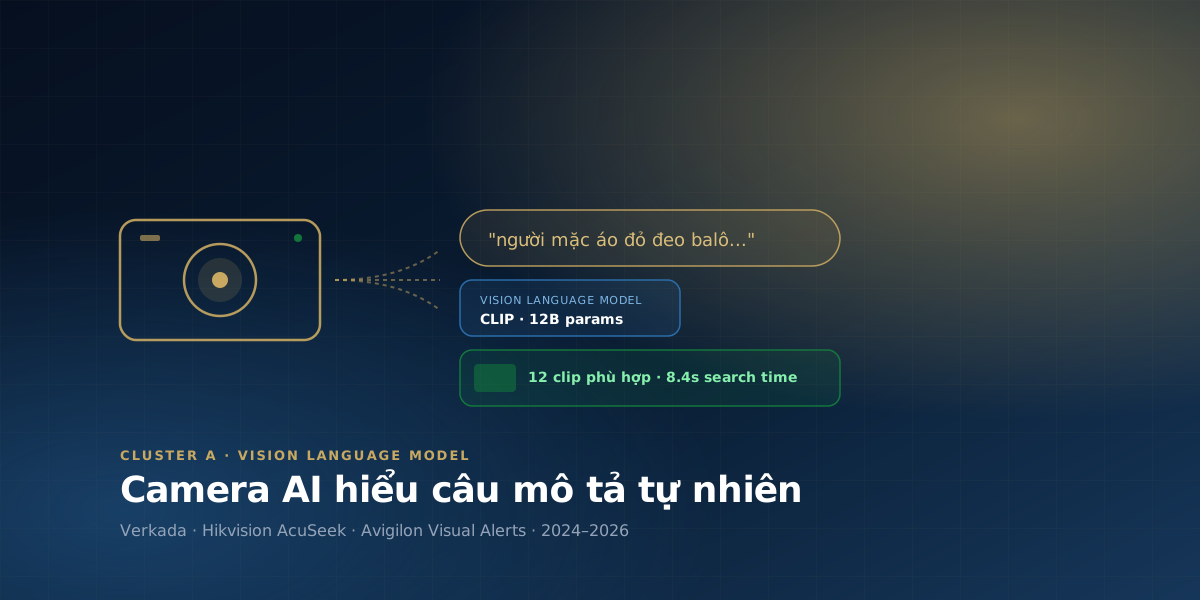
Vision Language Model (VLM) reverses the search method. Instead of selecting from a dropdown, operators type a free-form description — "a man wearing a red backpack walking through the north gate around 2 PM yesterday" — and the camera returns the matching clip within seconds. This is an architectural difference, not an incremental improvement.
[Verkada](/thuong-hieu/verkada/) is the first vendor to commercialize VLM in the cloud VMS industry, launching **AI Search** in May 2024 with a CLIP-family model. Within the next 12-18 months, nearly all global Tier-1 vendors — both Chinese and Western — have pushed commercial VLM products to market.
Actual measured results during the 2024-2025 period:
- Verkada reports retail customers reducing **product shrinkage by 50%**, **2x faster** in checkout incident investigations
- Hikvision AcuSeek NVR claims to reduce forensic review time from **45 minutes to under 10 seconds** with queries like "person on a phone call" or "white van"
- Milestone Hafnia VLM in traffic command center context: **+19.4% accuracy** in flow/direction classification, **-30% alarm fatigue** for 24/7 operators
How does a Vision Language Model work?
Most commercial VLMs 2024-2026 in the security industry are built on the **CLIP** (Contrastive Language-Image Pre-training) architecture published by OpenAI in 2021, or its open-source descendants like OpenCLIP, SigLIP. CLIP has two "encoders" running in parallel:
- **Image encoder** (usually Vision Transformer / ViT): converts video frames into 512-1024 dimensional vectors
- **Text encoder** (Transformer 12-layer): converts descriptive sentences into vectors of the same size
The core point: the two encoders are trained together via *contrastive learning* on hundreds of millions of image-caption pairs from the internet. The model learns to pull correct pairs (image of a cat + caption "a cat") close together in vector space, and push incorrect pairs apart.
In real-world deployment, the system pre-encodes all video frames into vectors and stores them in an index. When an operator types "person in red jacket near ATM", the text encoder converts the sentence into a vector, and the system finds image vectors with the highest cosine similarity — returning results in seconds because all heavy computation was done during recording. This is why **AcuSeek NVR can search 24h footage in under 10 seconds**: the index was pre-computed by the Hikvision Guanlan model.
Enterprise vendors go beyond basic CLIP. Milestone Hafnia VLM (11/2025) **fine-tunes on 75,000 hours of real-world video** collected from the EU and US, using the NVIDIA Cosmos Reason + Cosmos Curator platform. Bosch IVA Pro Context (expected 2026 on CPP16 chipset) adds an LLM head to summarize scenes and perform reasoning — surpassing the match-by-similarity limitation of pure CLIP.
One important distinction to understand: **"AI Search by Attributes"** from the previous generation (Avigilon Appearance Search 2017, Hikvision DeepinMind, Dahua Video Metadata 2.0 with 28+ attributes) **is not VLM**. These two technologies have similar names but are architecturally different in scale.
Six vendors have commercialized VLM (timeline 2024-2026)
**Verkada AI Search — 05/2024** (cloud VMS)
[Verkada](/thuong-hieu/verkada/) is the first vendor to bring VLM to the commercial market in the cloud security industry. It uses the CLIP-family model with in-house preprocessing. Has guardrail moderation — blocks queries about race, ethnicity, subjective gender. Expanded in September 2024 with AI-Powered Alerts proactive monitoring via VLM.
**Hikvision Guanlan + AcuSeek NVR — 04-06/2025** (on-premise)
[Hikvision](/thuong-hieu/hikvision/) announced Guanlan Large-Scale AI Models on 29/04/2025 — a 3-tier architecture (foundation → industry → task) comprising large vision, language, and multimodal models. AcuSeek NVR launched in 06/2025 is the first consumer-facing product, processing locally on the NVR without cloud upload. DeepinViewX Bullet Cameras (07/2025) run edge VLM on the camera, claiming >90% reduction in perimeter false alarms compared to previous-generation AI.
**Avigilon Unity Video 8.7 Visual Alerts — 09/2025** (server-side)
[Avigilon](/thuong-hieu/avigilon/) released Visual Alerts in Unity Video 8.7 on 18/09/2025, the first on-premise GenAI feature using natural-language prompts to create alerts across the entire field of view. Deployed via Avigilon AI Appliance 2X — requires a dedicated hardware appliance, not yet running on the camera edge.
**Genetec Security Center SaaS — 09/2025** (cloud)
[Genetec](/thuong-hieu/genetec/) announced Natural Language Search in Security Center SaaS on 18/09/2025, rolling out at the end of September. Expanded in early 2026 with Investigation Assistant providing contextual analysis and visual trajectory search.
**Milestone Hafnia VLM — 11/2025** (VMS-as-a-Service)
[Milestone](/thuong-hieu/milestone-systems/) announced Hafnia VLM in November 2025, fine-tuned on 75,000 hours of video. Provides XProtect Video Summarization (free plug-in, pay-per-prompt) and VLM-as-a-Service for third parties. AI Search on-prem via BriefCam expected by end of 2026.
**Bosch IVA Pro Context — 2026** (edge VLM on camera)
[Bosch](/thuong-hieu/bosch-security/) announced IVA Pro Context at ISC West 04/2025; cloud rollout at the end of 2025, **edge VLM on CPP16 chipset from 2026** — the first Western product to bring true VLM down to the camera, requiring no intermediary appliance.
**Important note**: [Dahua](/thuong-hieu/dahua/) WizMind as of April 2026 remains pure deep-learning classification — no commercial VLM product equivalent to AcuSeek or Verkada AI Search. This is a notable gap compared to Hikvision.
**3 Enterprise Use Cases Worth Investing in for 2026**
### Retail loss prevention for chains with 50+ branches
[Verkada reports](/giai-phap/chong-that-thoat/) that retail customers reduce **50% product shrinkage**, are **2x faster** in POS incident investigation, and achieve **20% reduction in theft processing time**. Typical workflows: searching for "person holding Louis Vuitton bag" or "customer placing item in pocket near cosmetics aisle" become daily operations. Especially suitable for large supermarket chains, high-end cosmetics, and premium fashion — where products have high value and losses are measured in billions of VND per year.
### Bank/ATM forensic search
Hikvision AcuSeek case study claims a reduction from **45 minutes of review to under 10 seconds** for queries like "black SUV with round headlights" or "person in black hoodie with backpack". For [Vietnamese banks](/mo-hinh/ngan-hang-tai-chinh/), the real value lies in the ability to search using specific patterns that cannot be pre-trained: "customer standing too long in front of ATM", "person wearing a mask leaving the transaction counter at 10 PM", "motorcycle parked blocking the emergency exit". An incident investigation is completed in hours instead of days — critical for the State Bank of Vietnam's 24-48 hour forensic compliance requirements.
### Smart city / Traffic command center
Milestone Hafnia VLM improves **19.4% accuracy** in flow/direction classification in traffic context, **+4.4% alert verification accuracy**, **-30% alarm fatigue** for operators. Critical for 24/7 command centers as it reduces operator burnout — one of the classic issues in multi-person, multi-shift SOCs.
Should VLM invest in Vietnamese enterprises immediately in 2026?
**Should invest** if the business meets all 3 conditions:
- 100+ cameras are operational and forensic investigation is a regular workflow (at least 3-5 incidents/week)
- Requires fast forensic compliance — banks, US-EU FDI, listed companies
- Has budget for new hardware ($25,000-50,000 for a 16-32 camera pilot)
**Should wait 1-2 years** if:
- Fewer than 50 cameras, manual video review 1-2 times/month is still sufficient
- Most cameras are analog or old IP cameras that do not support streaming via VLM appliance
- Vietnamese language query is the primary requirement (see limitations below)
- Limited budget — VLM prices are expected to drop 30-40% in the next 12-18 months when embedded VLM cameras (Bosch CPP16 and competitors) become widely commercial
**Key trade-off**: initial cost is 30-50% higher than previous-generation AI, but in return, ROI from forensic investigation is 270 times faster (45 minutes down to 10 seconds) and the ability to search for patterns that cannot be pre-trained. For businesses with 100+ cameras and compliance requirements, payback is typically 12-18 months based on operator time saved.
An Ninh Số recommends a pilot at 1-2 branches with 16-32 cameras over 60-90 days, specifically measuring the false positive rate, search time, and reliability of VLM results in the Vietnamese environment before a wide-scale rollout. [Schedule a survey](/lien-he/) for the engineering team to analyze the specific existing camera infrastructure and propose a suitable VLM combo.
Six VLM 2026 limitations to know before investing
**1. Hallucination — VLM "guesses" actions based on scene context.** The CVPR 2025 paper MASH-VLM confirmed that "leading VLMs hallucinate actions based on the scene context or incorrectly predict scenes based on the observed actions." For example: A VLM seeing a person in the kitchen might auto-generate the caption "cooking" even if the person is just standing. In a security context, false positives are higher than with previous-generation attribute search — requiring human review for every critical alert.
**2. Weak multilingual support — Vietnamese prompts lack official benchmarks.** Most VLM training data is heavily English-grounded. Verkada, Hikvision, Avigilon, Milestone have no official Vietnamese benchmarks as of April 2026. In real-world deployments, English queries ("person in red shirt near ATM") still yield the best results. Pure Vietnamese queries ("áo đỏ", "xe máy SH") show significantly reduced accuracy. Native Vietnamese support is on the 2027+ roadmap for major vendors.
**3. Privacy guardrails.** Verkada proactively blocks queries about race, ethnicity, and subjective gender to comply with GDPR and best practices. Other vendors have not publicly announced equivalent policies — posing compliance risks when deploying for banks and listed companies. Guardrails must be audited before go-live.
**4. Hardware lock-in — older cameras CANNOT be upgraded for VLM.** New hardware is required: AcuSeek NVR (Hikvision), AI Appliance 2X (Avigilon), CPP16 chipset (Bosch). Analog cameras are not supported. Older IP cameras can still be used but must push streams through intermediate VLM hardware — unable to leverage edge AI on-camera from legacy devices.
**5. Real-time latency still requires GPU-class hardware.** 4K-8K camera real-time inference requires a Jetson Orin AGX 275 TOPS or equivalent if running on-camera. Many vendors offload to appliances/cloud (Avigilon AI Appliance 2X, Bosch cloud-first, edge-later) due to power budget and heat dissipation constraints of individual cameras.
**6. Lessons from Amazon Just Walk Out (April 2024).** Amazon shut down Just Walk Out for full-size Amazon Fresh stores after discovering the "autonomous" AI system still required ~1,000 reviewers in India for human-in-the-loop. A general lesson for all VLM/agentic AI security deployments: human-in-the-loop is a default requirement, not an option. Do not expect 100% autonomous AI — expect AI to filter 95% of noise so humans can focus on the 5% critical cases.