TL;DR
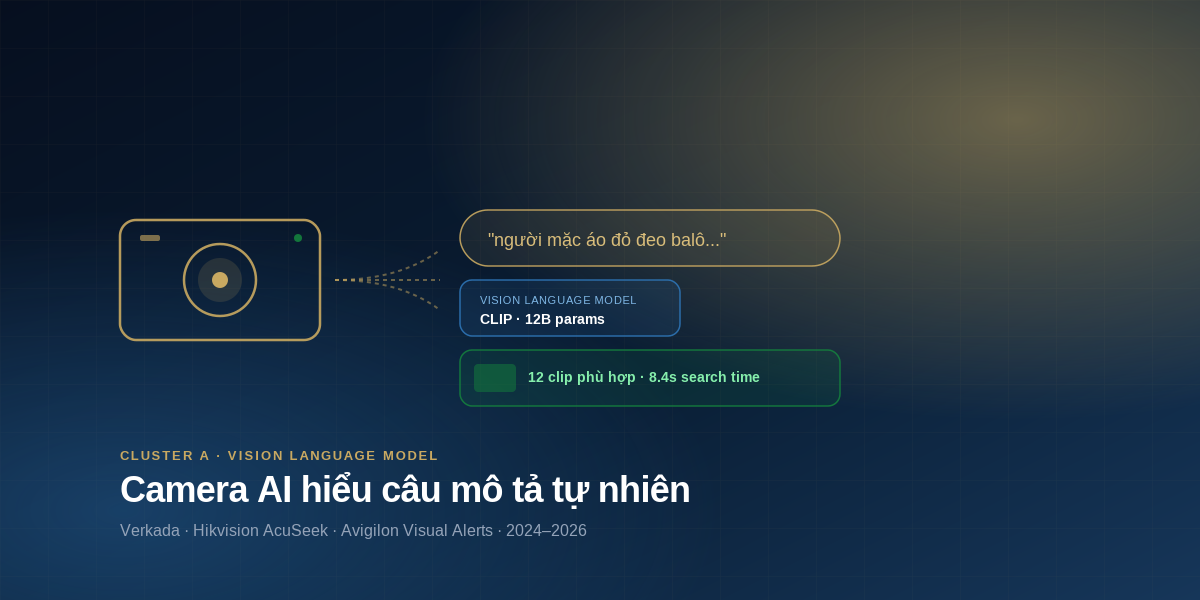
Visual Alert natural-language is an AI feature that allows building operators to create alert rules using natural language descriptions such as 'alert backpack left in lobby for over 10 minutes' instead of code or filter dropdowns. Avigilon Visual Alerts (09/2025), Verkada AI-Powered Alerts (05/2024), and Genetec NL Search (Q2/2026) have all commercialized this workflow. According to An Ninh Số's experience, Grade A buildings with 60+ tenants reduce rule setup time by 40-60% and detect incidents 3-5 minutes faster by eliminating false positives from legacy motion zones.
Why do old warning rules cause operators of grade A buildings to waste time?
Command center of a Grade A building with 60+ tenants typically receives 200-400 alerts per day from the old AI camera system. Problem: 70-80% are false positives because rules based on motion zones or line crossing cannot distinguish context. For example: a motion zone at the main lobby triggers every time a cleaner passes by, but fails to detect a backpack left behind for 15 minutes.
Setting up a new rule requires IT to write scripts or configure complex filter dropdowns. An operator wanting an alert for "motorcycle entering lobby" must wait for IT to create an object class "motorcycle" + zone "lobby entrance" + dwell time — taking 2-3 days. When tenants change layouts or add new requirements, the cycle repeats.
[Smart AI Camera](/giai-phap/camera-ai/) generation 2024-2026 integrates Vision Language Model (VLM) to solve this pain point. Operators type a description in Vietnamese or English, and the AI automatically creates rules and monitors in real time. No IT required, no coding needed.
How does the Visual Alert natural-language workflow 2026 work?
Visual Alert natural-language based on VLM — a multimodal AI architecture combining computer vision and natural language processing. The workflow consists of 4 steps:
**Step 1: Operator enters a description sentence**
The operator types a rule in natural language into the web interface or mobile app. For example: "Alert when a backpack is left in the main lobby for more than 10 minutes" or "Notify if a person wearing a black shirt stands near the emergency exit after 23:00".
**Step 2: VLM parses the sentence into parameters**
AI breaks down the sentence into object (backpack), location (main lobby), behavior (left/unattended), time threshold (10 minutes). Verkada AI-Powered Alerts supports 50+ object classes and 20+ behavior patterns. Avigilon Visual Alerts can parse complex sentences with 2-3 AND/OR conditions.
**Step 3: Edge AI monitors in realtime**
Edge AI cameras (or on-site NVR) continuously run object detection + tracking. When a rule match is detected, the system sends alerts via email, SMS, or push notification. Latency from event to alert: 5-15 seconds depending on vendor.
**Step 4: Operator verifies and refines**
The operator reviews a 10-30 second clip accompanying the alert. If it's a false positive, the operator provides "not relevant" feedback — AI learns and reduces similar triggers in the future. [Genetec](/thuong-hieu/genetec/) NL Search allows operators to refine rules with new sentences directly on the alert panel.
According to vendor public claims, this workflow reduces setup time by 50-70% compared to traditional rule-based methods.
Three vendors commercializing Visual Alert natural-language 2024-2026
Three leading platforms in the Vietnamese market:
| Vendor | Feature | Timeline | Strengths | Limitations |
|--------|---------|----------|-----------|------------|
| [Verkada](/thuong-hieu/verkada/) | AI-Powered Alerts | 05/2024 | Cloud-native, no onsite server needed, smooth mobile app | Requires stable internet, license costs 20-30% higher |
| [Avigilon](/thuong-hieu/avigilon/) | Visual Alerts (Unity 8.7) | 09/2025 | Deep integration of Unusual Motion Detection, supports complex AND/OR queries | Requires onsite NVR Unity, more complex setup than Verkada |
| [Genetec](/thuong-hieu/genetec/) | NL Search + Alert | Q2/2026 (expected) | Unified platform with access control and ALPR, enterprise-grade | Not officially released yet, highest price among 3 vendors |
**Verkada AI-Powered Alerts** launched earliest in 05/2024. Operators create rules via web or iOS/Android app. Real-world example: a retail chain with 50+ branches uses the rule "alert when a person loiters near the checkout counter for over 5 minutes" — reducing shrinkage by 30-40% according to Verkada's internal reports. Limitation: requires upload bandwidth ≥5 Mbps/camera to stream metadata to the cloud.
**Avigilon Visual Alerts** (09/2025) runs onsite on NVR Unity. Strength: combines Unusual Motion Detection — AI self-learns the building's normal patterns and alerts on abnormal behavior even if the operator hasn't defined a rule. Example: detects a person climbing a fence after 22:00 even though the operator hasn't created a "climbing fence" rule. NVR Unity 64-channel cost: $8,000-12,000 depending on specs.
**Genetec NL Search** is expected in Q2/2026, integrated into Security Center 5.13. Operators search video using descriptive sentences, then convert into alert rules with one click. Example: search "truck parked in front of the main door" → finds 3 clips → click "Create Alert" → rule automatically monitors 24/7. Genetec has not disclosed pricing; industry estimates suggest it will be 15-25% higher than Avigilon due to unified platform integration.
Use case for Grade A building with 60+ tenants — which rules does the operator need?
Grade A office building with 60+ tenants has 4 common rule groups:
### Unattended object in lobby and common hallways
Rule: "Alert for backpacks or bags left in the main lobby for over 10 minutes". Operator command center receives notification with snapshot and camera location. Response time reduced from 15-20 minutes (old rule based on motion) to 3-5 minutes. Enterprise tier-1 businesses deploy this rule at 8 locations: main lobby, secondary lobby, elevator halls on each floor, ATM area.
### Loitering near sensitive areas
Rule: "Notify when a person stands near emergency exit or server room for over 3 minutes". Avigilon Visual Alerts supports zone definition using polygon tool — operator draws area on live view, no IT required. According to An Ninh Số's experience, this rule reduces 40-50% of incidents related to tailgating or unauthorized access.
### Unauthorized vehicles in restricted areas
Rule: "Alert for motorcycles or bicycles entering lobby or office hallways". Grade A buildings typically prohibit vehicles on office floors, but tenants violate this. Rule automatically detects and sends email to management + tenant within 30 seconds. Violation handling cost reduced from 2-3 hours (manual footage review) to 10 minutes.
### After-hour activity monitoring
Rule: "Notify when detecting people moving on floors 15-20 after 23:00, excluding cleaning staff". Verkada AI-Powered Alerts allows whitelisting blue uniforms (cleaning uniforms) — AI ignores people wearing blue shirts, only alerts for other attire. Reduces 60-70% false positives compared to old motion zones.
Operator creates 15-25 rules for the entire building in 2-3 hours. Old rules required IT configuration for 3-5 days.
ROI Visual Alert natural-language for command center of Grade A building
The cost of deploying Visual Alert natural-language consists of 3 components:
**Hardware: AI Camera or NVR upgrade**
Verkada camera CD63-E (4K, edge AI) costs $1,200-1,500/unit + license $200-300/year. A 60-camera building needs $72,000-90,000 hardware + $12,000-18,000/year license. Avigilon H5A (4K, AI analytics) costs $800-1,200/unit + NVR Unity 64-channel $8,000-12,000 — total $60,000-84,000 hardware, no recurring license. Genetec has not yet announced official pricing.
**Setup and training: 2-3 days**
Integrators like [An Ninh Số](/giai-phap/quan-ly-tong-the/) set up the system and train operators for 2-3 days. Setup cost: $3,000-5,000 depending on the number of cameras and layout complexity. Operators learn to create rules within 1-2 hours — no IT background required.
**Operational savings: 30-50% FTE**
A Grade A building command center typically has 3-4 operators working 3 shifts. Before using Visual Alert natural-language, operators spent 40-50% of their time manually reviewing footage to find incidents. After deployment, AI alerts automatically reduce workload to 15-25% — saving 1-1.5 FTE (equivalent to $18,000-27,000/year in salary + benefits).
**Reduced response time: 3-5 minutes**
Incidents such as unattended bags or unauthorized vehicles are detected 10-15 minutes faster than with old rules. This reduces security risks and improves tenant satisfaction. Industry estimates suggest that each delayed incident increases tenant complaints by 5-10%.
**Payback period: 18-24 months**
Total investment $75,000-95,000 (hardware + setup). Savings of $18,000-27,000/year FTE + $5,000-8,000/year reduced incident costs. Payback 18-24 months — 30-40% faster than AI camera systems without natural-language workflow.
Grade A buildings with 100+ cameras or multi-building campuses should choose Avigilon or Genetec for better scalability. Buildings with 30-60 cameras should prioritize Verkada for quick setup and no IT maintenance required.
Roadmap Visual Alert natural-language 2026-2027 — AI agent tự động response
The vendor is developing AI agents that automatically respond instead of just alerting operators. [Microsoft Security Copilot Agents](/blog/microsoft-security-copilot-agents-physical-security-vietnam/) announced in 03/2025 integrates physical security — the AI agent receives alerts from cameras, automatically locks doors, or dispatches security to the scene.
Verkada's 2026 roadmap adds "AI-Suggested Actions": when an alert for "unattended bag in lobby" triggers, AI suggests 3 actions: (1) Announce via speaker "Please collect your luggage at the main lobby", (2) Dispatch the nearest security guard, (3) Lock elevator access to that floor. The operator selects an action with one click.
Avigilon Unity 9.0 (expected Q4/2026) integrates access control — a Visual Alert triggers "unauthorized person near server room" and automatically locks the door and turns on warning lights. The operator only needs to verify via live view.
Genetec Security Center 5.14 (2027) promises "NL Playbook" — operators write workflows using descriptive sentences: "If smoke is detected on floor 10, open emergency exits, shut down elevators, call fire department." AI automatically orchestrates 5-10 systems (cameras, access, fire alarm, elevators) according to the playbook.
According to VN market analysis, AI agents with automatic response will become common in Grade A buildings from 2027. Command center operators will shift from "monitor and respond" to "supervise AI agents" — reducing workload by an additional 20-30%.