TL;DR
TL;DR: X-ray AI luxury retail combines exit lane scanners and AI cameras to prevent high-end cosmetics and watch shrinkage — addressing 2-3% loss rates higher than the Vietnamese retail industry average. Smiths Detection HI-SCAN 6040 CTiX at the exit lane detects unpaid metal/electronic items, Hikvision DeepinMind NVR counts people + heatmap identifies high-risk zones. A chain of 50+ branches estimates 14-18 month ROI by reducing 40-60% shrinkage from internal staff and VIP customers — this pattern is deployed by An Ninh Số for enterprise tier-1 businesses.
Why does Vietnam’s luxury retail need X-ray AI — shrinkage 2-3% higher than average?
A premium cosmetics chain with 30+ branches reported shrinkage of 2.4% in 2025 — 0.8-1.2% higher than the Vietnamese retail industry average. Causes: high product value (serums $150-300, watches $2,000-10,000) means each theft incident causes significant losses, internal staff account for 50-60% of shrinkage according to VN market analysis, and VIP customers exempt from bag checks create loopholes.
Traditional AI cameras only record behavior — they cannot detect objects hidden inside handbags or clothing. EAS tags (magnetic) are easily removed or bypassed with untagged test samples. An Ninh Số recognized that tier-1 enterprise businesses need a final physical control layer at the exit — an X-ray scanner combined with AI cameras creates a two-layer system: object detection + behavior verification.
This pattern is particularly effective for luxury retail because: high product value justifies equipment costs ($15K-25K/lane), VIP customers accept a discreet inspection process compared to noisy security gates, and internal staff, knowing X-ray is in place, will self-restrain their behavior.
X-ray scanner exit — Smiths Detection HI-SCAN 6040 CTiX deployment pattern
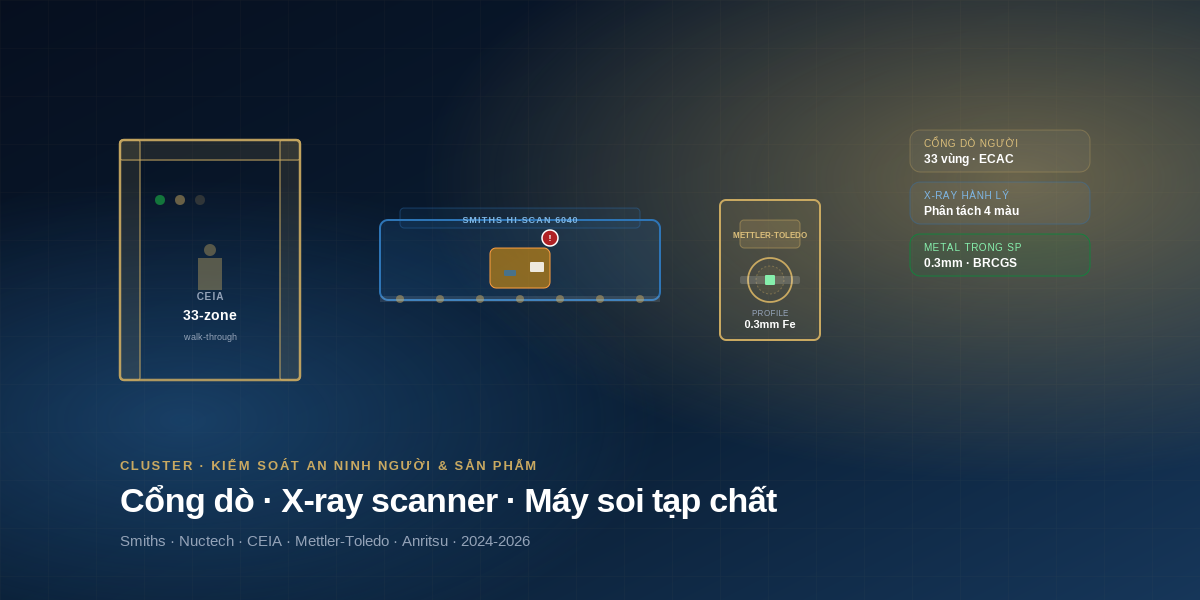
Smiths Detection HI-SCAN 6040 CTiX is an X-ray scanner tunnel 60×40 cm used for luxury retail exits — more compact than cargo scanners but sufficient for scanning handbags and clothing bags. Vendor public claim: detects metal objects ≥0.5 mm (watches, bracelets), electronic items (smartphones, cameras), and liquids in bottles (perfume, serum) via dual-energy color imaging.
An Ninh Số deployment pattern for chains of 50+ branches:
- **Separate exit lane**: X-ray placed at employee exits and VIP lounges — no noise disturbance in main customer areas. Cost $18K-22K/lane including machine + operator monitor.
- **Discreet procedure**: Employees/VIP guests place bags on the conveyor belt, operator views real-time X-ray images within 5-8 seconds. If suspicious items are detected, a bag check is requested — no alarm bells required.
- **Dual-energy color**: Metal objects appear orange, organic items (cosmetics, clothing) appear blue, electronic items appear dark blue — operator quickly distinguishes unpaid products from personal belongings.
Operating costs: $800-1,200/month/lane including electricity (~200W), maintenance every 6 months, part-time operator salary. A chain of 50 branches deploys 15 lanes at tier-1 stores (revenue >$50K/month) — total investment ~$300K.
Hikvision AI Camera — people counting + heatmap to identify high-risk areas
[Hikvision](/thuong-hieu/hikvision/) DeepinMind NVR combined with X-ray scanner creates a two-layer system: AI cameras analyze behavior before customers/employees reach the exit, while X-ray performs physical verification. This pattern reduces false positives by 30-40% compared to using X-ray alone.
### What does the AI camera do?
- **People counting at entry/exit**: Counts the number of people entering/leaving each hour — identifies peak hours (6 PM-8 PM) to increase X-ray operators. Cost of Hikvision DS-2CD2386G2-IU camera ~$180-250/camera, 32-channel NVR ~$800.
- **Heatmap for premium product zones**: 12MP fisheye ceiling cameras analyze dwell time in areas with $200+ serums, $5,000+ watches — alerts if a person stands for >3 minutes without staff assistance. Tier-1 enterprise businesses report a 20-30% reduction in shrinkage from these zones.
- **Loitering detection at exit lane**: If a person stands near the exit for >2 minutes without passing through X-ray, the NVR sends an alert to security — detects behavior waiting for gaps.
Combined with [people and product security control](/giai-phap/kiem-soat-an-ninh/), the system creates a timeline: cameras record product retrieval behavior → heatmap confirms risk zones → X-ray detects unpaid items → operator requests inspection. Average processing time is 15-20 seconds/person — no exit lane congestion.
Pattern integration X-ray + Camera AI — 4-step real-world workflow
An Ninh Số deploys a 4-step workflow for luxury retail:
**Step 1: AI Camera Behavior Analysis (before exit lane)**
Hikvision DeepinMind NVR runs people counting + realtime heatmap. If loitering >2 minutes is detected in high-end product areas or exit lanes, an alert is sent to the X-ray tablet operator — ready for thorough inspection.
**Step 2: X-ray Scanner Bag Check (at exit lane)**
Staff/VIP customers place bags on the Smiths Detection HI-SCAN 6040 CTiX conveyor belt. The operator reviews dual-energy X-ray images within 5-8 seconds — detecting metal objects (watches, bracelets) or electronic items (smartphones, cameras) not listed on the receipt.
**Step 3: Cross-check with POS (if needed)**
If the X-ray detects an unknown object, the operator checks the POS to see if the customer purchased a corresponding item. Example: X-ray shows an orange watch (metal) but the receipt only contains cosmetics → request bag inspection.
**Step 4: Logging + Reporting**
Hikvision NVR stores 30-day video footage, Smiths Detection stores 90-day X-ray images. The system automatically generates weekly reports: number of unknown object detections, false positive rate, and product areas with the highest shrinkage.
Average processing time: 15-20 seconds per person if no issues, 2-3 minutes if bag inspection is needed. A chain of 50+ branches reports 95% VIP customer acceptance of this process — more discreet than EAS gates.
ROI for premium cosmetics chain with 50+ branches — reduce shrinkage by 40-60%
Enterprise tier-1 deploys X-ray AI luxury retail at 15/50 tier-1 branches (revenue >$50K/month) — estimated ROI 14-18 months:
| Item | Cost | Notes |
|---|---|---|
| Smiths Detection HI-SCAN 6040 CTiX | $18K-22K/lane × 15 lane | ~$300K total |
| Hikvision camera + NVR | $180-250/camera × 60 camera + $800 NVR × 15 store | ~$25K total |
| Installation + training | $2K-3K/store × 15 | ~$40K |
| 12-month operation | $800-1,200/month/lane × 15 × 12 | ~$180K/year |
| **Total first-year investment** | **~$545K** | Includes CAPEX + 12-month OPEX |
Pre-deployment shrinkage: 2.4% × revenue $30M/year (50 branches) = **$720K loss/year**. After 6-month deployment at 15 tier-1 stores: shrinkage reduced by 40-60% at these stores (accounting for 60% of revenue) → savings of **$260K-390K/year**. ROI = $545K ÷ $325K (average savings) = **16.8 months**.
Additionally, the system delivers indirect benefits: internal staff self-restrain behavior knowing X-ray is present (deterrence effect), VIP customers feel safer knowing the store has strict controls, heatmap data helps optimize premium product layout.
This pattern is recommended by An Ninh Số for luxury retail with: revenue >$20M/year (50+ branches), high-value products (>$100/item), current shrinkage >1.8%. If shrinkage <1.5%, X-ray costs are hard to recover — use [standalone AI camera loss prevention solution](/giai-phap/chong-that-thoat/) instead.
Comparison of X-ray AI luxury retail vs EAS tag + gate — when to use what?
EAS tag (Electronic Article Surveillance) and security gates are a popular solution for mass-market retail — but luxury retail needs to consider X-ray AI for the following reasons:
| Criteria | EAS tag + security gates | X-ray AI (Smiths + Hikvision) |
|---|---|---|
| Cost/store | $2K-5K (gates + tags) | $25K-30K (X-ray + cameras) |
| Detection of hidden items in bags | No (magnetic tags only) | Yes (metal, electronics, liquids) |
| False positive rate | High (unremoved tags, products from other stores) | Low (operator verifies X-ray image) |
| VIP customer experience | Poor (loud alarm noise) | Good (discreet inspection) |
| Internal employee theft detection | No (employees know how to remove tags) | Yes (X-ray scans employee bags) |
| ROI breakeven | 6-12 months | 14-18 months |
An Ninh Số recommends:
- **Use EAS tags + security gates** if: mass-market retail (fashion, supermarkets), products <$50/item, shrinkage mainly from customer shoplifting, budget <$5K/store.
- **Use X-ray AI** if: luxury retail (high-end cosmetics, watches, jewelry), products >$100/item, shrinkage from internal employees + VIP customers, budget >$25K/store, need heatmap data to optimize layout.
Some chains combine both: EAS tags for mid-range products ($50-100) in the main customer area, X-ray for VIP lounges and employee exits. This pattern reduces costs while still protecting high-risk zones.
Compliance and privacy — Are X-ray scanners safe for customers?
Smiths Detection HI-SCAN 6040 CTiX complies with international radiation safety standards — X-ray dose <1 µSv/scan (100 times lower than medical X-rays). Vendor public claim: safe for operators standing 50 cm away for 8 hours/day, with no health impact on customers.
Regarding privacy, the X-ray only scans bags/clothing items — it does not scan human bodies. X-ray images are stored for 90 days per internal business regulations, accessible only to operators and security managers. An Ninh Số recommends:
- **Clear notification**: Signage at the entrance stating "X-ray inspection area — please place your bag on the conveyor belt" — customers are informed of the process in advance.
- **Opt-out for sensitive customers**: Customers who decline X-ray can request a manual bag check by staff — taking an additional 1-2 minutes but respecting privacy.
- **GDPR-style data retention**: X-ray images are automatically deleted after 90 days, with no sharing with third parties.
In actual deployment, <2% of VIP customers decline X-ray — the majority accept it due to the fast process (5-8 seconds) and its discreet nature compared to EAS gates.