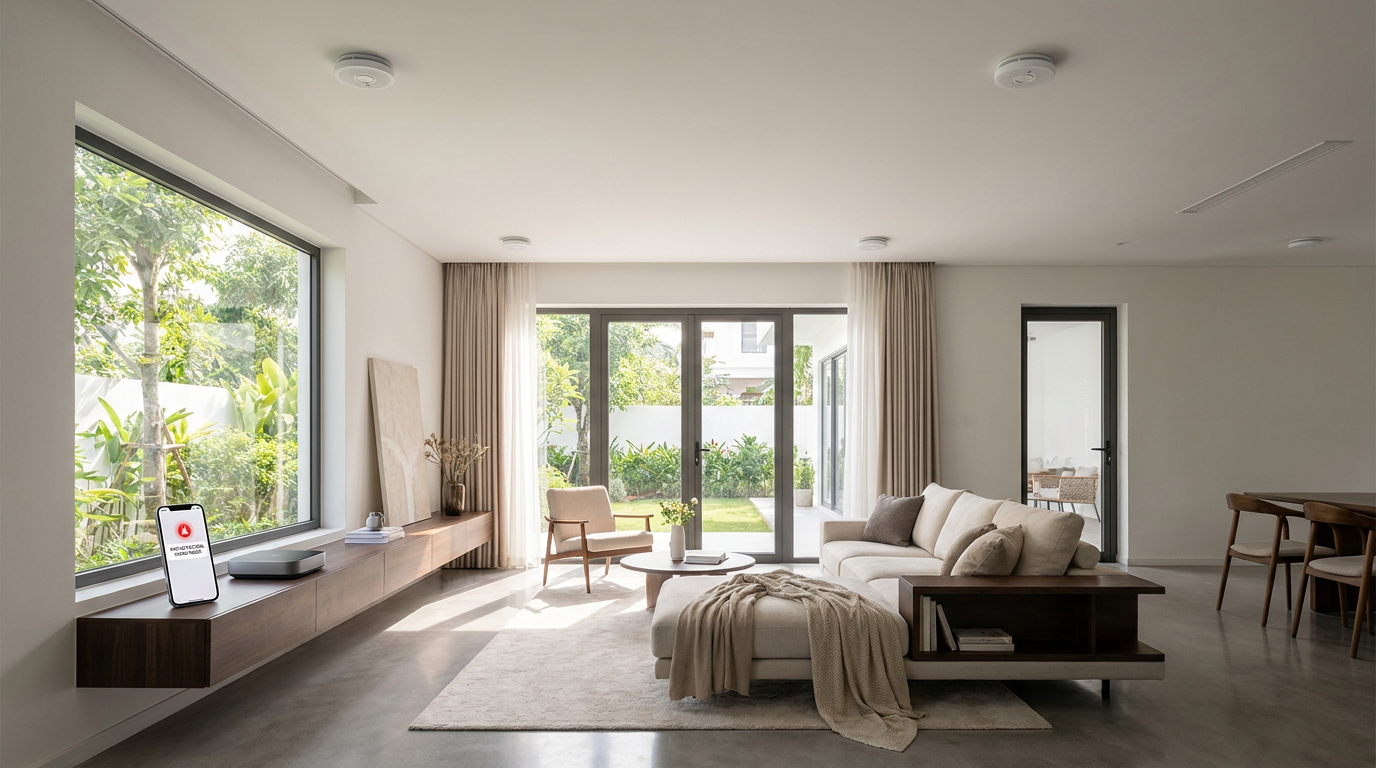
A smart home fire alarm system integrates smoke, heat, CO/CO2 sensors and a central controller, allowing homeowners to monitor fire safety remotely via a single app. In Vietnam, demand for installing this solution is growing 40-50% annually, especially in the high-end villa and penthouse segment, where synchronous integration with existing smart home systems is required.
What devices does a smart home fire alarm system include?
A complete smart home fire alarm system includes optical smoke sensors, heat sensors, CO/CO2 gas sensors, a central control unit (hub/gateway), alarm sirens, warning lights, and modules for integration with other smart home devices such as door locks, curtains, and lighting. These devices communicate via Zigbee, Z-Wave, or Wi-Fi protocols, ensuring a response within 1-3 seconds when a risk is detected.
Optical smoke sensors operate on the principle of light scattering when smoke particles enter, suitable for detecting smoldering fires. Heat sensors activate when the temperature exceeds 54-70°C, ideal for kitchens or garages. CO gas sensors measure carbon monoxide concentrations from 0-1000 ppm, alerting when levels exceed 50 ppm – the safe threshold according to WHO. Central controllers like the Aqara Hub M3 or other Matter/Zigbee 3.0 compatible hubs process signals and trigger automated scenarios.
Benefits of integrating fire alarms with smart home systems
Integrating a fire alarm system into a smart home offers 3 main benefits: early detection of fire risks within 5-10 seconds, activation of automated scenarios (unlocking doors, shutting off gas, turning on emergency lights), and instant notification via app to 3-5 pre-configured phone numbers. This helps reduce property damage by an average of 60-80% compared to conventional local fire alarm systems.
When a smoke sensor is triggered, the system can automatically: call the homeowner via a backup 4G SIM, open all curtains and ground-floor lights for easy firefighter access, shut off the smart gas valve, and unlock the main door and emergency exits. Event data is recorded on the cloud with timestamps and video from AI villa cameras for verification, aiding post-incident investigations.
Comparison of connectivity protocols: Zigbee, Z-Wave, and Wi-Fi
The choice of connectivity protocol for a smart home fire alarm system directly impacts stability, coverage range, and integration capabilities. The table below compares the 3 most popular protocols currently on the Vietnamese market.
| Criteria | Zigbee 3.0 | Z-Wave 800 | Wi-Fi (2.4 GHz) |
|---|---|---|---|
| Response speed | 0.5-1.5 seconds | 1-2 seconds | 2-5 seconds (network dependent) |
| Maximum range (no repeater) | 10-30 meters | 30-50 meters | 30-50 meters |
| Scalability (max devices) | 40-60 devices | 232 devices | 20-30 devices (limited bandwidth) |
| Power consumption (battery sensors) | 2-3 years | 3-5 years | 6-12 months |
| Average cost (hub + 5 sensors) | 4-8 million VND | 7-12 million VND | 3-5 million VND |
| Matter compatibility | Yes (hub firmware 2024+) | Yes (Z-Wave 800 hub) | No (requires separate bridge) |
For high-end villas with an area of 200-500m², An Ninh Số recommends using the Zigbee 3.0 or Z-Wave 800 protocol due to their stability and scalability. Wi-Fi is only suitable for small apartments under 100m² with a limited number of devices.
Installation cost of a smart home fire alarm system for a 200-500m² villa
The total turnkey installation cost for a smart home fire alarm system in a villa with an area of 200-500m² ranges from 15-45 million VND, depending on the number of sensors, device brand, and integration requirements with the existing smart home system. Below is a detailed reference cost table.
| Item | Quantity | Cost (VND) | Notes |
|---|---|---|---|
| Central hub (Zigbee) | 1 | 2,500,000 - 4,500,000 | Aqara M3 / Matter compatible hub |
| Optical smoke sensor | 4-6 | 3,200,000 - 6,000,000 | 1-2 sensors per floor |
| Heat sensor | 2-3 | 1,600,000 - 3,000,000 | Kitchen, garage, technical floor areas |
| CO/CO2 gas sensor | 2-3 | 2,400,000 - 4,500,000 | Bedrooms, basement, machine rooms |
| Alarm siren + warning light | 2-4 | 1,600,000 - 3,200,000 | Indoor + outdoor |
| Integration module (door lock, gas valve, curtains) | 3-5 | 2,100,000 - 4,200,000 | Depends on existing devices |
| Installation + configuration + scenario programming | 1 | 3,000,000 - 6,000,000 | Warranty 12-24 months |
| Total | 14,400,000 - 31,400,000 | Excludes existing smart home devices |
Costs may increase by 5-10 million VND if integration with high-end smart home systems like Lutron or Crestron is required, or if a backup 4G gateway is installed to ensure connectivity during a power outage.
Deployment process for a smart home fire alarm system from An Ninh Số
An Ninh Số deploys smart home fire alarm systems following a 5-step process: on-site survey, solution design, device installation, scenario programming, and handover for operation. The average completion time is 3-5 days for a 200-500m² villa, including app usage training and emergency response guidance.
- On-site survey (1 session): Technicians measure the area, determine locations for smoke, heat, and CO sensors based on floor plans and the existing smart home system.
- Solution design (1 day): Create a device list, connection diagram, and detailed automated scenarios (e.g., fire detected → unlock doors, shut off gas, turn on lights, make calls).
- Device installation (2-3 days): Mount ceiling/wall sensors, run power cables (if any), connect the hub, and sync with the smart home app.
- Scenario programming (1 day): Configure alert thresholds, automated scenarios, push/SMS/call notifications, and test each device's response.
- Handover for operation (1 session): Guide the homeowner on app usage, run simulated scenario tests, and schedule periodic maintenance every 6 months.
Case study: Installing a smart home fire alarm system for a 350m² villa in District 2
In September 2025, An Ninh Số deployed a smart home fire alarm system integrating smoke, heat, and CO sensors for a 350m² villa in Thảo Điền (District 2). The total cost was 28.5 million VND, including 6 smoke sensors, 2 heat sensors, 2 CO sensors, an Aqara M3 hub, an outdoor siren, and a smart gas valve integration module. Results: incident detection time decreased from 3-5 minutes to 8-12 seconds, and the homeowner received app alerts within 2-3 seconds after sensor activation. The system was also integrated with 7 layers of enterprise security to prevent hacking and unauthorized access.
Frequently asked questions
Does the smart home fire alarm system work during a power outage?
Yes. Most smart home fire alarm sensors use CR123A or AA Lithium batteries with a lifespan of 2-5 years. The central hub is typically equipped with a built-in backup battery, operating for 8-12 hours during a power outage. Some high-end hubs support backup 4G connectivity, ensuring notifications are sent to the homeowner even when both Wi-Fi and mains power are lost.
Do CO gas sensors require periodic maintenance?
CO gas sensors have an average lifespan of 5-7 years, after which the entire sensor module needs replacement. An Ninh Số recommends checking the sensors every 6 months by pressing the Test button on the device or via the app to ensure accurate operation. If the sensor reports an error or low battery, replace the battery immediately (CR123A battery, costing 50,000-80,000 VND each).
Is the smart home fire alarm system compatible with existing smart home devices?
Most smart home fire alarm systems using Zigbee 3.0 or Z-Wave protocols are compatible with popular smart home hubs such as the Aqara Hub M3, Hubitat, Home Assistant, or high-end systems like Crestron and Lutron via integrated drivers. However, it is necessary to check the manufacturer's compatibility list before purchasing. An Ninh Số offers free surveys and integration consultation.
What is the installation cost for a smart home fire alarm system in a 100m² apartment?
For a 100m² apartment, the turnkey installation cost ranges from 8-15 million VND, including 1 central hub, 2-3 smoke sensors, 1 heat sensor (kitchen area), 1-2 CO sensors, an alarm siren, and installation. If the apartment already has a smart home system, the cost is reduced by 2-3 million VND as a new hub is not required.
Can the smart home fire alarm system automatically call the fire department?
Currently, most residential smart home fire alarm systems do not have the feature to automatically call the fire department directly due to legal regulations and the risk of false alarms. Instead, the system sends push notifications, SMS, and calls to 3-5 pre-configured phone numbers (homeowner, security, relatives). The homeowner is responsible for calling 114 after confirming the incident via surveillance cameras.
Contact us now at 0796 700 777 for a free consultation and installation survey for a smart home fire alarm system for your villa or apartment. An Ninh Số supports optimal solution design based on area and budget, with a 12-24 month device warranty and periodic 6-month maintenance.