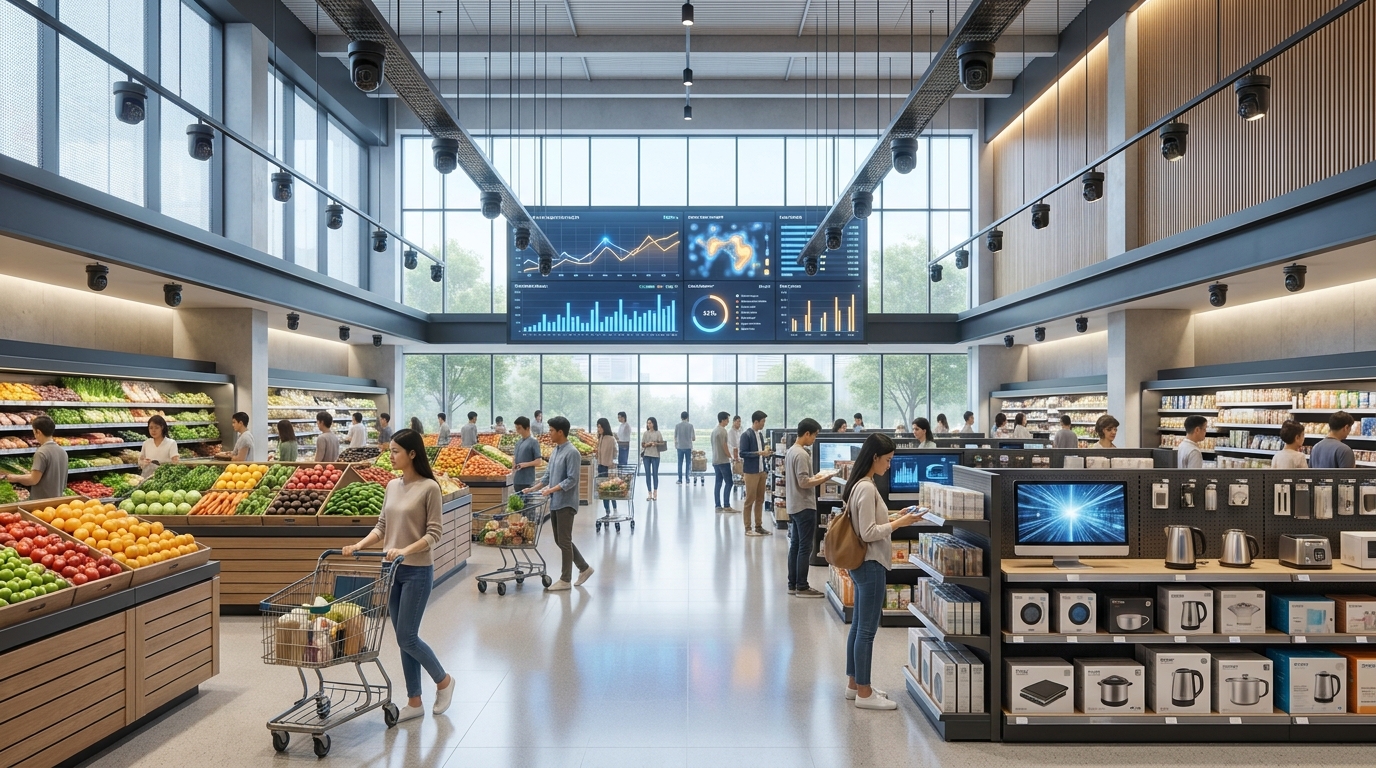
AI people counting cameras are a solution that integrates computer vision into surveillance camera systems, automatically counting the number of customers entering and exiting in real time. In Vietnam, this technology is being widely deployed in retail chains, mini-supermarkets, and showrooms to optimize operations and measure marketing effectiveness. The case study below describes the 6-month journey of a 20-store supermarket chain in Ho Chi Minh City, where footfall data helped increase revenue by 15%.
How do AI people counting cameras for supermarkets work?

AI people counting cameras use computer vision algorithms to detect and count the number of people passing through the observation area, distinguishing them from other objects. Data is sent to a central management platform, allowing real-time monitoring and reporting of trends by hour, day, and week.
The system includes 3D stereo vision cameras or AI cameras with integrated on-board processing chips, installed at entrances/exits and strategic areas within the supermarket. Footfall data is automatically synced to a dashboard, supporting analysis of conversion rate (percentage of visitors who make a purchase), dwell time, and traffic flow. In this supermarket chain, each store installed 2-4 cameras depending on size, connected via LAN to a central NVR. The investment cost for each store ranged from 15 to 25 million VND, including cameras, cables, and installation.
Specific benefits: Optimizing staffing and increasing revenue
Footfall data helped the supermarket chain adjust work schedules according to peak hours, reducing staffing costs by 12%. At the same time, conversion rate analysis helped improve layout and promotional programs, directly contributing to a 15% revenue increase.
Before deployment, the supermarket chain often scheduled staff based on intuition, leading to understaffing during peak hours (5 PM - 8 PM) and overstaffing during off-peak hours (9 AM - 11 AM). After obtaining real-time footfall data, the operations department made adjustments: increasing staff by 30% during the 5 PM - 8 PM window and reducing staff by 20% during the 9 AM - 11 AM window. As a result, staffing costs decreased by 12% while service quality improved. Additionally, conversion rate data showed that the promotional product display area had an 8% lower conversion rate than the checkout area. The chain adjusted the layout, placing key products near the entrance, which helped increase average revenue by 15% after 6 months.
Comparison of AI people counting cameras with traditional solutions

AI people counting cameras outperform manual solutions such as infrared sensors or manual counting due to higher accuracy and detailed data analysis capabilities. The comparison table below clarifies the differences.
| Criteria | AI People Counting Camera | Infrared Sensor | Manual Counting |
|---|---|---|---|
| Accuracy | 95-98% | 70-85% | 60-75% |
| Traffic flow analysis | Yes | No | No |
| Operating cost | Low (automatic) | Medium | High (labor) |
| Historical data | Full storage | Limited | Inconsistent |
| POS/CRM integration | Yes | No | No |
AI cameras not only count the number of people but also provide data on dwell time, repeat customer rate, and performance of each area. This is a significant advantage over infrared sensors, which merely count the number of beam breaks.
Real case study: La Me supermarket chain in Ho Chi Minh City
The La Me supermarket chain (fictional name) with 20 stores in Ho Chi Minh City deployed AI people counting cameras starting in March 2025. After 6 months, revenue increased by 15%, staffing costs decreased by 12%, and the repeat customer rate increased by 8%.
The deployment process took 3 weeks for all 20 stores, carried out by the technical team of Việt Đức Trí Group. Each store installed 3 AI 3D stereo vision cameras at the main entrance, checkout area, and key product display area. Data was aggregated on a centralized management platform, allowing performance comparison between stores. Notable results:
- Average revenue per store increased from 1.2 billion to 1.38 billion VND/month.
- Staffing costs decreased from 180 million to 158 million VND/month/store.
- Conversion rate increased from 22% to 28%.
- Repeat customer rate within 30 days increased from 35% to 43%.
The chain also leveraged footfall data to optimize promotional programs: instead of discounting everything, they focused on off-peak hours (2 PM - 4 PM) with special vouchers, increasing customer traffic during this period by 25%.
Criteria for selecting AI people counting cameras for supermarket chains

When choosing AI people counting cameras, consider accuracy, POS integration capability, investment cost, and technical support. 3D stereo vision camera lines such as the Xovis PC3 or AI cameras from Hikvision/Dahua all perform well.
Below are the key criteria:
- Accuracy: Choose cameras with accuracy ≥95% in crowded conditions.
- Integration: Supports connection with POS and CRM via API or middleware software.
- Cost: Each camera ranges from 8 to 15 million VND, depending on brand and features.
- Warranty: Minimum 12 months, with on-site technical support.
For more information on loss prevention solutions for supermarkets, you can refer to the article Loss prevention with EAS tags for pharmacy + minimart chains 2026.
Investment cost and ROI for a 20-store chain

The total investment cost for 20 stores is approximately 400-600 million VND, including cameras, installation, and software. With a 15% revenue increase, ROI is achieved within 4-6 months.
Cost breakdown:
- AI 3D stereo vision cameras: 10-15 million VND/camera × 3 cameras/store = 30-45 million/store.
- Footfall management software: 50-80 million VND for the entire chain.
- Installation and cabling: 5-10 million/store.
- Total: 400-600 million VND.
Monthly benefits: additional revenue of 180 million VND/store (from 1.2 billion to 1.38 billion) × 20 stores = 3.6 billion VND/month. Staffing cost reduction of 22 million/store × 20 = 440 million VND/month. Thus, the total monthly benefit is approximately 4 billion VND, with ROI achieved after 4-6 months. To learn more about similar solutions, refer to the article Case Study: A 50-store fashion chain successfully deploys UHF RFID.
Frequently asked questions
Are AI people counting cameras accurate?
AI people counting cameras use computer vision and deep learning