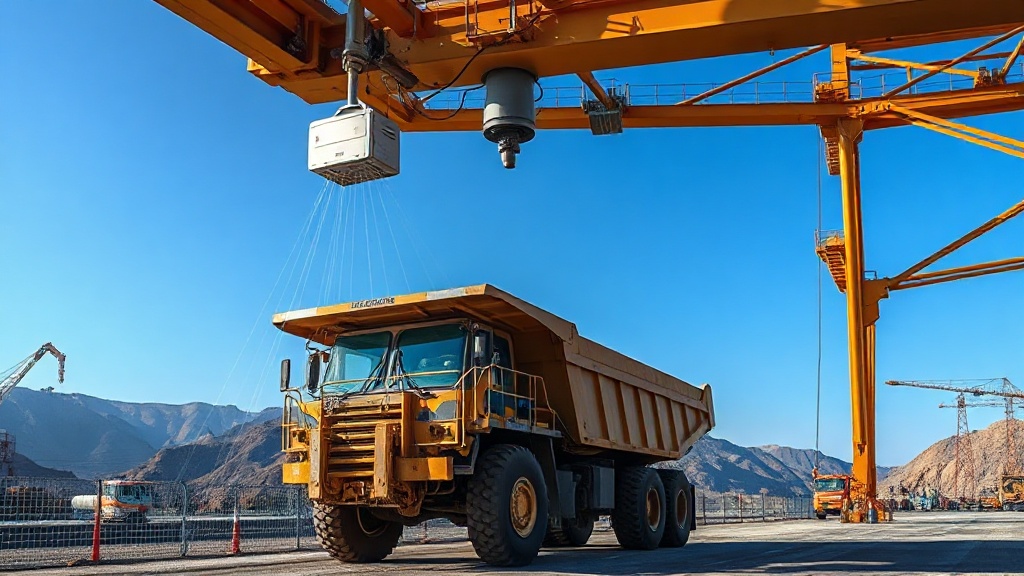
Measuring truck volume with LiDAR is a solution that uses 3D laser scanning sensors to automatically calculate the cargo volume in the truck bed. This technology is being deployed by logistics companies, manufacturing plants, and raw material centers in Vietnam to replace manual estimation methods, which often have an error rate of 15-20%.
What is LiDAR and how does the truck volume measurement principle work?
LiDAR (Light Detection and Ranging) is a laser scanning technology that measures distance using the Time-of-Flight principle. When scanning a truck, the sensor emits 30,000-300,000 laser pulses per second, measuring the return time to create a 3D point cloud. From the point data, software reconstructs the shape of the cargo bed and calculates the exact volume.
The system consists of three main components: the LiDAR sensor (fixed on a gantry or warehouse ceiling), an AI-integrated signal processor, and result display software. When a truck passes through the scanning area, LiDAR performs 50-100 scans per second, creating a point cloud with a density of 1-5 points/cm². Processing algorithms filter out noise (truck frame, background) and calculate only the volume of cargo above the bed.
Comparing truck volume measurement with LiDAR vs. manual methods
Manual methods using tape measures and volume estimation have an average error of 12-18%, while LiDAR achieves an accuracy of ±1-3%. In terms of speed, manual methods take 5-10 minutes per truck, while LiDAR completes the task in 3-5 seconds as the truck slowly passes through the gantry.
| Criteria | Manual | LiDAR 2D | LiDAR 3D |
|---|---|---|---|
| Error rate | 12-20% | 3-5% | ±1-3% |
| Time per truck | 5-10 minutes | 10-30 seconds | 3-5 seconds |
| Labor | 2 people | 1 supervisor | Automatic |
| Investment cost | 0 VND | 150-300 million | 400-800 million |
| Maintenance | None | Once/year | Once/year |
With a volume of 50-100 trucks per day, the ROI of a 3D LiDAR system typically reaches 8-12 months due to labor savings and reduced losses from under-measurement.
Types of LiDAR sensors suitable for truck volume measurement
LiDAR 2D (single-line) is suitable for static volume measurement of uniformly shaped goods, costing 150-300 million. LiDAR 3D (multi-line or solid-state) is used for dynamic measurement with higher accuracy, costing 400-800 million. MEMS solid-state LiDAR is a trend for 2026 due to its small size and 30-40% cost reduction compared to mechanical LiDAR.
Sensor selection criteria depend on 3 factors: truck speed (under 10 km/h use LiDAR 3D, over 10 km/h need high-speed LiDAR 3D), type of goods (bulk materials require higher point density than packaged goods), and installation environment (indoor use LiDAR 905nm, outdoor requires 1550nm for sunlight interference resistance).
Which industries use LiDAR truck volume measurement?
In Vietnam, this technology is heavily applied in 4 industries: mining and cement (measuring rock, sand), agriculture (rice, grain, fertilizer), scrap (steel, plastic), and logistics (packaged goods, containers). Each industry has specific technical requirements for measurement range and accuracy.
- Cement and construction materials: Measuring sand, rock, clinker on dump trucks. Error reduced from 15% to 2%, saving 500 million - 1 billion VND/year for a plant handling 200 trucks/day.
- Agriculture and food: Measuring rice, grain, coffee, rubber. Requires dust and moisture-resistant LiDAR, combined with load scales.
- Scrap and recycling: Measuring scrap steel, plastic waste. Goods have complex shapes, requiring high-density LiDAR 3D.
- Logistics and warehousing: Measuring containers, pallets. Integrates with WMS for automatic inventory updates.
Guide to integrating LiDAR volume measurement systems into existing processes
The integration process includes 5 steps: site survey (traffic volume, goods type, speed), selecting the appropriate LiDAR sensor, hardware installation (scanning gantry, brackets, electrical cabinet), software setup and connection to the enterprise management system (ERP/WMS), and trial running and calibration for 7-14 days.
The system can integrate with existing access control systems (KSRV) to automatically recognize license plates, cross-referencing with volume measurement and load scale data. Output data in JSON/XML format can connect directly to accounting software or ERP. Some Vietnamese enterprises have successfully integrated with MISA, SAP, and Oracle.
Investment cost and ROI of LiDAR truck volume measurement systems
The investment cost for a LiDAR volume measurement system ranges from 300-800 million VND depending on configuration (sensor, software, installation). For enterprises handling 50-100 trucks/day, ROI is achieved in 10-14 months thanks to an 8-12% reduction in cargo loss and savings of 1-2 workers.
Detailed cost breakdown: LiDAR 3D sensor (400-600 million), processing software (50-100 million), installation and infrastructure (50-100 million), annual maintenance (20-30 million). Small enterprises can opt for a LiDAR 2D solution costing 150-250 million, which has a higher error rate but fits limited budgets. See also cost of installing automatic parking systems for a broader view of infrastructure investment.
Frequently Asked Questions
Is LiDAR truck volume measurement accurate?
Yes, the LiDAR 3D system achieves an accuracy of ±1-3% depending on the type of goods and truck speed. For stable-shaped goods like sand and rock, the error is under 2%. For scrap or irregularly shaped goods, the error may reach 3-5%. Accuracy is 5-10 times higher than manual methods.
How much does it cost to install a LiDAR volume measurement system for trucks?
Costs range from 300-800 million VND for a complete system: sensor, software, installation, and a 12-month warranty. LiDAR 2D solutions cost 150-250 million, LiDAR 3D solutions cost 400-800 million. Annual maintenance costs are about 20-30 million, including sensor calibration and software updates.
Can the LiDAR volume measurement system operate outdoors?
Yes, if you choose a LiDAR sensor with a 1550nm wavelength, it works well in harsh sunlight and light rain. 905nm sensors are suitable for indoor or sheltered environments. Outdoor systems require an IP65 waterproof electrical cabinet and wind-load-resistant brackets.
How to integrate volume measurement data into enterprise management software?
The LiDAR system outputs data via RESTful API or direct database connection (MySQL, SQL Server). Data includes license plate, volume, time, and captured images. It can integrate with MISA, SAP, Oracle, and popular ERP software in Vietnam. Average integration time is 2-4 weeks.
Is maintaining the LiDAR volume measurement system complicated?
Periodic maintenance is required every 6-12 months, including cleaning the optical window, checking connection cables, and software calibration. Solid-state LiDAR sensors have a lifespan of 50,000-80,000 operating hours (equivalent to 5-8 years). Annual maintenance costs are about 5-8% of the initial investment value.
Contact 0796 700 777 for consultation on LiDAR truck volume measurement solutions suitable for your business scale. See more comprehensive vehicle control solutions for enterprises.