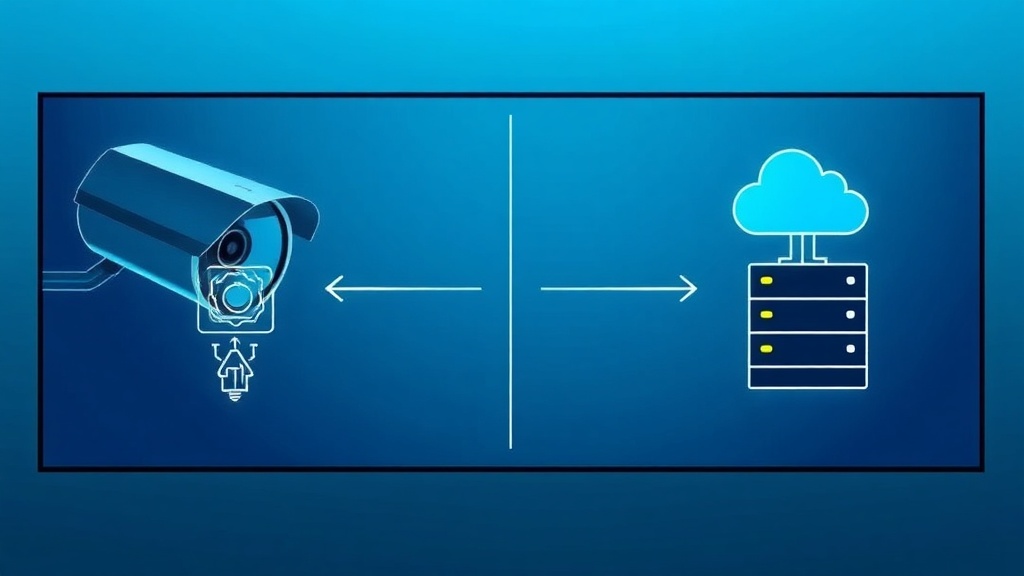
Edge AI and Cloud AI are two camera data processing architectures that differ in computing location: Edge AI runs AI models directly on the camera device (on-device), while Cloud AI sends the video stream to a centralized server for analysis. For B2B enterprises in Vietnam — from mini supermarkets to 2000m² factories — choosing the wrong architecture can lead to a 40-60% increase in operational costs or latency that fails to meet real-time requirements.
What is Edge AI? How on-device processing cameras work
Edge AI is a technology that embeds AI processing chips (NPU/GPU) into cameras, enabling the execution of computer vision models such as facial recognition, object detection, and people counting directly on the device without sending video to the cloud. Edge AI cameras typically have a latency of 30-100ms and operate independently of the internet.
Popular Edge AI chips on the market include HiSilicon 3559A, Ambarella CV52, and NPU-integrated SoCs from Hikvision AcuSense or Dahua IVS. AI models are optimized (quantized) to run on hardware with limited RAM and power. The Hikvision DS-2CD2T46G2-ISU/SL AcuSense camera is a typical example: it detects people and vehicles with 95%+ accuracy, entirely locally, with no cloud subscription required.
What is Cloud AI? When do businesses need centralized processing?
Cloud AI sends the video stream from cameras to cloud servers (AWS, Azure, Google Cloud, or on-premise VMS) for processing using more powerful AI models. This architecture allows for easy model updates and handling of complex tasks like multi-layer behavior analysis, but requires 2-8 Mbps bandwidth per HD camera and a minimum latency of 300-800ms.
Enterprise Cloud AI platforms like Milestone XProtect Corporate 2024 or Genetec Security Center Omnicast allow deploying third-party AI models (such as BriefCam Synopsis for video forensic). However, bandwidth costs for 50 4MP cameras in Vietnam can reach 15-25 million VND/month, not including storage and processing fees. Integrating AI Cameras & Smart Locks with Apple HomeKit is a typical application requiring careful consideration between Edge and Cloud.
Edge AI vs Cloud AI Camera Comparison: Latency, bandwidth, cost, security
The core differences between Edge AI and Cloud AI lie in four criteria: latency, bandwidth, total cost of ownership (TCO over 3 years), and data privacy/security. Edge AI excels in latency, bandwidth, and security; Cloud AI is more flexible in scaling and model updates.
| Criteria | Edge AI Camera | Cloud AI Camera |
|---|---|---|
| Latency | 30-100ms (real-time) | 300-800ms (depends on internet) |
| Bandwidth (per 4MP camera) | 0.5-1.5 Mbps (sends only metadata) | 4-8 Mbps (sends full stream) |
| TCO 3 years (50 cameras) | 200-350 million VND (hardware + maintenance) | 400-700 million VND (bandwidth + cloud fees + hardware) |
| Privacy & Compliance | High — data does not leave the device | Lower — requires strong encryption and data residency |
| Scalability | Limited by camera hardware | Flexible, easy to scale with cloud resources |
| AI Model Updates | Complex (requires firmware update) | Easy (push from cloud) |
Benefits of Edge AI: Optimizing latency and reducing operational costs
Edge AI reduces latency to 30-100ms, enabling real-time applications like intrusion detection, early fire warnings, or access control without delay. Simultaneously, bandwidth costs are reduced by 70-80% compared to Cloud AI because only metadata is sent.
A 200m² mini supermarket with 8 Edge AI cameras can save 12-18 million VND/year in bandwidth costs compared to an equivalent Cloud AI solution. Additionally, data not leaving the device helps businesses comply with Decree 13/2023/ND-CP on personal data protection. The AI People Counting Camera for Retail Chains is a popular Edge AI application.
When should a business choose Cloud AI?
Cloud AI is suitable when a business needs multi-layer analytics on the same video stream, such as combining facial recognition, behavior analysis, and people counting simultaneously. Or when frequent AI model updates are needed without changing the firmware of each camera.
For example: a 5-story shopping mall with 200 cameras needing customer behavior analysis to optimize layout — Cloud AI allows deploying new models in 1-2 days, while Edge AI could take 2-4 weeks to update each device. Bandwidth costs of 15-25 million VND/month are acceptable if revenue increases by 10-15% thanks to analytics data.
Combined Edge + Cloud AI Solution: Hybrid Architecture
Hybrid architecture combines the advantages of both: Edge AI cameras handle real-time processing (intrusion detection, fire alerts) and send metadata + short clips to the cloud for advanced analysis (trending, aggregated reports). This is a trend recommended by Milestone and Genetec for B2B enterprises.
A real-world deployment example: a 5000m² manufacturing plant uses 30 Hikvision AcuSense cameras (Edge AI) for real-time intrusion and workplace accident detection, while connecting to Milestone XProtect Corporate 2024 for long-term data storage and analysis. Hybrid costs are 30-40% lower than pure Cloud AI. AI Cameras for 2000m² Factories is a typical case study for hybrid architecture.
Criteria for choosing Edge AI or Cloud AI for B2B enterprises in Vietnam
Choose Edge AI if the business has fewer than 100 cameras, requires real-time processing, has a limited budget, and handles sensitive data. Choose Cloud AI if multi-layer analysis, easy scalability, and an IT management team are needed. Hybrid is the optimal choice for businesses with both needs.
- Mini supermarkets / retail stores: Edge AI — prioritize low cost, real-time theft detection
- Factories / warehouses 2000m²+: Hybrid — Edge for security + Cloud for production analysis
- Corporate offices / banks: Edge AI — data security, compliance with Decree 13
- Shopping malls / large complexes: Cloud AI — behavior analysis, operational optimization
Frequently Asked Questions
Does an Edge AI camera need the internet?
No. Edge AI cameras operate independently of the internet. They process AI directly on the device and only need a LAN connection to send metadata or alerts. However, remote access or data synchronization requires a stable internet connection.
Is a Cloud AI camera secure?
Yes, if deployed correctly. It requires TLS 1.3 encryption for the video stream, AES-256 encryption for stored data, and choosing a cloud provider with data residency in Vietnam (AWS Singapore or VNPT Cloud). However, security risks are higher than Edge AI because data must travel over the internet.
Cost of Edge AI vs Cloud AI for 50 cameras over 3 years?
Edge AI: 200-350 million VND (hardware + maintenance). Cloud AI: 400-700 million VND (bandwidth + cloud fees + hardware). The 40-60% difference mainly comes from bandwidth and cloud storage costs.
Is hybrid architecture complex?
Not overly complex. It requires Edge AI cameras that support sending metadata via ONVIF/RTSP protocols, and a VMS (like Milestone XProtect or Genetec) for centralized management. An Ninh Số provides turnkey hybrid solutions, including configuration and training for enterprise IT teams.
Can Edge AI camera models be upgraded?
Yes, but it is more complex than Cloud AI. It requires a firmware update via USB or OTA if the camera supports it. Some high-end lines like Hikvision AcuSense or Dahua IVS allow remote AI model updates via VMS, but the frequency is limited to 1-2 times per year.
Should a small business choose Edge or Cloud?
Edge AI is a better choice for small businesses (under 20 cameras) due to lower costs, no internet dependency, and ease of deployment. Cloud AI is more suitable when the business has an IT team and needs large-scale data analysis.
What solutions does An Ninh Số provide?
An Ninh Số provides all three architectures: Edge AI (Hikvision AcuSense, Dahua IVS cameras), Cloud AI (Milestone XProtect, Genetec Security Center), and Hybrid (Edge + VMS combination). We consult and deploy solutions tailored to the scale, budget, and security requirements of each business.
Contact us now at hotline 0796 700 777 or email [email protected] for consultation on Edge AI and Cloud AI solutions suitable for your business.