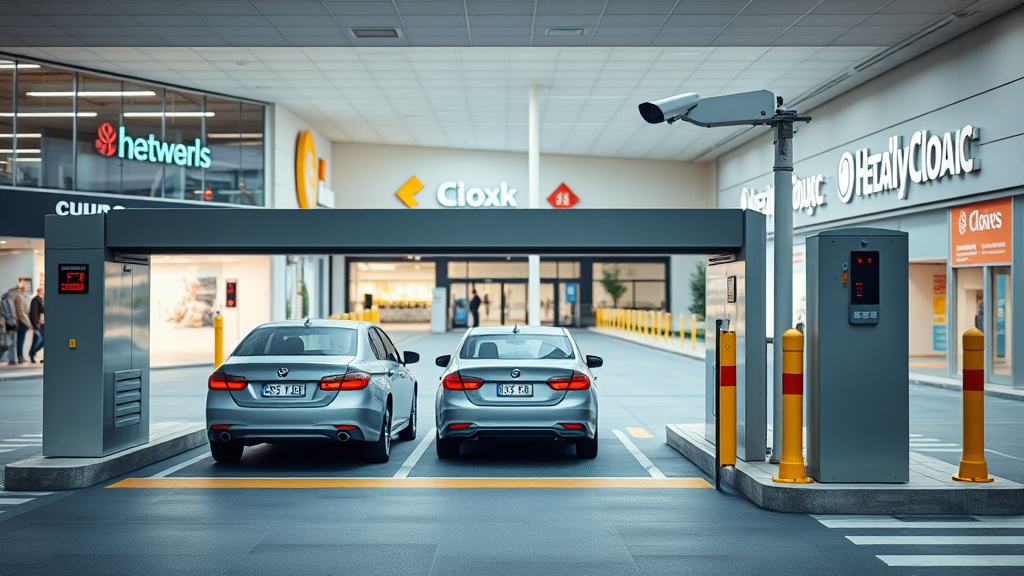
The shopping mall vehicle control system has evolved from mechanical barriers + paper tickets to an integrated platform of AI, IoT, and digital payments. According to a 2025 survey, 72% of customers rate the parking experience as directly influencing their decision to return to the mall. This article lists 8 core features that a modern mall vehicle control system needs, from LPR license plate recognition to traffic data analysis and loyalty integration.
What components make up a mall vehicle control system?
A complete mall vehicle control system includes: automatic barriers integrated with LPR, automatic ticket dispensers, payment kiosks, parking position sensors, LED guidance boards, AI security cameras, and centralized management software. These components connect via LAN or cloud, enabling real-time monitoring and data analysis.
Unlike systems for apartment buildings or office towers, a mall system must handle large vehicle volumes without fixed peak hours, while integrating multiple payment types and loyalty programs. Typical equipment includes heavy-duty automatic barriers like the Kapaisi KPS-DZ-8003 or integrated license plate recognition modules like the Kapaisi LPR Module.
1. Automatic License Plate Recognition (LPR) – The foundational feature
Automatic License Plate Recognition (LPR) is a core feature, allowing vehicles to enter/exit without stopping for a ticket. LPR cameras capture the license plate as the vehicle approaches the barrier, compare it against the database, and automatically open the barrier if the vehicle is valid (registered, priority vehicle).
In Vietnam, LPR modules like the Kapaisi LPR Module support recognition of white-background, blue-background, and provincial plates with 96-99% accuracy in daylight conditions. Average processing time is 1-2 seconds, reducing wait times by 60-70% compared to manual ticket issuance. For a mall with 2,000-5,000 vehicles/day, LPR helps reduce barrier staffing by 3-5 personnel.
2. Reverse Vehicle Search – Solving the "forgot where I parked" pain point
The reverse vehicle search feature allows customers to look up their parking spot via a search kiosk or mobile app. The system records the time, license plate, and parking location (by zone, floor, spot number) upon entry, then displays the shortest route to the vehicle.
According to statistics from malls with 3-5 basement levels, customers spend an average of 8-15 minutes finding their car. With a search kiosk or app, this time drops to 1-3 minutes. The system combines ultrasonic sensors or vacancy-counting cameras (Xovis PC3) to pinpoint the exact parking spot. Some advanced solutions also support sending a QR code via SMS if the customer forgets their ticket.
3. Multi-channel Automatic Payment (Cashless Payment)
Automatic payment allows customers to pay parking fees through multiple channels: on-site payment kiosks, mobile apps, QR codes, bank cards, or e-wallets (Momo, VNPay, ZaloPay). The system automatically calculates fees in real-time and issues electronic invoices.
Surveys show that 68% of customers are willing to return to a mall if cashless payment is available. Integrating automatic payment reduces queue times at payment counters by 40-50% during peak hours (5:00 PM - 7:00 PM). The system supports various ticket types: hourly, daily, monthly, and event tickets (free with purchases over 500,000 VND).
4. Loyalty Program Integration
This feature connects the vehicle control system with the mall's CRM loyalty system, allowing customers to earn parking points or redeem reward points for free parking hours. When a vehicle exits, the system automatically checks purchase transactions and applies corresponding promotions.
For example: A customer spending over 1 million VND at the supermarket gets 2 hours of free parking. The LPR system recognizes the plate, queries the central POS, and automatically reduces the fee upon exit. Malls implementing this feature report a 12-18% increase in ancillary revenue (F&B, entertainment) as customers stay longer. Integration with brands like Dahua/Hikvision AI cameras helps synchronize security and loyalty data.
5. Smart Security Alerts
Smart security alerts include detecting unknown vehicles, suspicious vehicles (license plates on a blacklist), abnormal behavior (parking too long, wrong spot, collisions), and intrusion alerts for restricted areas. The system sends real-time notifications to the monitoring center.
AI cameras with behavior analysis can detect wrong-way driving, vehicles stopping in fire lanes, or blocking emergency exits. Large malls (Vincom, AEON) have deployed this system, reducing parking lot security incidents by 70-80%. The system stores video for 30-90 days for investigation purposes. See more comprehensive KSRV solutions for businesses.
6. Smart Parking Guidance
The smart parking guidance system uses ultrasonic sensors or vacancy-counting cameras at each parking spot, displaying the number of available spots per zone/floor on LED boards at entrances and intersections. Some advanced systems even guide drivers to a specific spot via an app.
For a mall with 500-1,000 parking spots, the guidance system reduces internal traffic time by 30-40% and increases parking space utilization by 15-20%. Sensor data is also used to analyze peak hours and optimize staffing schedules. Ultrasonic sensors have 98% accuracy and a lifespan of 5-7 years.
7. Traffic Data Analytics & Reporting
The system collects data on vehicle traffic by hour, day, and month; average parking duration; occupancy rates; parking fee revenue; and the effectiveness of promotional programs. Reports are automatically exported as dashboards or Excel files.
This data helps mall management make decisions: adjust operating hours, optimize peak-hour pricing, and evaluate event effectiveness. For example, if data shows 90% occupancy on weekends, the mall could increase rates or expand parking. The analytics system also detects anomalies like vehicles parked too long (suspected abandonment) or vehicles entering/exiting multiple times a day.
8. IoT Integration & Scalability
Modern vehicle control systems support IoT protocols (MQTT, HTTP API) to connect with other mall systems: HVAC, lighting, overall security, and fire protection (PCCC). Scalability allows adding new barriers, cameras, and sensors without changing the infrastructure.
When connected to the fire protection system, if a fire alarm is triggered, all barriers automatically open for vehicle evacuation. Integration with smart lighting saves 20-30% of electricity in the parking area when unoccupied. The system can scale from 2 barriers to 20 barriers, and from 200 to 2,000 parking spots without upgrading central hardware. Refer to similar large-scale access control solutions for factories.
Frequently Asked Questions
How much does it cost to install a mall vehicle control system?
Cost depends on scale: a basic 2-lane (entry/exit) system is about 80-150 million VND, including barriers, LPR cameras, ticket dispensers, and basic software. A 4-6 lane system with full features (vehicle search, payment, analytics) ranges from 300-800 million VND. For a mall with 1,000 parking spots, total investment could be 1-2 billion VND. Average payback period is 18-36 months due to labor savings and increased ancillary revenue.
Does the system support integration with the mall's customer loyalty app?
Yes, most modern systems provide open APIs (RESTful, GraphQL) allowing integration with the mall's CRM loyalty, POS, and mobile app. Customers can register their vehicle, view parking history, receive promotions, and pay directly through the app. Integration time is typically 2-4 weeks depending on the partner system's complexity.
How to handle cases where the license plate is not recognized?
When LPR fails (dirty, blurry, or obscured plates), the system switches to manual mode: the customer is prompted to enter the plate on a touchscreen or take a paper ticket from the dispenser. Barrier staff can enter it manually via the management interface. LPR failure rates are typically below 3-5% under real operating conditions.
Can the mall vehicle control system manage motorcycles?
Yes, the system can be configured with dedicated lanes for motorcycles using lower barriers and LPR cameras at an appropriate height. However, because motorcycle plates are often small and easily obscured, many malls opt for RFID cards or fingerprint solutions for motorcycles instead of LPR. Some systems allow a combination: LPR for cars, RFID cards for motorcycles.
Is it necessary to change the electrical and network infrastructure when installing a new system?
Modern vehicle control systems use 220V power and LAN networks (PoE for cameras). For malls with existing electrical and network infrastructure, installation does not require major changes. If the parking area lacks network connectivity, 4G/LTE can be used for main devices. An Uninterruptible Power Supply (UPS) is necessary to ensure system operation during power outages.
Contact An Ninh Số via hotline 0796 700 777 or email [email protected] for consultation on a mall vehicle control solution suitable for your scale and budget.