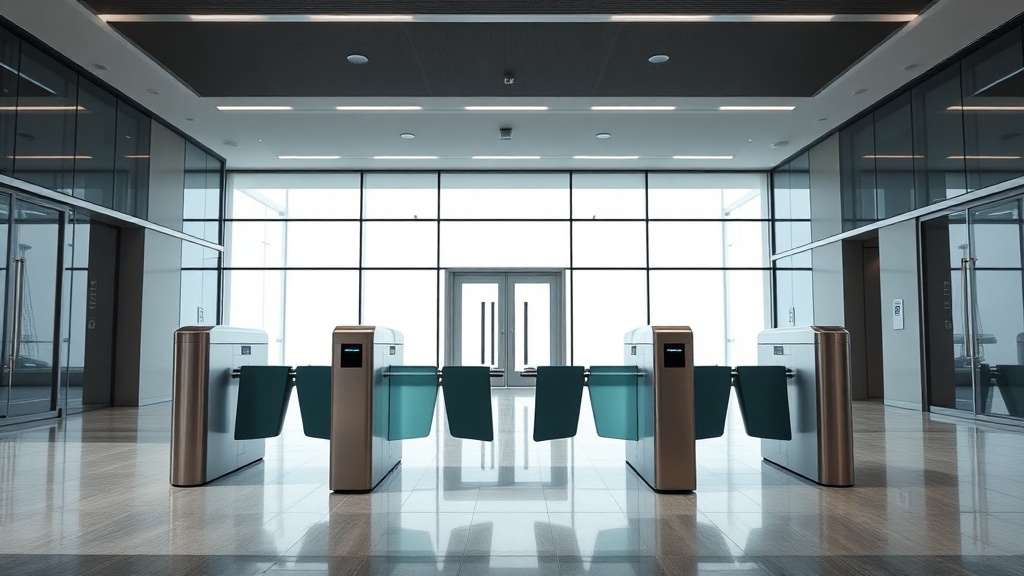
Turnstile gates are physical access control devices that operate based on a rotating or wing-opening mechanism, allowing only one person to pass after authentication. In Vietnam, the turnstile market is growing 18-22% per year due to security demands at Grade A office buildings, industrial park factories, and shopping centers. This article analyzes 4 popular turnstile lines and criteria for choosing the right one for each type of business.
What is a turnstile gate? Basic classification
A turnstile gate (rotating gate) is an electro-mechanical access control device that requires users to authenticate via card, fingerprint, or face before passing through. There are 4 main types: tripod turnstile (3-arm), flap barrier (glass wing), swing barrier (swing wing), and full-height turnstile. Each type has different structural features, security levels, and costs, suitable for specific usage environments.
Turnstile gates operate as smart barriers, connecting to the KSRV system to record time, personnel, and intrusion alerts. Depending on foot traffic volume and security requirements, businesses can choose one of the four types below.
Criteria for choosing turnstiles for offices and factories
Three core criteria when choosing a turnstile: foot traffic volume (measured in passes/hour), required security level (anti-climbing, anti-tailgating), and investment budget (including purchase, installation, and maintenance costs). For offices, prioritize aesthetics and speed; for factories, prioritize durability and weather resistance.
- Traffic: Offices 200-500 people/hour, factories 500-2000 people/hour.
- Security: Basic (tripod) for standard factories; high-end (flap/full-height) for sensitive areas.
- Budget: Tripod 12-25 million VND, flap barrier 25-45 million VND, full-height 40-60 million VND per gate.
1. Tripod turnstile (3-arm gate) – Cost-effective solution for factories
The tripod turnstile features a Y-shaped structure with 3 rotating arms; users must gently push the arm to pass after authentication. This type accounts for 55-60% of the Vietnamese turnstile market due to its low cost, easy installation, and high durability. Suitable for factories, industrial parks, parking lots, and buildings with high traffic but limited budgets.
Tripod turnstiles are often integrated with ZKTeco K14 fingerprint time attendance machines or HID card readers. The main drawbacks are ease of climbing (for malicious individuals) and lower throughput than flap barriers (about 20-25 people/minute vs. 30-40). However, for factory environments where workers enter and exit in shifts, this is the optimal cost solution.
2. Flap barrier (glass wing gate) – High aesthetics for offices
Flap barriers use tempered glass or acrylic wings that open upon successful authentication and automatically close after 1-2 seconds. This type is popular in Grade A office building lobbies, banks, and shopping centers due to its luxurious design, integrated LED lights, and better anti-tailgating capability than tripods.
Flap barriers can connect to office building access control systems using Mifare cards or facial recognition. The initial investment cost is 2-3 times higher than tripods, but it offers superior aesthetics and a smooth user experience. Note: glass wings can break if installed in areas with vehicle traffic.
3. Swing barrier (swing wing gate) – Flexible for wide passages
Swing barriers have wings that open to both sides like automatic doors, allowing users to pass through with large items (suitcases, small goods). This type is suitable for main entrances of buildings, hotels, hospitals – places that need to combine access control with luggage or cart flow.
Swing barriers typically have a passage width of 600-1000mm, wider than tripods (500mm) and flap barriers (550mm). Average throughput is 15-20 people/minute, lower than flaps but offering greater flexibility. High-end models like Kapaisi KPS-TD-3301 can integrate anti-pinch sensors and real-time people counting.
4. Full-height turnstile – Absolute security
Full-height turnstiles are 1.8-2.2m tall, fully enclosing the user's body, providing absolute anti-climbing and anti-tailgating protection. This type is commonly found in electronic component manufacturing plants, high-value warehouses, prisons, airports – places with the strictest security requirements.
The cost of full-height turnstiles is the highest among the four types, ranging from 40-60 million VND per gate excluding readers. Throughput is only 10-15 people/minute due to the bulky structure. However, for areas requiring protection of assets over 50 billion VND, this is a worthwhile investment. Can be combined with factory access control systems using Suprema Facestation F2 facial recognition readers.
Comparison table of 4 popular turnstile types
| Criteria | Tripod 3-arm | Flap barrier | Swing barrier | Full-height |
|---|---|---|---|---|
| Dimensions (W x H) | 500 x 1000mm | 550 x 980mm | 600-1000 x 1000mm | 600 x 2000mm |
| Throughput | 20-25 people/min | 30-40 people/min | 15-20 people/min | 10-15 people/min |
| Anti-climbing | Average | Good | Fair | Absolute |
| Cost (VND) | 12-25 million | 25-45 million | 20-40 million | 40-60 million |
| Main applications | Factories, parking lots | Offices, banks | Hotels, hospitals | Warehouses, electronics factories |
Case study: 5000m² electronics factory chooses full-height turnstiles
An electronic component manufacturing plant in Bac Thang Long Industrial Park (Hanoi) installed 6 full-height turnstile gates combined with ZKTeco SpeedFace-V5L facial recognition readers. After 6 months, material loss rates decreased by 85% and time attendance time was reduced from 15 minutes to 3-5 minutes for 2000 workers per shift.
The initial investment cost of 360 million VND for 6 gates (including installation and software integration) was recouped after 14 months thanks to reduced losses and optimized management personnel. This case shows that despite the high cost, full-height turnstiles deliver clear ROI for production environments with high security requirements.
Notes on turnstile installation and operation
When installing turnstiles, ensure a flat concrete foundation with good load-bearing capacity (minimum 300kg/m²) and an underfloor wiring system. Operation requires periodic maintenance every 3-6 months, checking motors, sensors, and electromagnetic locking systems. Avoid outdoor installation without a canopy, as rain and moisture can damage control circuits.
For dusty factory environments, choose turnstiles with IP54 protection rating or higher. Offices can use IP40. Connect with AI surveillance cameras to record images of people passing through, aiding traceability in case of incidents.
Frequently asked questions
Which turnstile gate is suitable for an office building with 200 employees?
For an office with 200 people, a flap barrier is the optimal choice due to its high aesthetics, speed of 30-40 people/minute, suitable for peak hours. Cost is around 25-35 million VND/gate, integrated with Mifare card readers or facial recognition. If the budget is tight, a tripod 3-arm (12-18 million VND) can also meet requirements but is less luxurious.
Is the 3-arm turnstile effective against climbing?
Tripod turnstiles have average anti-climbing capability. People can climb over if determined, so this type is more suitable for administrative control environments (time attendance) than absolute security. If complete prevention is needed, use a full-height turnstile with a height of 2m.
What is the installation cost of turnstiles for a factory with 1000 workers?
For 1000 workers entering and exiting in shifts, approximately 4-6 tripod turnstile gates (price 12-25 million VND/gate) or 2-4 full-height gates (40-60 million VND/gate) are needed. Total turnkey installation cost (including readers, software, wiring) ranges from 100-300 million VND, depending on configuration.
Can turnstiles be integrated with existing time attendance systems?
Most turnstiles support Wiegand 26/34 or RS485 protocols, compatible with fingerprint, card, and facial recognition time attendance machines from ZKTeco, Suprema, HID. An Ninh Số specializes in integrating turnstiles with existing time attendance software, ensuring real-time data synchronization.
How often should turnstile maintenance be performed?
Periodic maintenance every 3-6 months, checking motors, infrared sensors, electromagnetic locks, and cabling. Average maintenance cost is 1-3 million VND/time/gate. For dusty environments (factories), maintain every 3 months; for offices, every 6 months is sufficient.
Can turnstiles operate outdoors?
Some turnstile models have IP65 rating (waterproof) suitable for outdoors, but most only achieve IP54. It is recommended to install a canopy if placed outdoors to avoid direct rain. Full-height turnstiles generally have better weather resistance than tripods and flap barriers.
How to choose an effective anti-tailgating turnstile?
Choose a full-height turnstile with a height of 2m, combined with dual infrared sensors to detect climbing. Flap barriers also have better anti-tailgating capability than tripods thanks to fast-closing glass wings. If the budget is limited, add AI surveillance cameras to monitor the turnstile area for intrusion detection.
An Ninh Số provides and installs turnkey solutions for tripod, flap barrier, swing barrier, and full-height turnstile lines for businesses. Contact hotline 0796 700 777 for consultation on choosing the right turnstile gate for your office building or factory.