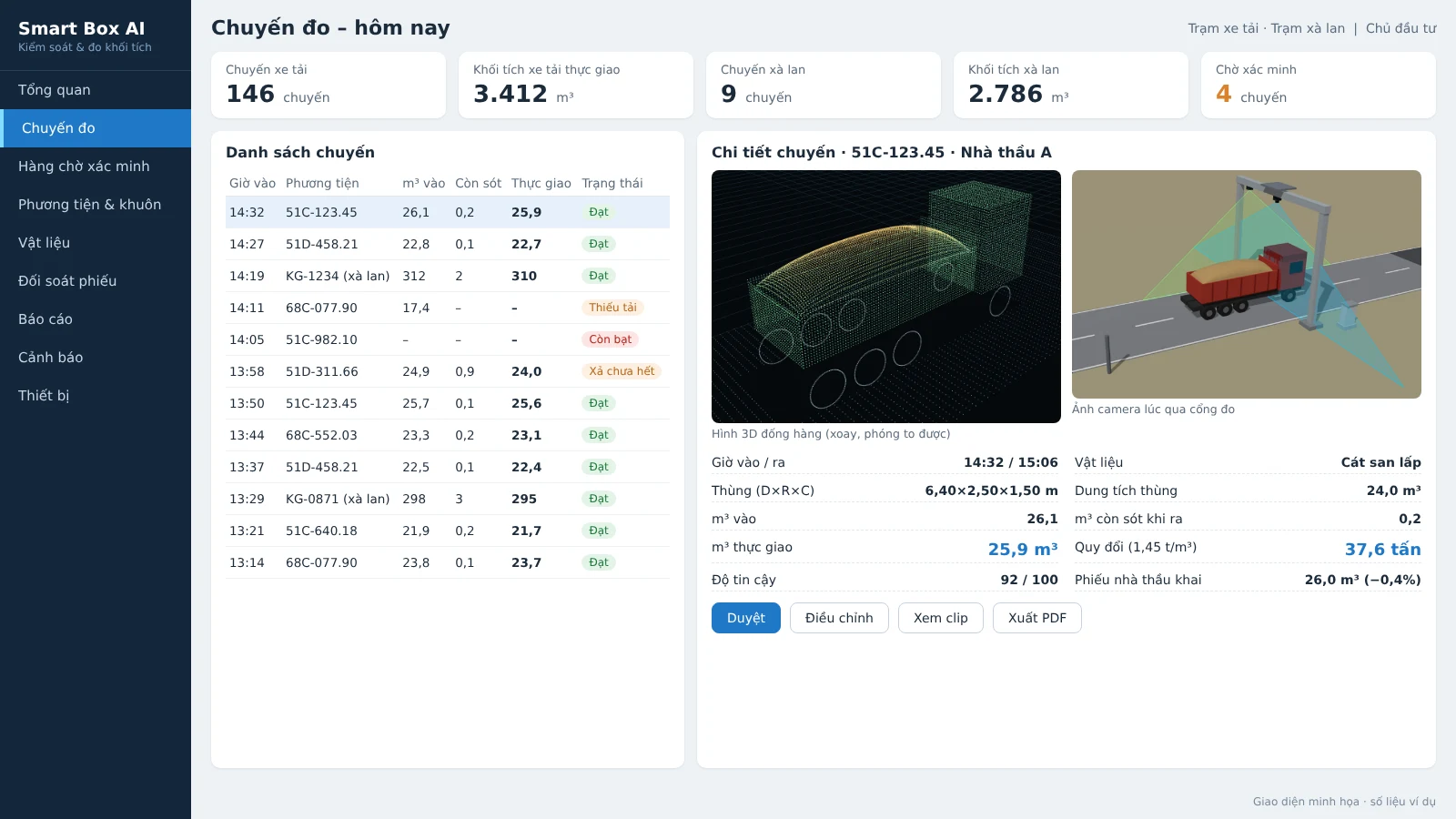
Acceptance of backfill volume determines how much the Investor pays the transport contractor. When volume is calculated by manual measurement or trip counting, everyone has a different number and there is no evidence to cross-check. The Smart Box AI solution for measuring truck and barge volume moves acceptance to per-trip data: license plate, photo, 3D image and actual delivered m³.
Smart Box AI measures the volume of backfill material on each trip using 3D LiDAR and AI cameras, and vehicles do not have to stop. Each trip is measured when entering loaded and when leaving empty, recording the license plate, photo, 3D image, actual delivered m³ and converted tonnage, then compiled into a payment reconciliation report. Accuracy of ≤ ±3% for trucks (trips from 10 m³) and ≤ ±5% for barges are proposed targets, to be re-agreed by both parties based on the results of a 4-week trial run.
Common methods for accepting backfill volume
There are three commonly used ways to accept backfill material volume: manual measurement of the truck bed, counting trips multiplied by capacity, and measuring terrain at the start and end of the period. All three lack independent data for each trip.
Manual measurement of the truck bed
The supervisor measures the truck bed dimensions with a tape measure to calculate the volume, then multiplies by the number of trips. This method is easy to do but has many weaknesses:
- It cannot measure the actual shape of the material pile, especially the part protruding above the truck bed sides
- It cannot be checked when the truck is still covered with a tarpaulin
- It depends on the skill and honesty of the person measuring
- Each truck must stop, causing congestion at the gate
Counting trips multiplied by capacity
Take the registered capacity of the truck and multiply by the number of trips. This method is simple but does not reflect the actual delivered quantity:
- Not every trip has a full bed
- A truck leaving with material still remaining is still counted as a full trip
- The bed may be enlarged or replaced with a different-capacity truck without the records knowing
- Handwritten records are prone to error and hard to re-check
Measuring terrain at the start and end of the period
Measure the elevation of the ground surface before and after a period to calculate the total volume filled. This method gives a total figure for the whole period but does not show the volume of each trip, each truck, or each contractor. After filling, the material is also rolled and compacted, making it difficult to cross-check back against the m³ transported to the site.
Common loopholes during acceptance
Backfill sites, mines, storage yards, ports and inland waterways receive a large number of trips every day. Without independent measurements, small differences per trip add up to a large payment amount.
- Estimating by eye, manual measurement of each trip: everyone has a different number, with no evidence to cross-check during acceptance.
- Underloaded trips, incomplete discharge: the truck enters with a half-full bed and leaves with material still remaining, but is still counted as a full trip.
- Switching trucks, raising the bed sides: the bed is enlarged or replaced with a different-capacity truck compared with the registration.
- Stopping the vehicle flow for inspection: stopping each truck to measure causes congestion at the gate and slows project progress.
Smart Box AI Solution for Digital Acceptance
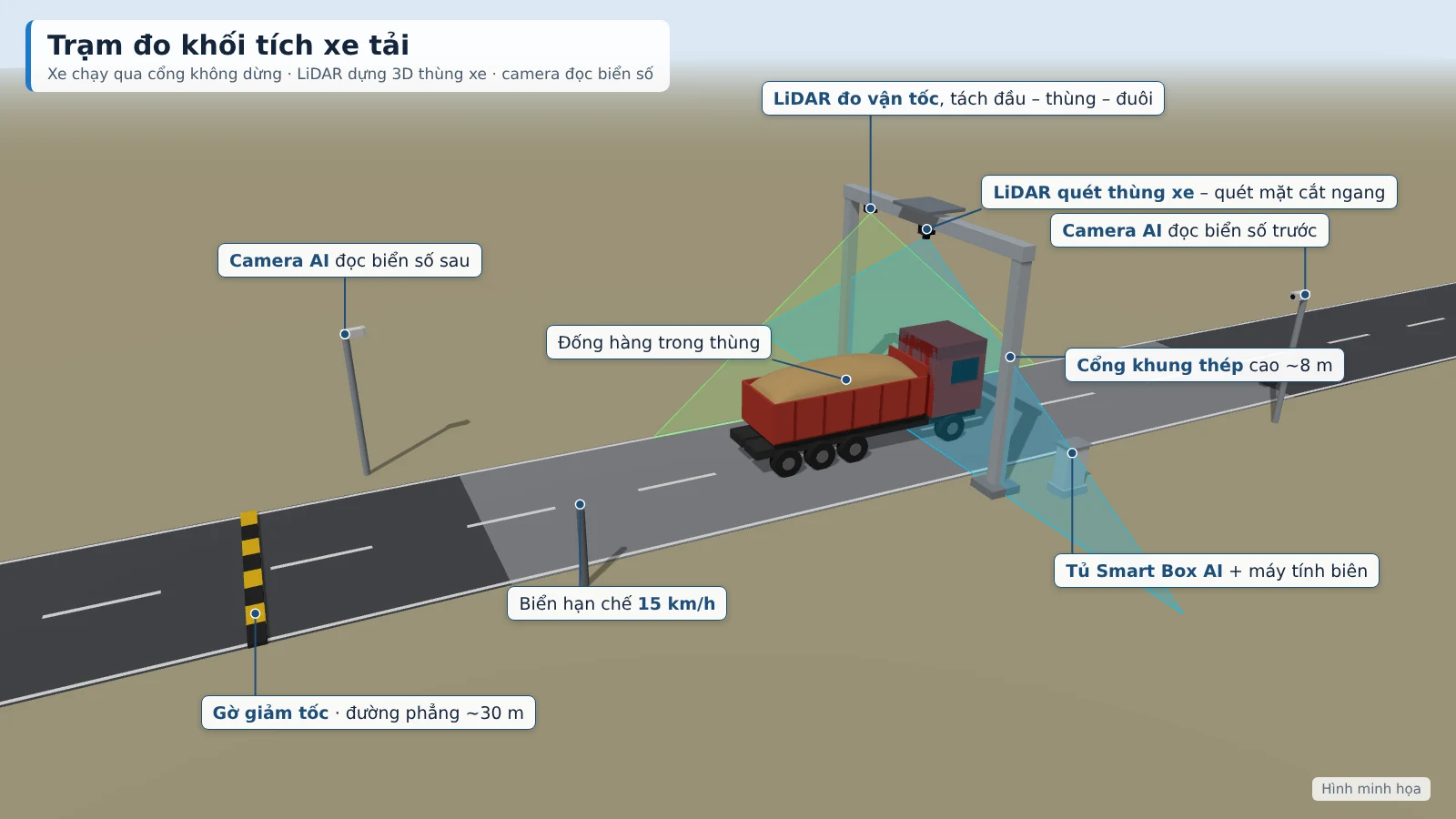
Smart Box AI is a bulk material volume measurement system using LiDAR and AI cameras, developed by Viet Duc Tri Group, supplied and deployed by An Ninh Số. Trucks pass through the measurement gate at under 15 km/h without stopping; each trip has a license plate, photo, 3D image and the actual delivered m³.
Main components
- Galvanized steel frame gate spanning the road, minimum clear width 6.5 m, sensors suspended at about 8 m, with a roof cover.
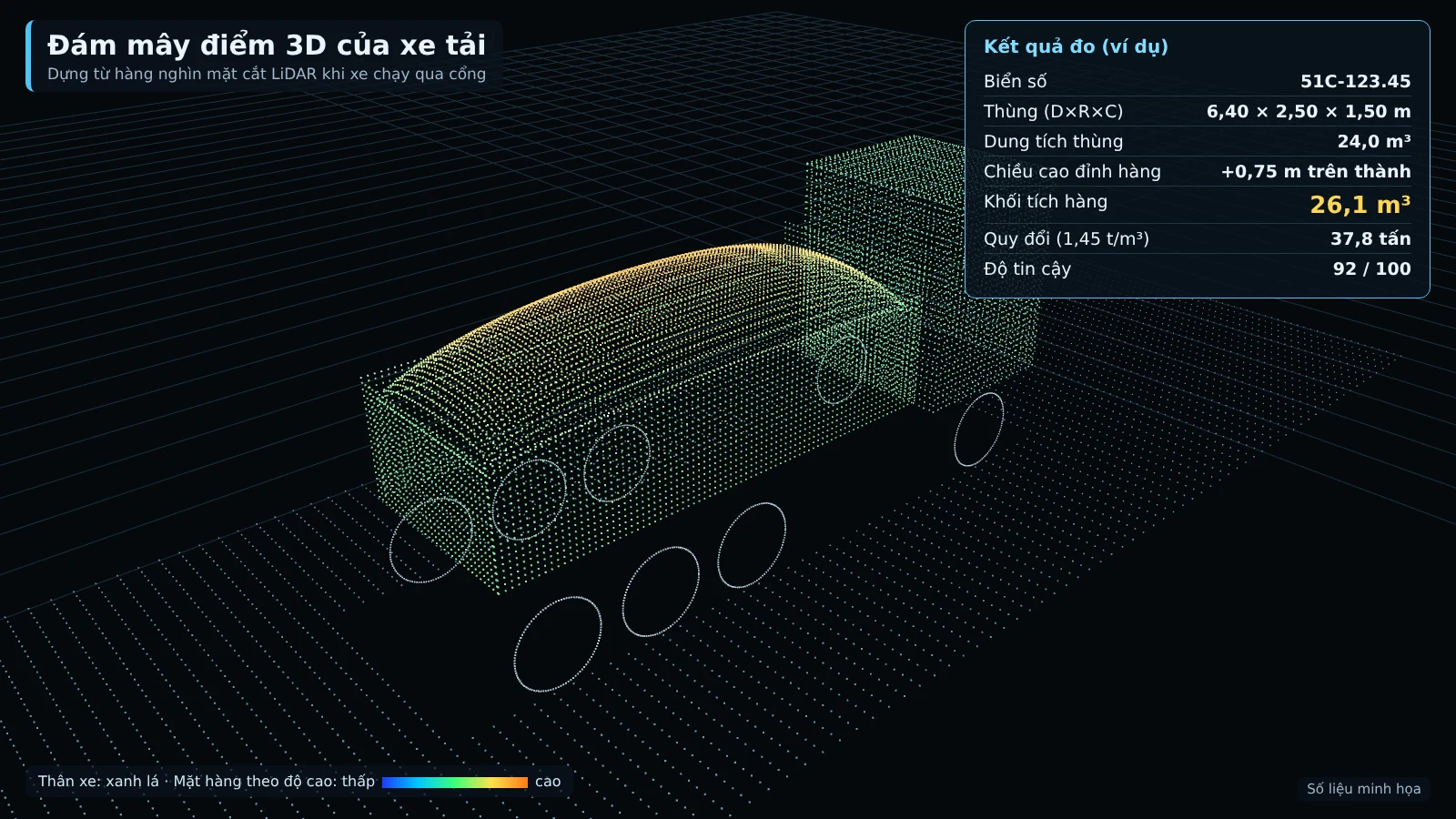
- LiDAR scans the truck bed from above, building a point cloud into a 3D image of the material pile; long vehicles have an additional LiDAR for speed measurement.
- 8MP AI camera reads front and rear license plates, operating day and night.
- Edge computer builds the 3D model and runs the Smart Box AI software right at the station.
- Management software on a web app for the Investor, and a TV at the security checkpoint to confirm trips.
The station applies to 2–4 axle dump trucks and open-top semi-trailers carrying sand, soil and stone. Each vehicle registers its bed template once by driving empty through the gate 3 times; the system stores the bed interior dimensions and bed floor as the baseline for all subsequent measurements, thereby detecting when a bed has been raised or a vehicle has been swapped. For materials transported by waterway, the barge station measures on the same principle, with additional draft measurement for cross-checking.
Digital acceptance process for each trip
Each truck trip is measured twice at the same gate, when entering loaded and when leaving empty, then goes through 4 processing steps to become acceptance data.
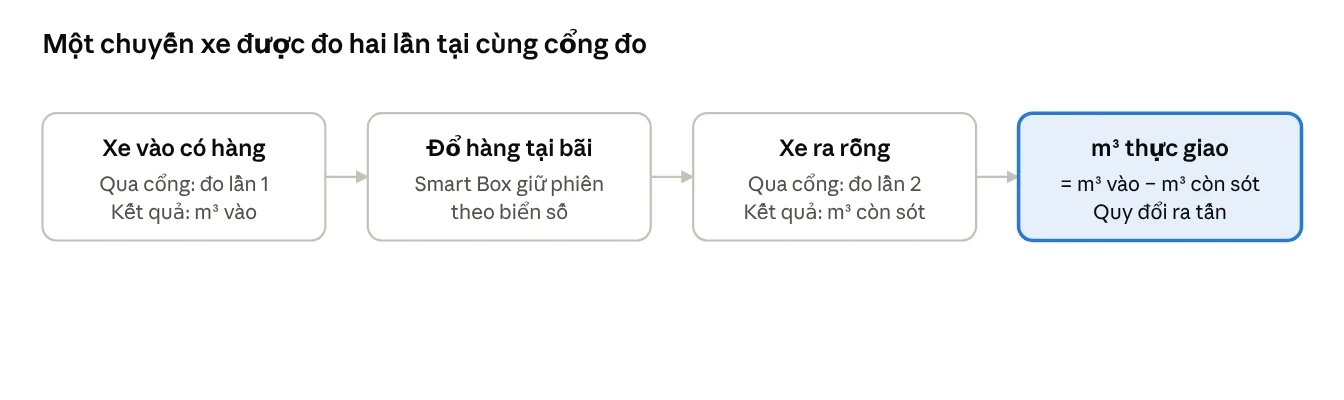
1. Measurement on entry
The truck opens its tarp and passes through the measurement gate at under 15 km/h. The system simultaneously:
- Scans the entire truck bed and material pile in 3D
- Reads front and rear license plates, records entry time
- Measures the length, width and height of the bed and of the material pile, compared with the registered bed template
- Captures the clearest photo and saves the camera clip at the moment of passing the gate
2. Measurement on exit
After unloading, the truck must also pass through the measurement gate on exit. The system measures the remaining material and pairs the loaded entry pass with the empty exit pass of the same vehicle:
actual delivered m³ = entry m³ − remaining m³
3. Conversion to tonnes
The actual delivered m³ is converted to tonnes according to the density table for each material type issued by the Investor. The density of bulk materials varies with moisture and compaction, so this table needs to be agreed by both parties before application.
4. Alerts and verification
Abnormal trips are flagged as soon as the truck passes the gate, according to thresholds set by the Investor:
- Underload: material m³ lower than the registered level (default 85% of bed capacity)
- Over the side: material pile higher than the bed side by more than 0.3 m
- Incomplete discharge: remaining material on exit above 0.5 m³
- Unable to measure: truck still covered by tarp, moving too fast, two trucks too close together
- Unknown vehicle: license plate not in the registered list
Alerts appear on the web app, the TV at the security checkpoint and are sent as messages to the responsible officer. Security staff only need to confirm the flagged trips instead of checking every truck.
Data management and reconciliation
All data for each trip is stored on site and on the project server, not uploaded to any external service, and is ready for payment reconciliation.
Trip record
- Vehicle: front/rear license plate, contractor, clearest photo
- Time: entry time, exit time, time spent inside the site
- Dimensions: length, width, height of the truck bed and of the material pile
- Volume: m³ in, m³ remaining, m³ actually delivered, material protruding above the bed sides
- Weight: tonnes converted by material type
- Images: 3D image of the material pile, photos and camera clips at the gate
- Confidence: measurement quality score (0–100)
Reconciliation report
Reports are exported to Excel and PDF by day, shift, week, month, by contractor and by individual vehicle. The payment reconciliation table includes:
| Metric | Description |
|---|---|
| Declared m³ | Volume declared by the contractor on the delivery note |
| Measured m³ | Volume actually delivered as measured by the system |
| Difference | The discrepancy between the declared figure and the measured figure |
| Adjusted trips | List of adjusted trips and the approver |
The system also compares measured m³ with the vehicle's registered capacity and reconciles vehicle counts across gates. Data is exported to Excel/CSV; an API is available to connect to the project's weighbridge or accounting software. Matching m³ with tonnes from a weighbridge to track actual specific gravity is a project-based extension.
Calibration and acceptance criteria
Figures can only be used for payment once the station has been calibrated and accepted with verification. Smart Box AI is calibrated on site, run for a 4-week trial, and only then accepted.
- Reference block: place a steel block of known dimensions under the measurement gate and align the sensors.
- Empty vehicle: each vehicle passes through 3 times at different speeds to build the bed profile and check repeatability.
- Verification with a loaded vehicle: level the material flush with the bed sides and measure manually; where a weighbridge is available, verify additionally by tonnes.
- Periodic: re-check with the reference block every month and after each relocation of the station.
The following criteria are proposed targets, to be re-agreed by both parties based on the results of the 4-week trial run: volume error ≤ ±3% for trucks (trips from 10 m³) and ≤ ±5% for barges; measurement rate ≥ 95% for trucks; correct vehicle identification ≥ 98% during the day, ≥ 95% at night; results within ≤ 30 seconds for trucks. Acceptance is based on 50 truck trips and 10 barge trips with verification over 7 consecutive days; the software exports a comparison table of measured m³, verification m³ and the error for each trip for both parties to sign off.
Clauses to include in the contract
For per-trip measurements to become a basis for payment, the contract with the transport contractor should clearly set out the operating rules at the measurement gate.
- Vehicles must have their tarpaulin open before the measurement gate.
- Drive at the correct speed of 15 km/h for trucks and 5 km/h for barges; one vehicle at a time.
- Exiting vehicles must also pass through the measurement gate to record any remaining material.
- The contractor submits the list of vehicles; for barges, registration documents are also required (hold dimensions, draft).
- Both parties agree on a table of specific gravity by material type for converting m³ to tonnes.
- Agree on how to handle "Not measured" trips and trips requiring verification.
The Investor prepares the site for the measurement gate with a straight, level road section of about 30 m before and after the gate, a power supply to the station, and arranges verification vehicles during the trial run.
Related solutions
Truck & barge volume measurement — Smart Box AI: 3D LiDAR and AI cameras measure m³ per trip without the vehicle having to stop; each trip has a license plate, photos and a 3D image as a basis for acceptance. View the solution, book an on-site survey →
Frequently asked questions
What types of fill materials can Smart Box AI measure?
The system measures loose materials carried in open-top bodies such as sand, soil, stone, ore, and coal. The truck station applies to 2–4-axle dump trucks and open-top semi-trailers; the barge station measures cargo in the hold. The m³ figure is converted to tonnes using the density table for each material type issued by the Investor.
What happens if a vehicle does not open its tarp when passing through the measurement station?
The contractor's regulations need to state clearly that vehicles must open their tarps before the measurement gate. If a vehicle is still covered by a tarp, is moving too fast, or two vehicles are too close together, the system reports "Unable to measure" and moves that trip to the verification queue so staff can review camera photos and clips.
Where is the measurement data stored?
All data is stored on site and on the project's server, not uploaded to any external service. When the connection is lost, the station still measures, buffers at least 7 days of data, and automatically re-sends it to the server via VPN once the network is restored.
Who has the right to adjust the volume figures?
Only the Investor may adjust the m³ figures. Verification staff review photos, 3D images, and camera clips, then approve or propose adjustments; every change is logged and appears in the reconciliation report together with the approver.
How long does it take to get a result for each measurement?
The proposed target is ≤ 30 seconds for trucks and ≤ 60 seconds for barges; these are proposed targets, to be re-agreed by both parties based on the results of a 4-week trial run. Each station processes on site, so a result is available as soon as the vehicle passes the gate, even when the network is down.
What if the system gives an unreliable result?
Each measurement has a confidence score of 0–100 based on speed, occlusion, and weather. Low-confidence measurements are automatically moved to the verification queue; staff review them and then approve, adjust, or reject the trip. Every change is logged with the person who made it.
Want to move fill acceptance to per-trip data? An Ninh Số surveys the measurement gate location, power supply, and vehicle flow, proposes a station configuration, and provides a live demonstration according to the Investor's schedule. See the solution details for Smart Box AI truck and barge volume measurement or call the hotline 0796 700 777.