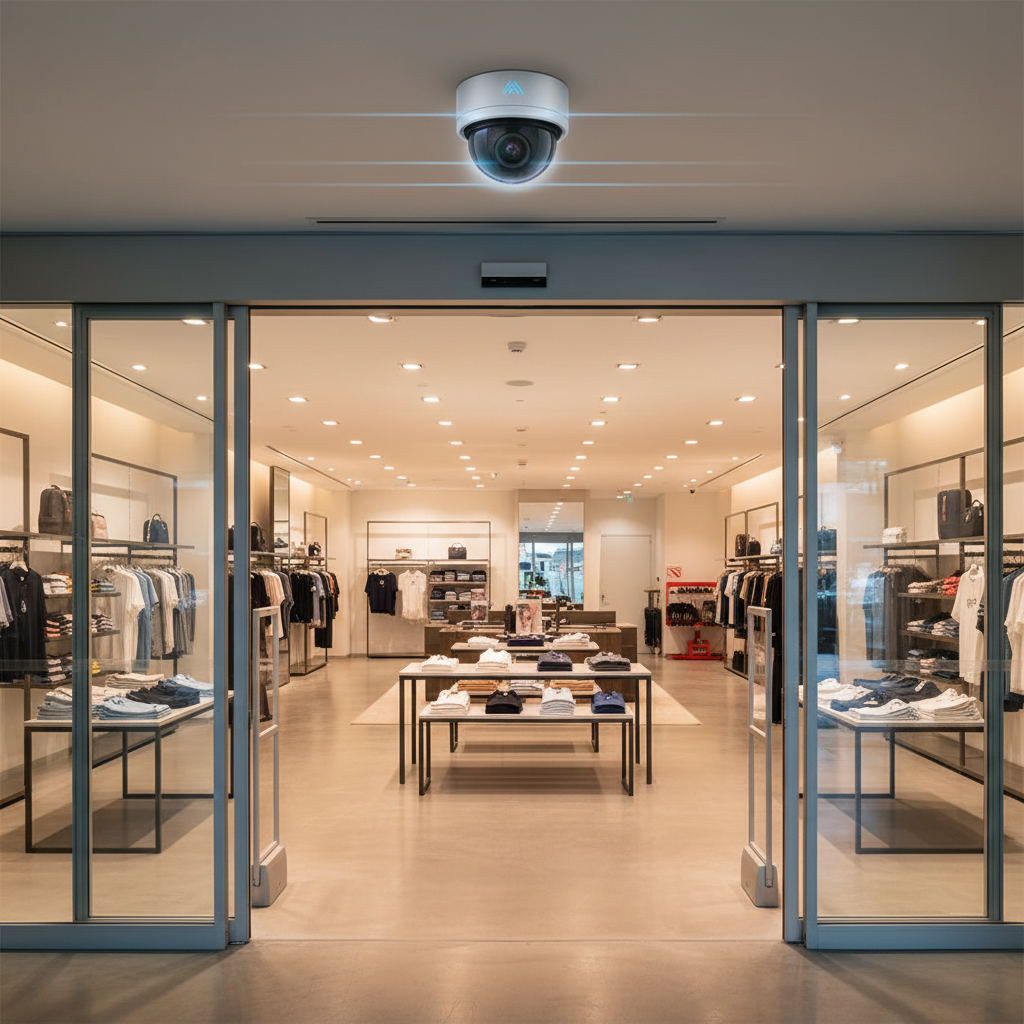
AI cameras for people counting and infrared sensors are two popular technologies for measuring customer traffic in retail stores. AI cameras use computer vision to identify and count people based on images, while infrared sensors detect temperature changes to count. This article analyzes the advantages and disadvantages of each technology, helping chain store owners make informed investment decisions based on real needs for accuracy, cost, and scalability.
How are AI cameras and infrared people counters different?
AI people counting cameras use computer vision algorithms to analyze video streams, identify human objects, track them, and count the number of entries and exits. Infrared sensors (PIR) detect changes in human body temperature moving through the scan area, triggering a counter. AI cameras record detailed data such as movement direction and dwell time, while infrared sensors only count the number of activations.
Different operating principles lead to differences in accuracy in real-world scenarios. AI cameras can achieve 95-98% accuracy in stable lighting conditions, while infrared sensors typically fluctuate between 80-90% due to interference from other heat sources like air conditioners or direct sunlight.
Detailed comparison table: AI cameras vs. infrared sensors
The table below compares 7 important criteria between AI cameras and infrared sensors in people counting applications for stores, helping business owners gain an overview before making an investment decision.
| Criterion | AI Camera (Vision) | Infrared Sensor (PIR) |
|---|---|---|
| Accuracy | 95-98% (when properly installed) | 80-90% (prone to interference) |
| Directional counting | Yes (separate in/out) | Limited (difficult to distinguish) |
| Person/object differentiation | Yes (AI filter) | No (easily miscounts pets, carts) |
| Operation in darkness | Active infrared (black & white) | Good (based on heat) |
| Investment cost (per point) | 8-15 million (camera + processing) | 2-5 million (sensor + counter) |
| Operating cost | Electricity + storage (HDD/cloud) | Low battery/electricity |
| System integration | ONVIF, RTSP, full API | Dry contact, basic RS485 |
When should you choose AI cameras for your store?
AI cameras are suitable for stores needing detailed customer behavior data: hourly entry/exit counts, dwell time, and conversion rates. This technology is particularly effective at high-traffic points of sale (over 500 visits/day) requiring high accuracy and integration with sales management systems and CRM.
- Mini-supermarkets and convenience stores needing traffic analysis to optimize staffing and displays.
- Showrooms and fashion stores wanting to measure the effectiveness of daily/weekly marketing campaigns.
- Shopping malls needing entry count data to calculate subscriber conversion rates.
- Restaurants and cafes wanting to know peak times for staff scheduling.
When should you choose infrared sensors?
Infrared sensors are a cost-effective solution for small stores (under 100m²) with low traffic (under 200 visits/day) that only need total entry/exit counts without detailed analysis. The investment cost is only 2-5 million per counting point, easy to install, and requires no complex network infrastructure.
- Grocery stores and street food stalls needing basic counts to know daily customer volume.
- Small warehouses and offices needing to control entry/exit numbers without analytical data.
- Small parking lots (under 50 vehicles) needing entry counts for simple capacity management.
Investment costs and real-world ROI for store chains
The initial investment cost for AI cameras is 3-4 times higher than infrared sensors, but the ROI from the data obtained can quickly compensate. For a chain of 5 stores, investing in AI cameras costs about 50-75 million, while infrared sensors cost only 15-25 million. However, data from AI cameras helps optimize operations, increasing revenue by 8-12% through better staff scheduling and display arrangements.
A convenience store chain in Ho Chi Minh City invested in AI cameras for 3 points of sale at a cost of 45 million. After 6 months, they discovered actual peak hours differed from initial assumptions. Adjusting work schedules saved 3-5 employees per month, equivalent to 18-30 million in monthly savings. Compared to infrared sensors providing only raw data, AI cameras deliver actionable insights.
Frequently asked questions
Are AI cameras accurate when the store is crowded?
Do infrared sensors work well outdoors?
How do maintenance and operating costs differ between the two types?
Can both technologies be integrated into one system?
Do AI cameras violate customer privacy?
Conclusion: Choose the right solution for your store chain
AI cameras are the optimal choice for stores needing detailed data, high accuracy, and scalable integration capabilities. Infrared sensors are suitable for basic counting needs with limited budgets. Depending on scale and objectives, both can be combined to optimize costs. Contact An Ninh Số via hotline 0796 700 777 for consultation on people counting solutions tailored to your business model.
Need detailed advice on people counting solutions for stores, supermarkets, or shopping malls? Call 0796 700 777 or email [email protected] for a free survey and quotation within 24 hours.