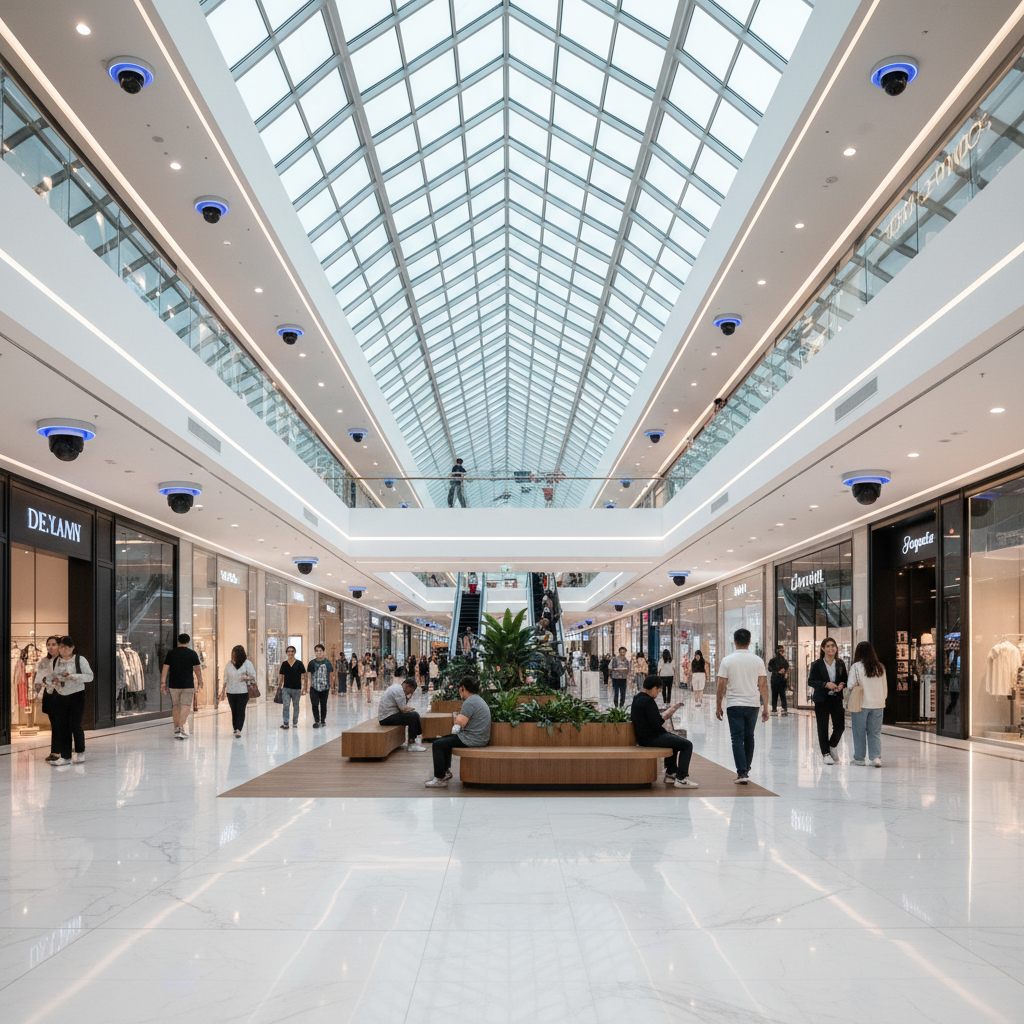
AI people counting cameras are a solution that integrates computer vision into surveillance systems, automatically counting and analyzing customer flow in real-time. In Vietnamese shopping malls, this technology is transforming traffic data into strategies for retail space leasing, promotions, and sales area layout, helping to increase revenue by 15-25% after 6 months of deployment.
How do AI people counting cameras operate in shopping malls?
AI cameras use computer vision to detect and count the number of people passing through doorways, hallways, and sales areas. Data is processed in real-time, allowing management to monitor customer density by hour, floor, and store without manual intervention.
The system consists of IP cameras with integrated AI chips, connected via LAN to a central server or cloud. Each camera can simultaneously analyze 15-25 people flows, classifying customers by age, gender, and dwell time. Output data is in the form of heatmaps and trend reports, helping managers make decisions based on actual data rather than intuition.
Integrated with POS and CRM systems, people counting data also allows measuring the conversion rate from visitors to buyers. A shopping mall with an area of 10,000-20,000 m² can install 30-50 AI cameras to cover all entrances and key areas. The initial investment cost ranges from 200-400 million VND, with a payback period of 8-12 months thanks to revenue optimization.
How to convert people counting data into a retail space leasing strategy?
People counting data provides objective evidence of customer traffic at each location, helping investors price retail space leases based on actual performance rather than fixed area rates.
For example, an area with a traffic flow of 500-700 customers/hour can be priced 20-30% higher than an area with only 200-300 customers/hour. Major brands are willing to pay a premium if data proves high traffic. Conversely, stores in low-traffic areas can be discounted or converted into food courts or entertainment zones to attract more people.
Historical data from 3-6 months also helps forecast seasonal and holiday trends, enabling investors to proactively adjust lease contracts. A shopping mall in District 7, Ho Chi Minh City, increased rental revenue by 18% after 6 months of applying a pricing model based on people counting data from AI cameras.
Optimizing promotions and events based on real-time traffic data
Real-time people counting data allows management to automatically activate promotions when customer density is low, or adjust event schedules to peak hours for maximum effectiveness.
Suppose on weekday afternoons, customer volume only reaches 40-60% compared to weekends. The system can automatically activate a 15-20% discount program for customers checking in via app or QR code at the entrance. Conversely, during the 6-8 PM slot on Saturday evenings, when traffic peaks, performance events or pop-up stores should be organized to maximize footfall.
A shopping mall in Da Nang increased promotional revenue by 22% after deploying a real-time offer activation system based on AI camera data. The cost per program decreased by 30% thanks to targeting the exact times needing stimulation, instead of running blanket promotions.
Arranging sales areas based on customer behavior heatmaps
Heatmaps from AI cameras accurately show which areas customers linger in and which walkways have few people, helping optimize floor layout and store arrangement based on actual behavior.
Heatmap data shows that 60-70% of customers typically follow the main path and turn right. Stores in these positions have a 40% higher visit rate than areas at the end of hallways. Based on this data, management can place new brands or those needing promotion on the main walkway, while the end areas should house food services or play areas to keep customers longer.
The average dwell time of customers in an area is also a crucial indicator. If customers only stop for 2-3 minutes in front of a fashion store, it may need display improvements or more sales staff. Conversely, a food court with a dwell time of 25-35 minutes is an opportunity to upsell drinks or combos.
Comparison of AI people counting camera lines for shopping malls
| Criteria | Basic AI Camera | Advanced Analytics AI Camera | Comprehensive Integrated AI Camera |
|---|---|---|---|
| Counting Accuracy | 85-90% | 92-96% | 97-99% |
| Customer Classification | No | Gender, Age | Gender, Age, Group |
| Heatmap | Yes (Simple) | Yes (Detailed) | Yes (Real-time + Historical) |
| POS/CRM Integration | No | Via API | Built-in |
| Reference Price (VND) | 5-8 million/camera | 12-18 million/camera | 20-30 million/camera |
| Suitable For | Small malls < 5,000m² | Medium malls 5,000-15,000m² | Large malls > 15,000m² |
Note: The above prices do not include installation and management software costs. For medium-sized shopping malls, investing in 30-40 advanced AI cameras (approximately 400-700 million VND) yields optimal efficiency. Refer to solutions from AI cameras from An Ninh Số for detailed consultation.
Case study: Lá Me Shopping Mall increases revenue by 25% after 4 months
Lá Me Shopping Mall (12,000 m², Ho Chi Minh City) deployed 35 advanced analytics AI cameras from An Ninh Số in March 2025. After 4 months, rental revenue increased by 25%, promotional revenue increased by 30%, and operating costs decreased by 18%.
Before deployment, management lacked objective traffic data, leading to inaccurate lease pricing and ineffective promotional programs. After installing the system, they discovered the 2nd floor had 40% lower traffic than the 1st floor. Instead of reducing rent, they converted this area into a food court and entertainment zone, combined with off-peak hour promotions. As a result, 2nd floor traffic increased by 50% in 2 months, driving a 25% increase in rental revenue.
Heatmap data also showed that 70% of customers moved from the main entrance to the right, so they placed high-end fashion brands on this walkway and moved the service area to the left. The visit rate for fashion stores increased by 35%.
Frequently Asked Questions
Do AI people counting cameras violate customer privacy?
AI people counting cameras only process data in numerical and heatmap form, and do not store facial recognition images. The system complies with personal data protection regulations under Decree 13/2023/NĐ-CP. Data is encrypted and stored only in statistical form, ensuring no invasion of customer privacy.
What is the installation cost of AI cameras for a 15,000 m² shopping mall?
For a 15,000 m² scale, approximately 40-50 advanced analytics AI cameras are needed. The total equipment cost is around 500-900 million VND, including cameras, servers, management software, and installation. The average payback period is 10-14 months thanks to increased rental revenue and operational optimization.
Can AI cameras integrate with existing building management systems?
Yes, most AI cameras support ONVIF and RTSP protocols, allowing integration with BMS, POS, and CRM systems via API. An Ninh Số provides middleware to connect with popular platforms such as SAP, Oracle, and local building management software.
Can people counting data help forecast future customer traffic?
Yes, after 3-6 months of data collection, the system can build a forecasting model based on seasonal, holiday, and event trends. Forecast accuracy reaches 85-90%, helping investors proactively adjust promotional schedules, staffing, and leasing plans.
Do AI cameras perform well in crowded conditions?
Modern AI cameras use powerful processing chips that can count accurately even when customer density reaches 5-7 people/m². Accuracy decreases insignificantly (1-2%) compared to normal conditions. The system also automatically adjusts the viewing angle and resolution when detecting crowds.
Contact us immediately at 0796 700 777 for consultation on AI people counting camera solutions suitable for your shopping mall.