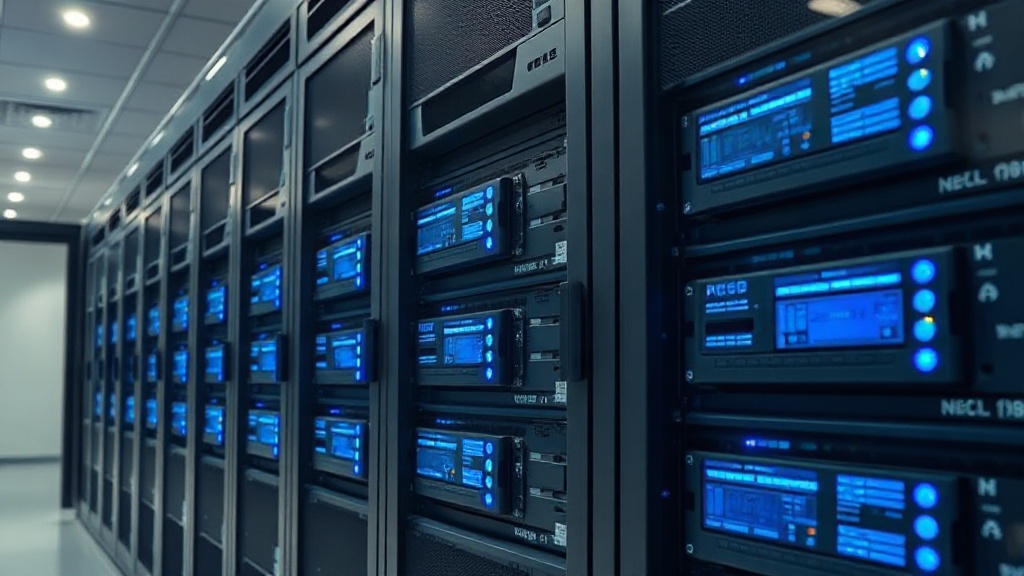
AI NVR on-box deep learning is an intelligent video processing architecture that integrates an NPU (Neural Processing Unit) chip directly onto the recorder's motherboard, enabling local execution of deep learning models without requiring a separate GPU server. According to a MarketsandMarkets 2025 report, the edge AI market in security surveillance reached $2.8 billion, growing 34% YoY, with on-box NVR accounting for 22% of revenue — reflecting the trend of Vietnamese enterprises shifting from centralized to edge architecture.
What is AI NVR On-Box Deep Learning?

AI NVR on-box deep learning is a network video recorder (NVR) integrated with a dedicated AI processing chip — typically an NPU or embedded GPU — directly on the mainboard. Unlike traditional NVRs that only record and forward data to a server for analysis, an on-box NVR can independently execute deep learning models such as facial recognition, object detection, people counting, and behavior analysis right at the device.
This architecture falls under edge AI, where inference occurs closest to the data source — the camera — instead of sending video streams over the network to a central server. This significantly reduces latency (from 200-500ms down to 15-30ms) and network bandwidth, while also increasing data security since video does not leave the device.
On-Box vs Server CPU/GPU Architecture: Detailed Comparison




The core difference between AI NVR on-box and server CPU/GPU lies in the location of inference processing and resource management. Server CPU/GPU processes centrally at the server room, while NVR on-box processes distributively at each recorder, offering advantages in latency and operational costs for small to medium-sized systems.
Architecture Comparison Table
| Criteria | AI NVR On-Box | Server CPU/GPU |
|---|---|---|
| AI processing location | At NVR (edge) | At central server |
| Inference latency | 15-30 ms | 200-500 ms (including network) |
| Maximum channels | 8-64 channels (depending on model) | 64-500+ channels |
| Hardware cost (CAPEX) | 15-45 million VND | 150-600 million VND |
| Power cost (OPEX) | 50-150W | 500-2000W |
| Deployment complexity | Low (plug-and-play) | High (requires network config, GPU driver) |
| Maintenance | Low (firmware update) | High (OS, driver, applications) |
Benefits of AI NVR On-Box for Vietnamese Enterprises

Given the specific characteristics of the Vietnamese market, where initial investment costs and IT personnel are limited, AI NVR on-box offers 4 main benefits: 60-70% CAPEX reduction compared to GPU servers, low latency suitable for real-time applications, easy deployment across multiple branches, and better internal data security.
- Reduced investment cost (CAPEX): A 16-channel AI on-box NVR costs 20-35 million VND, while a GPU server for the same number of channels can cost up to 200-400 million VND. For a chain of 10 stores, this saves 1.8-3.6 billion VND.
- Low latency for real-time applications: Tasks like intrusion detection and unknown face alerts require responses under 50ms. On-box NVR achieves 15-30ms, while a GPU server over a LAN has a latency of 100-300ms.
- Simple deployment at multiple sites: No need for a dedicated server room or senior network engineers. Simply connect cameras to the NVR and configure via web GUI in 30-45 minutes.
- Internal data security: Video does not leave the device, reducing the risk of network leakage. Suitable for enterprises with high security requirements such as banks and data centers.
Limitations and When is a Server GPU Needed?

Related articles
How to choose a smart camera for luxury villas: Criteria & solutions
4 min readSmart villa cameras: Selection & installation criteria for luxury villas 2026
7 min readStart with a free 60-minute site survey
Our senior technical team will visit your site, assess the current setup, and propose a bundle matched to your business model and budget.